.jpg)
.jpg)
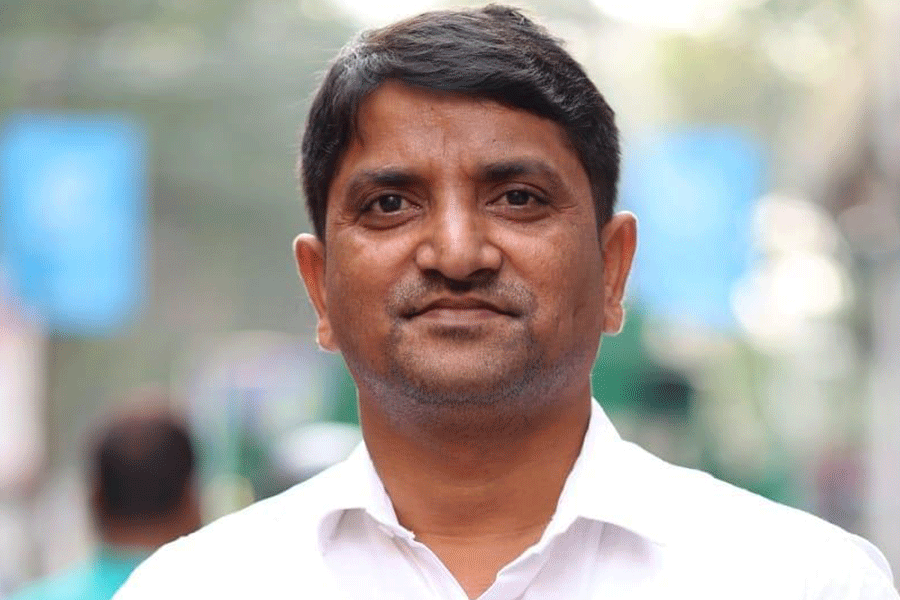
Calcutta: Former Bengal finance minister Ashok Mitra, who also served as the chief economic adviser to the Indian government, passed away in a city nursing home on Tuesday morning.
The Marxist economist was 90 and had been suffering from age-related complications.
His wife Gouri had died 10 years ago.
An economist by training - with a PhD under Nobel laureate economist Jan Tinbergen - Mitra held key offices in the economic bureaucracy in the country and abroad. But his rare ability to seamlessly slip into different roles - academic, administrator, politician, writer, editor and an activist - touched people beyond the world of economic policy-making.
Mitra was for decades one of the most popular columnists for The Telegraph and also Anandabazar Patrika, his writings, in his characteristic storytelling style, commenting on complex issues like Centre-state relations or occasionally paying tribute to eminent personalities with his insightful obituaries.
His offerings also included thoughts on the subcontinent's biggest passion - cricket. Be it Sourav Ganguly's omission from India's one-day international squad, or the shift of the India-England World Cup match from the Eden Gardens in Calcutta to Chinnaswamy Stadium in Bangalore in 2011, the man who had once famously said "I am not a bhadralok (gentleman), I am a Communist" would eloquently write on the gentleman's game.
The Dhaka University alumnus also had the ability to laugh at himself. One of his students, who had attended his series of lectures on Centre-State Fiscal Relations in Jawaharlal Nehru University sometime in late 1987 or early 1988, recounted how Mitra, in his pristine white dhuti-panjabi, introduced himself.
"Once upon a time, I happened to be a finance minister of a state in India," he had said, which apparently left the entire postgraduate class in splits.
But when he left the Writers' Buildings in 1986 - after two stints as Bengal's finance minister - the then Jyoti Basu government had a difficult time. Mitra's decision to quit the government, and the party, because of differences with Alimuddin Street had come as an embarrassment.
It was not the first time that he was leaving an important office. In 1970, Mitra had taken over as the chief economic adviser (CEA) to the Government of India in the finance ministry, but resigned in April 1972 and came back to Calcutta.
After Basu picked him as the finance minister of the first Left Front government, Mitra tried steering the state economy besides blaming Delhi's discriminatory policies for the plight of eastern India, especially Bengal.
"We cannot forget his consistent efforts to bring the issue of Centre-state relationship into focus," said Asim Dasgupta, who succeeded Mitra as the finance minister of Bengal.
For years, the Left government - and now the Mamata Banerjee regime - used the argument of the Centre's discrimination as one of the major reasons for Bengal's lack of industrialisation.
On industrialisation, Mitra had major differences with the Buddhadeb Bhattacharjee-led Left government and was critical of the path pursued by the former chief minister from 2006.
At the peak of the anti-land-acquisition movement in the state, he had written in one of his columns: "The uproar over Nandigram and Singur in West Bengal will not die away soon. Competitive democracy has its own laws."
Mitra's reservations about the path pursued by the Left had emboldened the then Mamata-led opposition and the anti-land-acquisition movement grew stronger. A change of guard followed. At an event organised by the Student Federation of India, the CPM's student wing, within a month of the Left's rout in the 2011 Assembly polls, Mitra had explained how the Left government got alienated from the people.
"It (the Left government) suffered from several ills... but still enjoyed the people's trust and confidence. It was from 2006, however, that people started moving in the opposite direction. Between 2006 and 2008, when Singur and Nandigram happened, people began realising that the government was no longer for them... These incidents opened their eyes. The people saw how arrogant the administration was becoming... They felt they were being taken for granted." In his assessment of political or social developments, Mitra never minced words. Not only did he himself dissent, on several occasions, he stood by the dissenters in the CPM.
His sharp criticism of the Left and its political path, however, did not prevent the leadership from turning up at his residence on 8/2A Alipore Road, where his mortal remains were brought in from a South Calcutta nursing home.
Several prominent CPM leaders, including Biman Bose, Surjya Kanta Mishra, Sujan Chakraborty, Shyamal Chakraborty and Rabin Deb, paid their last respects to Mitra.
Urban development minister Firhad Hakim and power minister Sobhandeb Chattopadhyay visited his residence too. Poet Sankha Ghosh and author Nabanita Dev Sen also paid their respects to Mitra.
More than 150 people joined the funeral procession as the hearse was taken to Keoratala crematorium. Most of those present there - or thousands of netizens who mourned his death on different social networking sites - rued: "They don't make anything like AM these days."