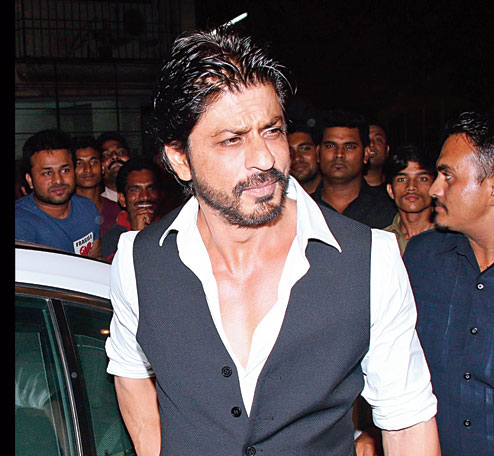

New Delhi, Aug. 12: When Shah Rukh Khan declared this morning that US authorities had once again “detained” him for secondary screening on landing at Los Angeles International Airport, public apologies flowed swiftly from two senior American diplomats.
But Khan, who has twice before been picked for special screening at US airports, can this time at least partly also blame India’s bureaucracy that is dithering in putting in place a mechanism that may have avoided Friday’s incident.
A pact inked in June just before Prime Minister Narendra Modi’s Washington visit had added India to a 64-year-old “Global Entry” programme under which pre-cleared frequent fliers are exempt from standard immigration checks on landing at any of 40 airports in the US. After initially planning to implement the programme with India by September, the US had indicated willingness to advance the project to August.
But India’s home ministry is yet to decide which travellers should be allowed to join the programme initially, or to approve an application centre for the project in India despite prods from the foreign office, senior officials familiar with the plans have told The Telegraph.
US Customs and Border Protection, the arm of the Department of Homeland Security in charge of immigration, did not apologise to Khan — unlike diplomats from the US State Department who need to worry about public outrage even when they are not at fault.
American immigration officers have the right to specially screen even a Global Entry member if the visitor’s fingerprints or documents don’t match. But barring such a scenario, membership of the Global Entry programme would have helped Khan clear immigration at Los Angeles airport — known by its code LAX — without a secondary screening.
“Sorry for the trouble at LAX,” US ambassador to India Richard Verma responded on micro-blogging site Twitter to Khan’s complaint, before referring to the efforts at implementing the Global Entry programme. “We are working to ensure it doesn’t happen again. Your work inspires millions, including in the US.”
US immigration officials had pulled Khan aside for special screening in 2009 at Newark airport in New Jersey, and then again at White Plains airport in Westchester county outside New York City in 2012. A man on the US “no-fly” list has a name similar to Khan’s, the US had explained at the time.
It is unclear whether Khan was detained this time, too, for the same reason. But while fans of the actor erupted in outrage on social media, American diplomats, while apologising, pointed out that no one is completely exempt from the possibility of extra screening at US airports in the post-September 11, 2001, era.
“Sorry for the hassle at the airport,” Nisha Desai Biswal, US assistant secretary of state for South and Central Asia said.
“Even American diplomats get pulled for extra screening!”
Former President A.P.J. Abdul Kalam, then defence minister George Fernandes and then Indian ambassador to the US
Meera Shankar are among prominent Indians holding public office and travelling on diplomatic passports to the US who too have faced secondary screening.
That Verma and Biswal apologised to Khan though the US was not in the wrong is a testament to the work of diplomats — who need to manage public perceptions of their country. They are unlikely to have responded similarly to Khan had he not been a superstar, but are aware that incidents involving him can draw far greater negative publicity among Indians than if the actor had been an ordinary visitor.
Khan said he respected security concerns but made clear he was upset.
“I fully understand and appreciate security with the way the world is, but to be detained at immigration every damn time really sucks,” Khan posted on Twitter early this morning — early Thursday evening in Los Angeles.
Later, he responded to the apologies from Verma and Biswal. “Respect the protocol and not expecting to be above it,” Khan replied to both US diplomats. “It’s just a tad inconvenient.”
That inconvenience is a reality visitors must accept, said former foreign secretary Nirupama Rao, also a former ambassador to the US. “The US post 9/11 is a changed country,” Rao said. “If you’re not prepared to accept stringent security controls, don’t go there.”
The Global Entry programme is intended to ease the pain of repeated immigration checks and grilling for frequent travellers to the US who have no past criminal record and have been vetted by both governments. The programme is currently offered to travellers from the UK, Germany, the Netherlands, Panama, South Korea, Mexico and Canada, apart from citizens of the US.
Under the first phase of the initiative, India and the US are expected to identify a shortlist of VIPs and public figures who can be added to the list of members of the Global Entry project. Khan, Indian and American officials said, is eligible for this list.
At US airports with the facility — Los Angeles international airport is among the 40 in America that do offer the service — members can walk up to special kiosks, hand over their machine-readable passports, place their fingerprints on a scanner for verification and complete a customs declaration. They can then collect their luggage and exit.
But for the initiative to be implemented with India, New Delhi needs to finalise the specific categories of initial beneficiaries and clear those with Washington, officials said.
Simultaneously, India needs to approve a new office in New Delhi — ideally at Indira Gandhi International Airport — where eligible travellers can enrol for membership.