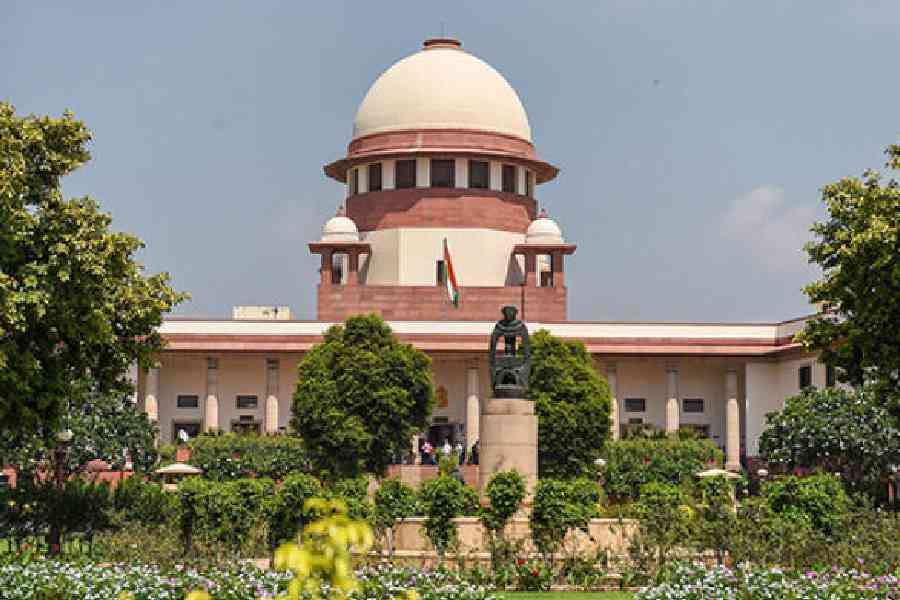
New Delhi, March 6: The Supreme Court today hinted it might revive the conspiracy charges that a special court in Rae Bareli had dropped against BJP veteran L.K. Advani and 12 others in a Babri Masjid demolition case.
"We will not accept the discharge of these 13 persons on technical grounds. You file a supplementary chargesheet. We will allow you to file a supplementary chargesheet," Justice R.F. Nariman, one of the judges on a bench headed by Justice P.C. Ghose, told additional solicitor-general Neeraj Kishan Kaul, who was appearing for the CBI.
The judge also said the bench would "pass an order for clubbing" two sets of cases related to the December 1992 demolition - one filed in Rae Bareli against the 13 and the other in Lucknow against "unknown" karsevaks.
"We will also pass an order for clubbing the two cases at Lucknow and Rae Bareli for holding trial at one of these places," Justice Nariman said.
Apart from Advani, the other key accused in the case included BJP leaders Murli Manohar Joshi, Kalyan Singh, Uma Bharti and Vinay Katiyar; the late Shiv Sena patriarch Bal Thackeray and several Vishwa Hindu Parishad veterans.
Uma is a minister in the Narendra Modi government, while Kalyan is governor of Rajasthan. Katiyar is a Rajya Sabha MP.
The bench said the CBI must file the supplementary chargesheet including the 13 names. "You should have filed a supplementary chargesheet by this time," Justice Nariman told Kaul.
The court was dealing with an appeal the CBI had filed in May 2011 - when the UPA was in power - against the dropping of the conspiracy charge against Advani and the others.
Kaul said the investigating agency had no objection if the two cases were clubbed. But senior counsel K.K. Venugopal, who appeared for Advani, opposed a joint trial.
If the conspiracy charges, Venugopal said, were revived against the leaders and if the joint trial was held in Lucknow, all the 186 witnesses who had deposed in the Rae Bareli court would have to be recalled and examined again.
The counsel also told the court that there had been "an inordinate delay" on the part of the CBI in filing the appeal.
Allahabad High Court had upheld the Rae Bareli special court's order on May 21, 2010. The CBI's May 2011 appeal meant a delay of around nine months. According to rules, an appeal has to be filed within 90 days.
But the bench said it would condone the delay and fixed March 22 for the next hearing.
The case filed in Rae Bareli was against Advani and the others who were on a dais in Ayodhya on December 6, 1992, when the mosque was attacked.
The case in Lucknow was filed against unknown "karsevaks" who were actually involved in the demolition.
The CBI had chargesheeted Advani and 20 others under penal code sections 153A (promoting enmity between classes), 153B (imputations and assertions prejudicial to national integration) and 505 (false statements and rumours, etc., circulated with the intent to cause mutiny or disturb public peace).
It subsequently invoked charges under Section 120B (criminal conspiracy), which were quashed by the Rae Bareli special court on May 4, 2001.
In its May 2010 order, the high court said there was no merit in the CBI's revision petition against the special court's order, which directed that the conspiracy charge be dropped against the 13 leaders.
The high court said the CBI had at no point of time, either during the trial in Rae Bareli or in its revision petition, ever said there was an offence of criminal conspiracy against the leaders.