The University Grants Commission’s 2023 rules have provisions for all students to get their grievances redressed, several academics have said while countering the argument that the new equity statutes, now stayed by the Supreme Court, discriminate against social elites.
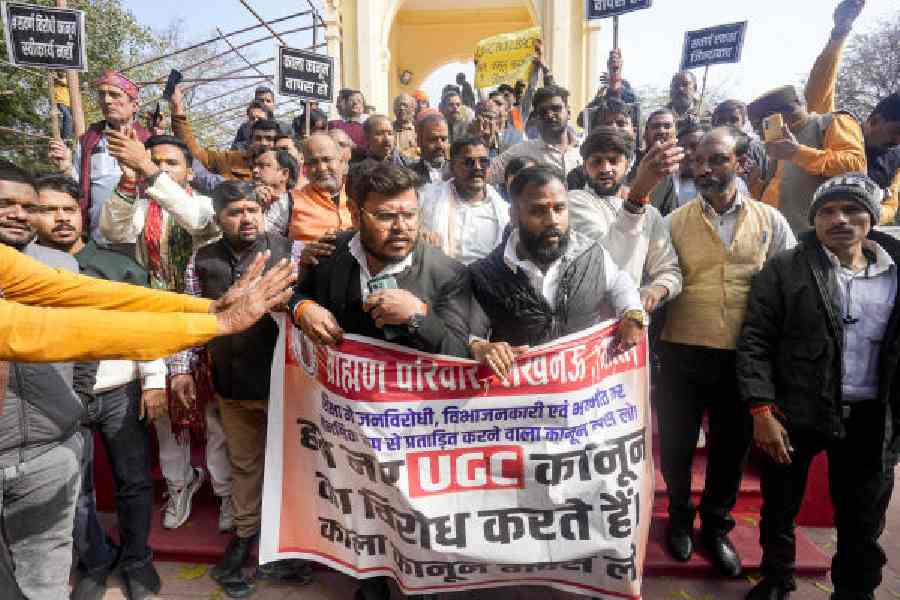
Those protesting against the UGC (Promotion of Equity in Higher Education Institutions) Regulations, 2026, allege that they could be misused against students from the forward castes. The proponents of the new rules argue that they are meant for the specific purpose of addressing the grievances of marginalised sections.
The equity rules are aimed at eliminating discrimination against the Scheduled Castes, Scheduled Tribes, Other Backward Classes, the Economically Weaker Sections, women and persons with disabilities. It also seeks to prevent bias on the basis of religion or place of birth. The UGC equity rules’ stated aim is to create a socially congenial atmosphere by sensitising the stakeholders regarding social inclusion. The rules leave it to the institutions to decide punishment after probing complaints of discrimination.
Sections of students have staged protests, alleging that there is no provision in the equity regulations to help general category students to file complaints and that there is no scope for action on false complaints.
Prof. N. Sukumar, a political science faculty member at Delhi University, said on Wednesday that the UGC’s 2023 regulations, which are for all students, had provisions for grievance redress that were followed by all universities.
The regulations mandate every institution to set up a student grievance redress committee (SGRC) where complaints can be lodged against irregularities in the admission process, false information in prospectus, withholding of or refusal to return certificates, denial of fee refund in case of withdrawal after admission, delay in the conduct of exams and the publication of results, and demand for capitation fees.
“The equity rules are for the specific purpose of promoting social equality and inclusion. They are meant to protect the weaker sections. But the grievance redress rules do allow students from all categories to seek remedy through complaints on any issue,” Sukumar said.
Sukumar said every university and college has its own rules on discipline that address the complaints of all students.
“When the equity rules were first notified by the UGC in 2012, there was no protest from these groups. The protests are happening when the government has announced the inclusion of caste enumeration in the upcoming population census. I suspect that these could be politically sponsored agitations to counter the caste census and affirmative actions for the socially backward,” Sukumar said.
According to the UGC (Redressal of Grievances of Students) Regulations, 2023, each institution shall have an online portal where any aggrieved student can submit an application seeking redress. The student would then have to appear before the SGRC and explain the matter. The SGRC shall send its report with recommendations to the competent authority of the institution within 15 working days from the date of receipt of the complaint, the regulations say.
The UGC had enforced separate regulations on equity promotion and grievance redress in 2012 when Prof. Sukhadeo Thorat was the chairman of the commission. Thorat told The Telegraph on Wednesday that the SCs, STs and the OBCs are traditionally oppressed groups that deserve a special law for their protection and promotion.
Thorat said the upper castes had been “scripturally allowed to discriminate the shudras and untouchables in social and religious functions, and (on) the rights to education, resources and equality”.
“The socially backward communities are discriminated against as groups based on their social identity. They face discriminatory social behaviour. On the contrary, the discrimination faced by any individual from a forward caste is differential treatment of that individual, not the group. The discrimination faced by the socially backward castes and individuals from among the forward sections cannot be equated to demand provisions for them under equity rules,” Thorat said.
Ganga Sahay Meena, a faculty member at the School of Languages at JNU, said on Wednesday that the equity rules of the UGC gave greater importance to sensitisation of faculty members and students on social discrimination. Punitive action on such discrimination is one aspect of the rules, Meena said, adding that individual institutions would take action in keeping with the rules only when wrongdoing is established.
“There is a lot of hue and cry that these norms would be misused against forward-caste students. This is a far-fetched fear. The equity committee will inquire and take action if it finds truth in a complaint. In case of false complaints, no action would be taken. Every rule can be misused, but that does not mean rules will not be made,” Meena said.
Students come with a lot of prejudices about social status and educational institutions are meant to reform students and rid them of such preconceptions, Meena said, adding that the equity regulations would help reform the outlook of students.