
I am not the Christopher Nolan fan who thinks every movie is his best yet. But having watched all of Nolan’s movies (sometimes three times, like Memento, to understand it) I can say Dunkirk is definitely his best yet.
When you walk into a packed hall for the first show on the first day of a film and there is no usual chatter, not even excited hollers when the Justice League trailer plays, you know that people in the hall mean business. Serious business. But when people file out of the hall as quietly as they sat through the film, you know you are not the only one reeling from what you just saw.
And what I saw was a film that pulled you in from the first moment, gripped your throat and dunked you in ice-cold water. But no matter how many times you get the sinking feeling, the movie never lets you drown.
Before I watched Dunkirk, I wouldn’t have believed that a war movie could gut you without showing much actual conflict. Yes bullets fly, bombs are dropped, ships sink and lots of people die, but you feel the loss of life more than you see it.
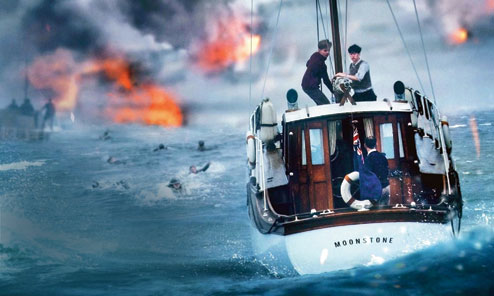
A master storyteller, Nolan weaves together the incidents at Dunkirk from three POVs — land, air and sea — all British of course, and across three different timelines. And he does it seamlessly. The soldier on the land looking for a way off the beach is desperation, the captain of a sailboat going to the beach is determination, and the Spitfire pilot is sacrifice, flying towards the beach to make sure they are not sitting ducks for enemy planes.
If Saving Private Ryan almost made you lose your lunch and left you devastated, Dunkirk makes it difficult to breathe and leaves you much the same way. Nolan doesn’t need to put you in closed spaces or in the dark to make it difficult to breathe. In fact the most claustrophobic moments are right there on the vast open beach in broad daylight, because that’s where you see the helplessness of the situation most clearly — like that soldier who just walked into the sea, or when a resolute Kenneth Branagh orders a ship hit by a bomb to be pushed away from Mole so as to not clog it up.
Hans Zimmer’s score is an element in the equations on its own. And then there is the cast. Everyone is good, including Harry Styles (that came as a surprise) but for me it is Mark Rylance, who captains one of the small boats that Britain sends to bring the boys back, who stands out. The other is Tom Hardy. That man had half his face covered for most of the time he was in the air, but he spoke volumes with his eyes.
This story of a historical triumph is definitely a historical cinematic triumph.
Chandreyee Chatterjee
As a fervid follower of Christopher Nolan and World War II, awaiting the release of Dunkirk — since he started testing the waters with the likes of Kenneth Branagh, Tom Hardy and Mark Rylance in 2015 — had not been easy.
That one of the greatest living filmmakers made a war epic on one of military history’s most extraordinary feats, described by Winston Churchill as a “miracle of deliverance”, was enough to make me trip over myself to go watch it when it finally released.
Let me put it this way, it was nothing quite like anything I have seen before in the genre. I’m no authority — and I do lack the necessary objectivity — but Nolan could well have made a film that will go down in the pages of cinematic history as an all-time phenomenon.
I do not know how the genius managed to pull off an incisive, gripping WWII film with no more than a blink-and-miss appearance of the Stahlhelm — the ubiquitous helmet of the Wehrmacht — but he did. What he also did was tell three very distinctive, very heroic stories — one each from the land, the sea and the air — by weaving them together seamlessly in an enthralling, non-linear narrative.
Nolan — with able contributions from Hoyte van Hoytema’s cinematography, Lee Smith’s editing, the maestro Hans Zimmer’s music and the art-set-costume-production design teams — and his cast take you by the collar and hurl you right into the middle of Dunkirk’s bloodied sands and freezing waters of May 26-June 4, 1940. He makes you live the
Allies’ Operation Dynamo (albeit from an exclusively British perspective) in a way that hasn’t been attempted before.
Trying to say anything more will not leave this spoiler-free.
Because the film nears its end in the most soul-stirring montage, cut to a rather atypical rendition of Churchill’s “We shall fight on the beaches” speech, I will take the liberty of tweaking another instance of his immortal oratory to wrap this up: ‘Never in the field of cinema was so much owed by so many to so few.’
Thank you, Team Nolan.
Meghdeep Bhattacharyya