President Donald Trump was on the verge of a crisis in the Iran war, faced with the rare instance of an American airman shot down and stranded deep inside enemy territory.
Then, the airman's daring Easter weekend rescue gave the U.S. president the chance to quickly flip the script. Standing before cameras on Monday, Trump recast the perilous operation as a providential military triumph, leaning in to its cinematic elements to project strength and command of a five-week-old war that remains deeply unpopular with U.S. voters.
"We have incredibly talented people, and if the time comes, we move heaven and earth to bring them home safely," Trump told reporters at the White House. "God was watching us."
It was the second time in less than a week that the president had scheduled time to directly deliver his message on Iran to the public, taking on the role of executive producer and chief publicist of his presidency in his uniquely Trumpian way. He has struggled to explain his rationale for the bombing campaign, including during a muddled prime-time address last week. His profanity-laced tirade on social media on Easter Sunday further pushed past the normal bounds of presidential communications and prompted questions from reporters about the 79-year-old president's mental fitness.
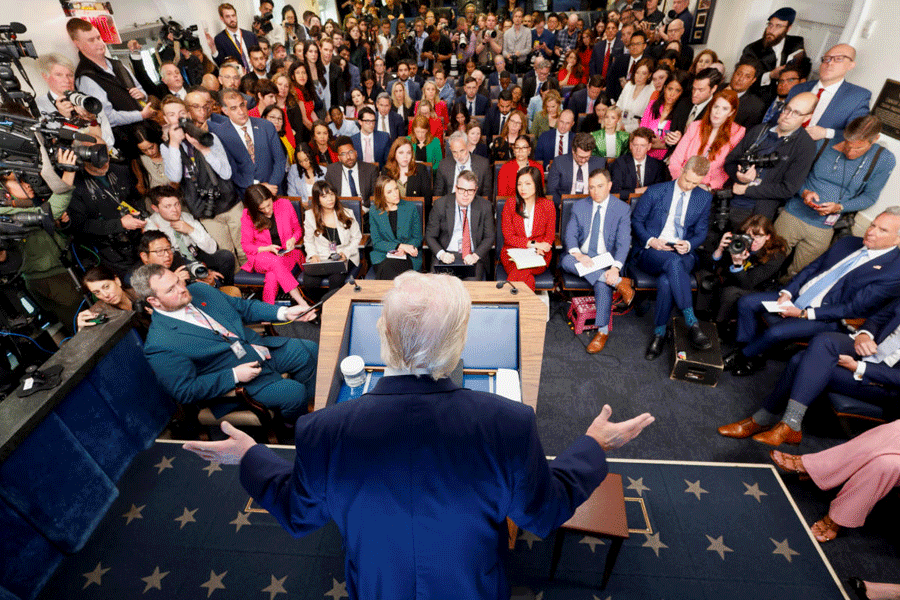
The scene in the James S. Brady Press Briefing Room on Monday offered a familiar display of Trump's political instincts: seizing a high-profile moment to tell the story on his terms and using it as a unifying rallying cry to win support from war-weary Americans.
Rescue details dominate briefing
He detailed an intricate rescue mission that he conceded was bolstered by luck. Trump administration officials, normally loath to discuss internal deliberations, over the weekend helped reporters write vivid accounts of the stunning operation.
Trump described a bleeding officer who evaded capture in Iran for two days, and search-and-rescue teams scaling mountains and trying to lift aircraft out of wet sand before destroying machinery that might otherwise fall into enemy hands.
"Hundreds of people could have been killed," Trump told reporters, noting that some military officials advised him against the operation.
"How many men did you send altogether?" Trump asked the chairman of the Joint Chiefs of Staff, General Dan Caine, who was standing nearby.
"I'd love to keep that a secret," Caine said.
"I'll keep it a secret, but it was hundreds and hundreds of these people," Trump said.
Reporters squeezed into the crowded room, blocking aisles and an entryway, and verbally sparred with one another to gain a more advantageous position in the president's line of sight. Though Trump seemed to revel in the details of the military's prowess - suggesting at a separate White House event earlier on Monday that the rescue might someday be depicted in a movie - he also threatened to jail a journalist at an unnamed news outlet who first reported that one airman had been successfully rescued before the second missing airman was found.
Frustration with allies, diplomacy
Trump continued to express frustration with the speed of diplomacy to end the war, anger at U.S. allies who will not help and exasperation with the blocked Strait of Hormuz, a vital route for global energy supplies. He dismissed a question about his mental health, saying, "I don't care about critics."
Asked whether he planned to escalate the war or end it, Trump was noncommittal.
"I can't tell you," Trump said. "I don't know."
As he moved to wrap up the hour-plus news conference, Trump sought to portray victory as an all-but-foregone conclusion.
"We won, OK?" he said. "They are militarily defeated."