In the deadline-driven world of film review writing, I find time hanging, every Friday afternoon, like the proverbial Sword of Damocles over my head. I write most of what I absorb; in hindsight, I feel I have invariably left out some observations. But that holds true for almost everything in life.
With Satluj, there was so much to take in, feel, assimilate and ponder, that I allowed the film to stay and grow within me for a day before I put my emotions into words. But Satluj wasn’t allowed to breathe for more than 48 hours. Dropped silently on Friday evening, it was pulled off Zee 5, without a doubt the most courageous streaming platform out there, by Sunday night. The platform — whose triptych of bold storytelling (Berlin, Kennedy) was crowned by Satluj — put out a statement saying that the film would be “unavailable in India until further notice” owing to “current developments”. It also vowed to bring back Satluj, as well as continue its endeavour to promote creators with artistic integrity and conviction. We hope the platform will come through with its promise and purpose every time.
For those looking for context — though Satluj has now made enough of a deserving, though long overdue, splash to be part of one’s consciousness (or at least social media feed) — the film, which was earlier titled ‘Panjab ’95’, was held back by the censor board at the behest of the powers that be for several years, with a reported demand of 127 cuts. That, of course, would have mutilated the film beyond recognition. Director Honey Trehan fought valiantly, with Zee 5 backing him. It came out, uncut and unfiltered. And then it was wrenched away.
So what is it about Satluj that terrifies the authorities so much? It is, after all, the story of one man’s undaunted courage. Of a man who didn’t let his discomfort slide and move on nonchalantly with his life. Of a man who decided to take up the cause of thousands of unnamed voices, even if it meant losing his own. Of a man — and a film — that has been throttled because it dared to speak truth to power.
Satluj, simply put, is what cinema should be. It moves, it motivates. It chokes you, it makes you angry. It pits individual courage against a collective apathetic machinery. It tells you that the end may be horrific, but the purpose of the journey makes a man who he is.
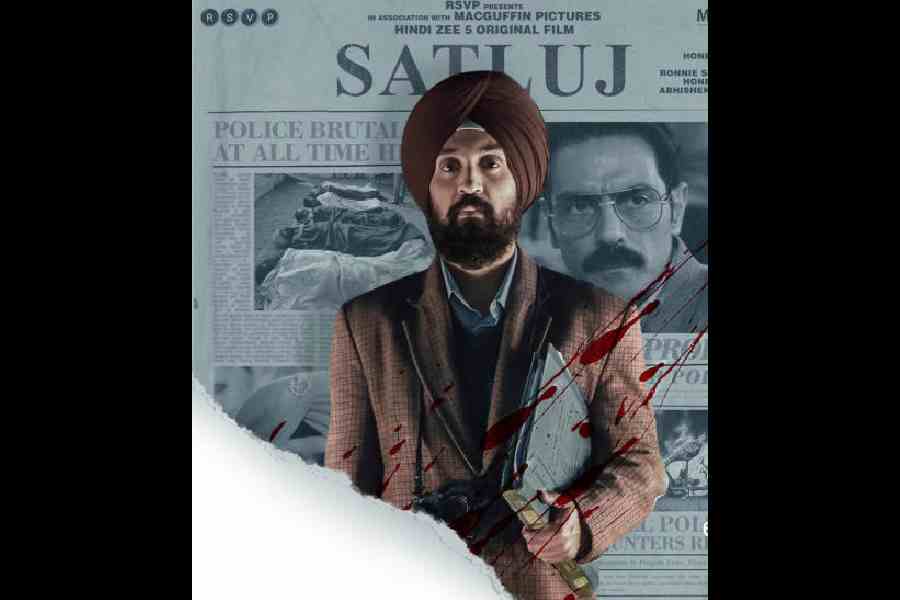
An unflinching tale of heroism and selflessness, Satluj is based on the real-life story of Jaswant Singh Khalra. An officer in the loan department of a bank in the 1990s, Jaswant (Diljit Dosanjh in yet another career-defining role) is a regular family man with a wife (Geetika Vidya Ohlyan is a picture of quiet courage) and two kids. This is the turbulent time of insurgency in Punjab, bursting at the seams with untold stories of men and women going randomly missing, killed brutally and their bodies disposed of, en masse in crematoriums or thrown into a watery grave. They remain unnamed, their stories stifled by unimaginable police atrocity.
With the scars of 1984 still fresh, Punjab sees itself nursing new wounds, with Jaswant thrown into it by destiny. His slain childhood friend’s mother (Jyoti Dogra) goes missing one night, and Jaswant can no longer turn a blind eye. The cops — and the state machinery as a whole — are the perpetrators, but where is the proof? It lands in Jaswant’s hands by chance, through the records of thousands of bodies cremated in the various burial grounds dotting his vicinity, their families, unbeknownst to them, still looking for their loved ones. Jaswant finds himself facing an uphill battle, one that puts his life and those of his family at unspeakable risk. But here is a man who will never back down.
Trehan diligently pieces together this story of bravery and resilience, apathy and barbarity. Jaswant stands on one side, while the impunity of so-called law enforcement has its face in the form of SSP Surjit Singh Sugga (Suvinder Vicky is a revelation in every role) who executes the dirty work at the behest of his boss and state police chief Inderpal Singh Bitta (Kanwaljit Singh is chillingly menacing), collectively seeking to legitimise state-led genocide. Jaswant quietly fights the good fight — he refuses state security and foreign asylum, turns a deaf ear to threats and slowly but surely fashions himself into a one-man army, with courage and resolve as his only ammunition. Jaswant is taken away forcibly one morning, never to return.
Satluj will have you in a chokehold throughout, with Diljit — in a performance that blends vulnerability with tenacity — compelling you to never take your eyes off him. Here is a man whose courage off screen is matched by his fearlessness on it.
In the second hour of its 163-minute runtime, Satluj metamorphoses into a procedural of sorts, with the CBI, led by the dogged resoluteness of top officer Samudra Singh (Arjun Rampal is on a roll), trying not only to bring back Jaswant but also to bring the criminals to book. His journey — like Jaswant’s — is fraught with danger and deception, even as the machinery does all it can to cover up the extrajudicial killings it has carried out for years. At one point, Samudra — Rampal’s character is in direct contrast to his chilling turn in Dhurandhar — delivers a monologue that sums up our collective frustration, whether we happen to be citizen activists or simply citizens. “This is a vicious circle of violence that the powerful use for their own agenda and it will never stop. It will go on and on until we don’t step in and set an example, or we can turn a blind eye and be on the wrong side of history forever.” These are powerful words rendered powerfully and you can’t help but ponder over them long after the moment passes.
What will make your hair stand on end — literally and figuratively — is that dream (or is it) of Jaswant appearing, much like the ghost of Banquo in Macbeth, to reveal how much his open wounds hurt when the water rushes into them. In that sense, the name Satluj, a witness to the brutality that became a part of the state, seems apt. It seems especially resonant, given a line early on in the film, that talks about floating bodies being like floating pages of history... they sink, and so does history.
At a point towards the end, Jaswant, his life hanging by a thread after being subjected to inhuman brutality, is asked by one of his captors as to why he persists. “Aap marr bhi jaoge toh kya badal jayega?” he is asked.
Jaswant’s reply: “Jab pehli baar suryaast ho raha tha, toh duniya ko laga tha ki yeh andhera hamesha ke liye rahega. Log darr gaye thhe, roshni ki aas chhodne lage thhe. Tab ek chhoti si jhopdi mein ek diye ne sarr uthaya aur kahan: ‘Main andhere ko challenge karta hoon. I challenge the darkness’.”
As citizens of a nation demanding truth and transparency, we echo Jaswant — we challenge the darkness. Bring Satluj back.
Satluj is an important story to be told because... Tell t2@abp.in