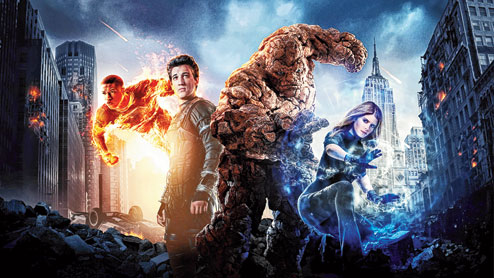
Josh Trank shot to prominence with his directorial debut, the 2012 science-fiction thriller Chronicle, which he also co-wrote. The tale of three teenage high-school seniors who gain telekinetic abilities was a worldwide smash, grossing over $125 million — more than 10 times its production budget — and was hailed for its smart script, direction and performances. Today, Trank comes up with his biggest film yet — Fantastic Four.

From the trailer, people have assumed that this is a more ‘grounded’ or ‘gritty’ take than the previous Fantastic Four movies...
I don’t really know what gritty and grounded means! I mean, what’s a gritty movie? French Connection?! This movie will be what it will be. If anything, I would just say it’s just very human. It’s a film that tonally, I think, can have its own definition and maybe when people want to make another superhero movie that’s different than anything else I’ll feel sorry for the person who’s going to be asked: ‘Well is it like the Fantastic Four reboot?’ And they’ll be like: ‘No!’ ‘Is it grounded? Is it gritty? Is it like Nolan?’ No. It really is kind of its own thing.
 You’ve assembled an amazing bunch of young actors, most of whom you might not expect to see in such a big blockbuster...
I’d worked with Michael B. Jordan on Chronicle. We had such a great time filming together and his character in Chronicle was such an archetypal charismatic character that when Fantastic Four came about, Mike just popped in my head as Johnny (Storm). I thought that would be really interesting just because what that could imply for the family dynamic and the options that would open up for me in making a superhero movie based on a many-decades-old property and modernising that. So we see a movie that represents the world we live in today, as opposed to the Sixties.
Miles (Teller, who plays Reeds Richards) was somebody I had met for Chronicle and I was really interested in his charisma and intelligence as a person. He did this movie called Rabbit Hole years back where he played a teenage driver responsible for the death of a child, who feels enormous guilt. It was very powerful and Miles was so captivating as this young kid trapped inside of his guilt. And as I’d been developing this Fantastic Four story where Reed Richards holds himself responsible for what happens to his closet friends, I felt it was something Miles could really sink his teeth into.
Why was Kate Mara your Sue Storm?
Well, I didn’t have a particular Sue in my mind when we started, so we went through the usual rounds of meetings with actresses and I tried to keep as open a mind as possible during the process. And then when we met Kate, she was so smart and interesting and stable and really centred... which were qualities that would work really well with the other characters. It was one of those very easy moments where, after the meeting, I could no longer imagine anyone else as Sue.
The previous Fantastic Four movies are still relatively fresh in people’s minds. In what ways is this version different?
Well I’ll say, first and foremost, there is nothing wrong with the first two Fantastic Four movies. There was an audience those movies were made for and they loved it and embraced it. The movies did pretty well. And I never looked at doing a new version of this as a way to spite any memory that anybody had of the previous films. The way that I really looked at it is I had a tone in my mind. It was a very specific tone. And I would do it injustice to try to compare what I was attempting to go for to any existing superhero movie that people are familiar with. Because that’s not really what I was doing. I really do like Nolan’s Batman movies, but I wasn’t like thinking in terms of... ‘Oh, look how he did that. I wanna do the same thing….’ That wouldn’t even cross my mind.
I feel like the vocabulary and knowledge that a lot of young people have today of movies don’t really go that much further back than the early 2000s. My go-to inspirations are directors that hail from the ’40s, ’50s, ’60s and ’70s. But if I were to discuss the challenge to overcome, in terms of perception, how we’re doing something kind of new here with a legendary and very famous superhero quartet, I would put it in terms of James Bond.
How so?
Well, how the James Bond franchise evolves and remodernises itself with every passing decade. Moonraker (1979) is a very different movie than Skyfall (2012). It’s a different embodiment of Bond as a character. It’s a different tone. It’s a different style. It’s a different approach, all in all.
But the thing that both of those movies share in terms of, you know, being a part of the same thread is the same pre-existing character. Roger Moore is James Bond and Daniel Craig is James Bond. And although there’s some big differences in terms of how they come across to the audience, the basic occupational qualities of the character are the same. In terms of his readiness for action, his absolute commitment to protecting the Queen and to defending the law-abiding citizens of this planet and in having a licence to go above and beyond the line of duty in order to protect the world. It’s the same idea, the same archetype.
 How did you approach action sequences in this new, more realistic, universe?
The first thing that I knew in my head is that whatever big action was going to unfold had to share familiar rules of physics to our audience going to see the movie. These are characters whose transformation bends and defies our own understanding of physics. But I wanted to see the action take place in such a way in which their powers and physical conditions were at odds with our own rules of physics and gravity. So I spent a lot of time workshopping big ideas with a team of pre-visual artists and storyboard artists to really craft this into something that would make sense. And I started to think about all of their individual powers as bodily conditions that are in sync with their physicalities and their emotions, just like our own abilities as normal human beings would be. I mean, you look at say, (basketball champ) Kobe Bryant. His ‘superpowers’ are his abilities on the court. And his powers are completely in sync with his physicality and his ability to control his emotions and focus on what and how he is using his powers. But he’s no different than the rest of us in the physics that he shares.
So you’re happy you made the movie you wanted to make?
Yes, I’m really, really proud of this. I’m really excited. This is a movie I would want to see. But at the end of the day, any movie, a big movie or a small movie, you’re not doing your job if you’re just making it only for you. You need to really make it for everybody. I want my grandparents and your grandparents to watch this movie despite the fact that it’s like, ‘Okay, a superhero movie? Not for me. Kids under the age of 25? Not for me. It’s about superpowers and scary things? Not for me...’ But if you saw a trailer or something, you’d go, ‘Wait, for some reason, I’m interested in this’. That’s been my goal and that was the goal with Chronicle. That’s how these two movies in more ways than one are similar and connected. It’s sort of like my superhero twology, you know what I mean? So the movie does need to be for me and for everybody.
I will watch Fantastic Four because.... Tell t2@abp.in
KATE MARA PLAYS INVISIBLE SUPERHERO SUE STORM
 What can we expect from this incarnation of Fantastic Four?
Well, I think the great thing about our version is that it is definitely based on the original comic books, but it’s modernised. It’s the origins of these characters, so you get to know them right before they get their powers and the complications that come along with that. So I think that’s different: we haven’t seen that with this specific story before. On a personal level, I’m a total superhero movie nerd and my favourite kind is always when I get to see the character forming their superpower because you feel so much closer to them — you understand why they got that specific power in the first place. It humanises them. Then you really root for them.
I also love that in our story, you see the struggles that each of us goes through in trying to figure out how to use our powers. You see us first as teenagers, and I feel like the general thing that most teenagers go through is, ‘Who am I and where do I belong?’ The interesting thing about this is seeing each of us handle the ups and the downs of that. I think, for me, that was the most exciting aspect.
Is it right to say this film takes elements from both the original Sixties comic book series and more modern incarnations?
Yeah, it takes a little bit from everything. I think that Simon [Kinberg, the writer of the film] was very smart in that he wasn’t using one specific comic to take our story from. It was a little bit from this one, little bit from that one. I think one of the special things about our movie is that while it’s new in its reincarnation of the Fantastic Four, it takes a lot of things from a lot of different comics. So I do feel like there’s going to be something in it that will make everybody happy in some way! Fans should feel like they know these people.
In this version, does Sue have any other powers apart from being invisible?
She can create force fields, which comes in very handy. It’s like a giant moveable bubble she can create around things. So it’s like our version of flying. I can create a force field around all of us and sort of transport us to another place.