It’s always a cool thing to say “hi”, “hello”, “yo man” or even shake hands. But why don’t you try to say “namaste” the next time you meet someone? When you do, observe the change in the response you receive. Wasn’t your presence more welcome? Did you feel the difference?
 |
It’s a brand name, the word namaste, the simple gesture with joined palms that seems to say, “Yes, this is India and I am 100 per cent Indian”. It’s recognition beyond doubt.
Namaste is an ancient Indian gesture and it is timeless. We have transported it to the West and the East. It stands as a symbol of greeting and respect shown in many cultures around the world. Then why does one choose instead the cool mannerisms of greeting and shed the Indian-ness one is born with? The essence of palms erected together in front of the chest, close to the heart, captivates the audience. You can conquer all and connect to the universe.
‘Nama’ means bow, ‘as’ means ‘I’ and ‘te’ means ‘you’. I bow to you. Such an emotion stirs the deepest form of regard and respect. Namaste represents a belief inside of you, and me, that we are both sparks of nature. Your soul and my soul salute each other. There is an instant connection in the energies of people without any prerequisites. Anytime, anywhere, anyplace. And anyone can perform the ritual of namaste. It is unconditional, egoless, simple and is yet a creative gesture.
The next time I see you it’s got to be namaste, placed in front of your heart, or at your forehead or in yoga with me in practically every asana.
ANJALI MUDRA/ NAMASTE
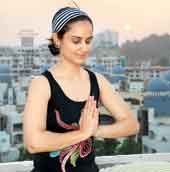
In yoga we perform the Anjali Mudra. It’s the same as performing a namaste, but the seal of the palms denotes an offering in the asanas, for example, in Veerbhadrasana (The Warrior Pose), Vikhasana (The Tree Pose), Hanumanasana (The Chair Pose) and more. In the Suryanamaskar too, the second and eleventh poses with palms joined in front of the chest, are poses of total submission of the yogi to Suryabhagwaan (The Sun God).
Technique: Sit on the mat in Sukhasana (The Easy Pose). Keep the spine perpendicular to the mat, the head in slightly bent position, and bring the palms together with every finger in contact with its counterpart, close to the sternum. The thumbs could brush against the centre of the chest/sternum. Eyes closed, lips lightly shut, breathing through nostrils naturally and chin tipped down. You are now in the position to say, ‘I bow to the divine in you from the divine within me… namaste’.
Efficacy: Practising Anjali Mudra centres all of what one aspires to do. It is believed that the tender pressure of the palms stimulates the lobes of the brain. It guides the doer to a state of clarity. It creates a sense of calm. It is the most expressive means to show that we are submissive. It is practised by dancers, performed in rituals and offered as a gesture of thankfulness to elders, teachers, nature etc.