The Bengali film industry is often accused of playing safe, sticking to the formulae of family drama and detective thrillers. Even filmmakers who once made a mark for walking against the tide have retreated into safe shells. In such a scenario, Ranjan Ghosh’s Adamya arrives like a breath of fresh air.
A political thriller, Adamya strips away familiar urban gloss and compels the viewer to confront another Bengal. It is rare to find a contemporary Bengali film that carries such overt political currents but doesn’t collapse under its own weight. It is not without reason that veteran filmmaker Aparna Sen chose to back the film as presenter.
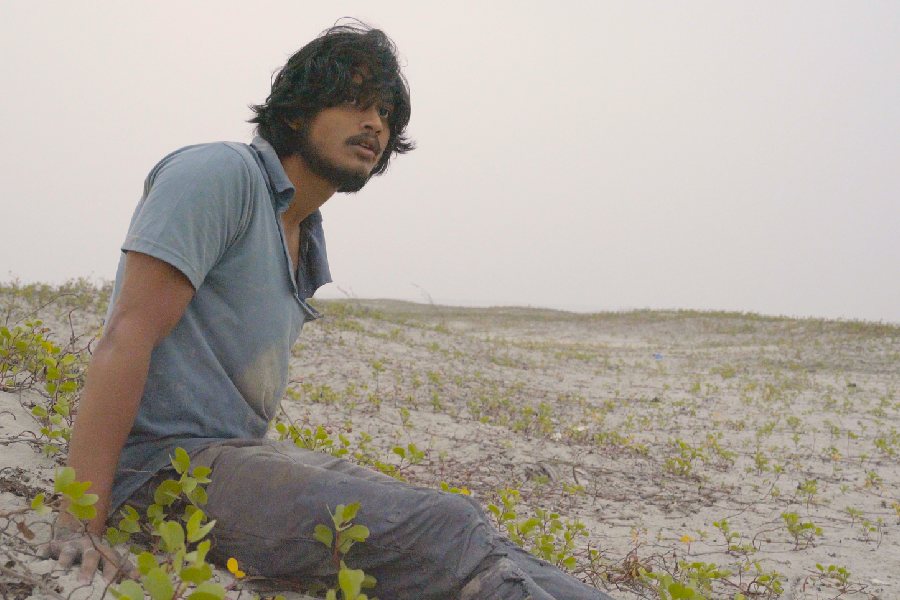
The premise of Adamya is simple. A political assassination attempt goes wrong. Palash (Aryuun Ghosh), a young student revolutionary goes on the run after the administration launches a massive manhunt. As the state machinery closes in, Palash retreats further from the city into villages, forests, and eventually to the edge of the sea.
Ghosh’s writing and direction is the backbone of the film. There is no melodrama. No preachy sloganeering. Ghosh obviously takes sides in the political quagmire, but his tone remains measured. This restraint gives Adamya its gravitas. The film — unlike many mainstream movies that explore political undertones — trusts its audience to observe, reflect, and arrive at their own conclusions.
Palash is a character who most of us can relate to. As someone who studied at Presidency College — considered a breeding ground of ‘urban naxals’ — during the turbulent period of 2005-2008, when West Bengal was going through a political churning, Palash’s ideological battle feels familiar. Inspired by the revolutionary poetry of Sukanta Bhattacharya and the martyrdom of Bhagat Singh, Palash is the epitome of resilience.
Aryuun Ghosh, in the role of Palash, delivers a standout performance that grows on you. Particularly in the latter half, when the emotional stakes intensify and isolation weighs heavier, Aryuun’s portrayal gains commanding force. He carries long stretches of the film with minimal dialogue, relying instead on gaze, posture, and physical stillness.
Visually, Adamya finds one of its strongest pillars in cinematographer Arkaprava Das. His camera is like a silent spectator in the storytelling, following Palash quietly. Shot across real locations in Sunderbans with a lean crew, the film feels textured and lived-in. We see the daily rhythms of village life — the tea stall boy, the fishermen, the fragile economy of survival. Water, forest and land are not backdrops but silent witnesses to Palash’s journey. And none of the locations are shot with the urban gaze. That’s what makes Adamya stand out.
Adamya also dismantles a persistent myth that cinematic impact depends on scale or glossy production values. This is a film built on conviction, with minimal crew and a shoestring budget.
Earlier this month, internationally-acclaimed filmmaker Wim Wenders, who serves as the head of jury at this year’s edition of Berlin International Film Festival, refused to take a question on Palestine during a presser. He suggested politics must be kept out of film fests. But Ranjan Ghosh’s film reminds us that art is indeed political.