

The shooting of Arindam Sil's Balighawr is expected to begin soon. Last month, the government-owned Bangladesh Film Development Corporation (BFDC) finally passed the script after a long wait. Sil is from Tollywood - the name for the local Bengali film industry - but the film is supposed to be an Indo-Bangladesh joint venture.
In the past five years, the number of films born of joint ventures between the two neighbours has gone up. The films have ranged from commercial potboilers to stories based on literary works and original scripts. Some recent releases are - Boss 2: Back to Rule, Nabab, Rangbaz, Inspector Notty K, Noor Jahan, Chalbaaz and Saturday Afternoon.
We, of course, are using the term "collaboration" in the widest possible sense. It connotes a sharing of artistes, technicians, shooting locales, literature and production costs.
Doob: No Bed of Roses, which was released last June was produced by Bangladesh's Abdul Aziz, Calcutta's Himanshu Dhanuka and the Bollywood actor Irrfan Khan. The film about wayward human emotions and passions, revolves around movie director Javed Hasan who falls in love and marries his daughter's friend, incurring the wrath of many and impacting the lives of many more. So we have a director from Bangladesh, Mostofa Sarwar Farooki, Irrfan playing Javed, and the principal characters essayed by Bangladeshi actors Nusrat Imrose Tisha and Rokeya Prachy and Tollywood's Parno Mittra. The shooting was done in Chittagong, Sylhet and Dhaka.
The film opens and closes with the same scene - the riverfront, a waiting dingi nouka (fishing boat) and playing in the background the Tagore song, Purano sei diner katha bhulbi ki re hai o sei... It went on to win the Kommersant award at the 2017 Moscow International Film Festival.
The Tagore song might be a yearning for the good old days, but collaborative efforts such as Doob may yet be the best thing to have happened to the film industry in Bengal in a long, long time.
The first film that opened the gates for such collaborative efforts was Goutam Ghose's Padma Nadir Majhi.
The 1993 film was produced by the West Bengal Film Development Corporation and was based on the eponymous novel by Manik Bandyopadhyay. The India-cast comprised Utpal Dutta, Roopa Ganguly and Rabi Ghosh, and the cast from Bangladesh included Raisul Islam Asad, Champa and Humayun Faridi.
Ghose, however, is reluctant to be hailed as a pioneer. Instead, he draws attention to the fact that 20 years before him, Bangladeshi producer Habibur Rahman Khan and the legendary Ritwik Ghatak came together for Titash Ekti Nadir Naam.
The 1973 film was an adaptation of a novel by Bengali writer Adwaita Mallabarman, who was born in Brahmanbaria district of Bangladesh. Says Ghose, "It was not strictly a collaboration as the film did not share artistes and technicians."
Both Titash Ekti Nadir Naam and Padma Nadir Majhi explored the lives of fishermen - an important community in riverine civilisations. Those days, art house and mainstream cinema behaved like estranged siblings with very definite styles, distinct identities and audiences in mind. Over the years, as divisions blurred, the thematic as well as cinematic character of the collaborations altered.
Ghose made Moner Manush in 2010, based on the life and philosophy of Lalon, a 19th century folk artiste of Bengal. Indian producer Gautam Kundu came together with colleagues from Bangladesh - Habibur Rahman Khan and Faridur Reza Sagar- for this film. In 2016, Ghose directed Shankhachil, the story of a village couple from Bangladesh who comes to Taki in Bengal's North 24-Parganas for their daughter's treatment.
Ghose says such projects necessitate a balancing act. "Even at the scripting stage one has to plan where to shoot and where not to." Why? It has to be ensured that both countries have an equal share of the work pie. He adds, "Since post-production facilities are better in India, we keep that part of the work here and balance by doing most of the shooting there. This is a challenge at times."
But a Doob or Moner Manush are exceptions. These last five years, production houses Eskay Movies (based in Calcutta) and Jazz Multimedia (based in Dhaka) have made several films, a lot of which are remakes of South Indian movies.
Co-owner of Eskay, Himanshu Dhanuka, says, "The audience in Bangladesh likes action films and thrillers and they are hits there just like they are here." Films such as Romeo vs Juliet (remake of the Punjabi film, Singh vs Kaur), Aashiqui (remake of the Telugu, Ishq), Niyoti (inspired by the Hollywood film, The Notebook), Shikari (remake of the Tamil Aadhavan) are said to be super duper hits in Bangladesh. "But there are many entry barriers. Bureaucracy in Bangladesh hampers our productions at times," cribs Dhanuka.
Dhanuka is referring to the recent amendments to the nitimala or the rulebook on joint cinematic ventures. It makes it mandatory for the director to submit the script to the BFDC for scrutiny. Arindam Sil's Balighawr was caught in this tweak.
Explaining the impetus behind the amendments, president of the Bangladesh Film Directors Association, Mushfiqur Rahman Gulzar, says, "We have decided not to be part of remakes of South Indian movies. The action movies, thrillers and those based on lives of terrorists do not have any resemblance to our lifestyle. Such films have flopped regularly at our box office. From now on, films will have to have original scripts, or be based on works of Bengali writers. There should be two producers and at least 50 per cent of the cast will have to be from our country. At the very least, the division will have to be in 60:40 ratio," he tells us over a call from Bangladesh. There will be relaxations for movies to be shot in a third country, provided it is not merely to save cost or disrespect Bangladesh. He adds, "We want to create movies that match our culture."
The message is clear - the Bengali language has its own heritage and this, the jointly produced films will uphold. Mindless rip-offs are off the menu.
Valid points and many in Tollywood also agree but are loath to speak up. Gulzar says, "We had to do it because at times the producers have not checked if it was a joint venture in the truest sense. They bought the movies and just screened them here... Collaboration is not always about money and actors. It is a way of paying respect to the countries. And when that is jeopardised, joint ventures don't succeed."
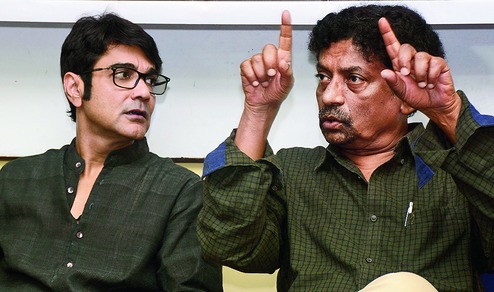
Bengali actor Prosenjit Chatterjee, who has played the central character in Moner Manush and Shankhachil, says, "Some of the norms can be changed as the language of cinema has changed. Filmmakers from both countries should sit and advice, and come up with solutions. Paperwork has to be easier. Somebody wants to do a film, he should not have to wait for months."
In an email from Bangladesh, Doob director Mostofa Sarwar Farooki tells The Telegraph, "Joint production is a great idea, it opens up a bigger market and ensures a handsome production budget. It also has a cultural impact, brings people together. But it will be successful only if we can make more films with an open mind addressing real issues from both sides. Templated stories won't help."
Goutam Ghose voices other concerns. He tells us it is imperative that the two countries work out the economics. "For every product that we export or sell, the money exchange happens in hard currency. A letter of credit is opened and exchange becomes easy. This doesn't happen in case of Bengali films. The revenue realised in each country is what each producer takes home. No money exchange happens." He emphasises on the need to open up the market. "Tamil, Telugu movies have high budgets because they have successfully tapped the international market."
Chatterjee points out that Bengali is among the 10 most-spoken languages of the world.
And he has a dream. "There will come a time when people will say, 'Let's go and watch a Bangla film'."