
Thirty years ago I’d have whooped at the news that the Tolkien family are negotiating to bring The Lord of The Rings to the small screen. Heroes, villains, glory, quests, despair, victory, all strung out over the many hours that TV series can now command; I’d have anticipated pure pleasure.
Now I am thoroughly indifferent, because it feels like a story whose time has passed. Tolkien doesn’t resonate with the lives we lead now or the issues we face. His is a simplistic boys’ own morality tale, without complexity, subtlety or character development, in which good people do good things, and bad people do bad things, and in the end the good guys — if a little more depressed than they were at the start — win out.
And it is just guys. The Lord of the Rings eliminates from its universe half the human race. With the exception of a giant bloated malevolent spider, every one of its interesting active characters is male and women appear only fleetingly as helpmeets, shrill relations or visions of beauty and purity in the background of the plot. Even the walking trees, for goodness’ sake, are men.
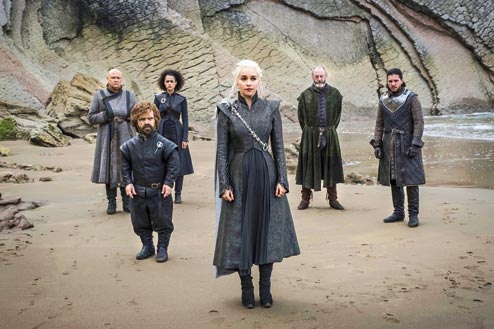
The limitations of Tolkien have been made all the clearer by the emergence of the hit fantasy Game of Thrones. And that’s not a sentence I ever thought I’d write. I skipped the series when it first came out, repelled by the reports of gratuitous sex and rape, continual savage violence and a passing glimpse of a zombie corpse with electric blue eyes.
After a while, though, Game of Thrones became such a common, casual reference point in conversations and the media that I began to feel I’d skipped a vital bit of history, culturally if not literally. Even David Cameron used it as a metaphor when I interviewed him and I nodded vigorously, though I’d no idea what he meant.

Just a month ago, almost as a duty, I sat down one evening to discover what I’d missed. I stood up seven hours later, at two in the morning, dazed and enraptured. It took only four weeks to catch up with the seven seasons of the rest. The characters may wear medieval robes, communicate by raven or live in ice walls, but the stories the series tells are so compelling because they reflect and illuminate what’s happening in the world today.
Game of Thrones is not principally about sex or dragons but power, and the savagery, cunning, deception, charisma or strategic brilliance that’s necessary to gain or retain it at a time when there are no bureaucratic or democratic institutions to take the place of brute force and fear. Its fictional scenes, inspired by centuries of European history, are not just entertaining; they also give us insights into contemporary lives.
When we watch kings or noblemen desperate to keep their thrones or castles, massacring innocent villagers, torturing political opponents, flaying old men or burning children alive, we have a glimpse of the self-justifying logic behind the atrocities carried out by Assad or Isis in Syria. We could also remember that we’re backing Saudi Arabia as civilians die in Yemen.
The cruel rule of the priestly puritans in the city of King’s Landing is not just an echo of 17th-century England, it also reminds us of the Taliban. The desperate machinations, scheming, betrayals and plots at the court of King’s Landing make the stories coming out of Trump’s White House, Putin’s Russia or Kim Jong-un’s North Korea more comprehensible. They might also make more sense of our own office politics, and why mediocre James from marketing has inexplicably been promoted to the board.
Game of Thrones is riveting because it offers so few certainties, only flawed, struggling, capricious human beings, fighting to survive. We see it through the eyes of seven competing kingdoms. Its heroes, queens and princes can be foolishly noble, strategically dim, blindingly brutal. They are massacred at wedding feasts because they trust too much or raped because they trust too little. No one is pure and only a couple of characters are unrelentingly evil. It plays constantly with our sympathies and our own sense of morality as we watch. Do we want our leaders or ourselves to be trusting and noble and betrayed, or should they be alert, occasionally savage, doing whatever is necessary for a greater good?
In this world, unlike Tolkien’s, women, constrained as they are by a medieval social context, are nevertheless as complex, intelligent, ruthless and essential to the narrative as the men. Amiable aristocratic grandmothers turn out to be ruthless poisoners; a royal teenage girl becomes a glittering avenger of wrongs; a queen who champions the poor and enslaved kills thousands of innocents to keep her throne.
The gift of Game of Thrones goes beyond enjoyment. It carries us empathetically into the inevitable reality of moral complexity in the exercise of all power, and into witnessing the thought processes of people who don’t adhere to 21st-century liberal, democratic ideals. At a time when the real world looks increasingly chaotic, disordered and unsympathetic to those values, little could be more critical for those of us who espouse them than understanding that these values aren’t universally appealing, and that they need to be constantly defended and fought for.
I can’t cheer Tolkien’s Rings because it’s essentially a child’s tale which tells us nothing real about human beings, admits of no grey areas, paints cartoons on a wall. But Game of Thrones, series 9-20? If only. Bring it on.
Jenni Russell
(The Times, London)
Which universe is more real for you — LOTR or GoT?
Tell t2@abp.in