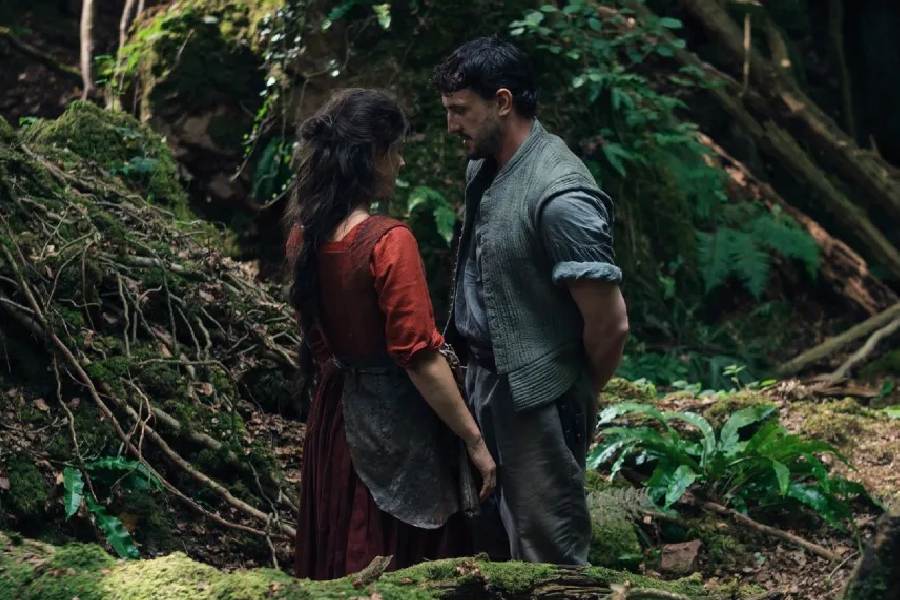
In her Oscar-nominated period film Hamnet, Chloe Zhao travels four centuries in the past to recount how the sorrow of child loss was the inspiration behind one of literature’s greatest tragedies. The death of William Shakespeare’s 11-year-old son, Hamnet, was the driving force behind the play Hamlet — and Zhao takes you on an emotional journey around its inception, exploring grief.
Jessi Buckley plays Agnes in Hamnet, a performance that has made her a frontrunner for the Oscars. Agnes is rumoured to be the daughter of a witch, a woman deeply connected to the earth and instinct.
Opposite her, Paul Mescal plays Will — not yet the towering literary figure, but a restless young man with poetic ambitions and an uneasy relationship with his father’s trade. Mescal avoids turning Shakespeare into a saint or a stereotype. Instead, he shows us someone pulled between duty and desire, family and ambition.
In the first half, we watch Agnes and Will fall in love. We see them marry, raise Susanna, and welcome twins Judith and Hamnet. Zhao takes her time to build the world of domestic bliss. The happiness feels earned. Which is exactly why what follows lands so hard.
Then comes the blow. Hamnet dies of an illness. Zhao doesn’t dramatise the tragedy. Instead, she slows down the narrative. Silence rules. Agnes retreats into herself. Will drifts further into London, chasing theatrical success while carrying a grief he cannot articulate. The loss hangs heavy, and unspoken, over everything.
Did Shakespeare channel that grief into Hamlet? This is a question that Zhao tries to explore in the second half. The similarity between the names Hamnet and Hamlet is historically documented, though scholars of English literature debate its significance. Zhao, drawing from Maggie O'Farrell’s eponymous novel and academic work by Stephen Greenblatt, leans into the possibility that the grief indeed inspired the bard.
This idea comes full circle in the final act, when Agnes travels to London to see Hamlet performed. As the famous lines — to be or not to be — from the play echo through the theatre, something shifts in her. She begins to see that her husband’s distance wasn’t absence of feelings, but his own way of mourning. Buckley says almost nothing in these scenes, yet her face recounts her feelings: realisation, heartbreak, and a flicker of understanding.
The supporting cast adds depth. Emily Watson brings tension as Mary Shakespeare, while Jacobi Jupe and Olivia Lynes make the twins humane. A scene between Hamnet and Judith, showcasing a strong sibling bond, is among the film’s most haunting moments.
If you’ve followed Zhao’s career, be it The Rider or Nomadland, you know she has a gift for turning landscapes into living, breathing structures. Here, the forests outside Stratford-upon-Avon are like a character in themselves. With commendable efforts from cinematographer Łukasz Żal and composer Max Richter, Zhao creates a world that is almost mystical. The camera lingers on morning dew, on wind slipping through branches, on Agnes curled beneath a towering tree in a flash of red. Nature seems to absorb her grief.
The pacing, however, is slow. Sometimes unapologetically so. Some viewers may find it testing. But Zhao is not interested in rushing through grief.
Hamnet, which has earned eight Oscar nods — including Best Picture, Best Director, Best Actress, Best Adapted Screenplay, Best Casting, Best Costume Design, Best Production Design, Best Original Score — is now playing in Indian theatres.