Members of the West Bengal Junior Doctors’ Front (WBJDF) marched to the Swasthya Bhawan on Friday, while Mamata Banerjee, the state chief minister who also holds the health portfolio was in a dharna some 31 kms away.
The junior doctors are upset with the guidelines issued recently for the posting of senior residents in state-run hospitals and health centres. Junior doctors in India are qualified medical professionals—holding an MBBS degree—who are in the initial stages of their medical career, typically undergoing postgraduate training (MD/MS/DNB) or working in a hospital to gain experience.
The forum alleged that the new guideline replaces the earlier merit-based counselling with an allotment system.
Speaking to The Telegraph Online, a member of the organisation Parichay Panda said, “For the last two years, there was merit-based counselling where doctors could choose their preferred medical college or district hospital to serve their bond based on their marks. This new SOP introduces randomised allotments based on the whims of the administration.”
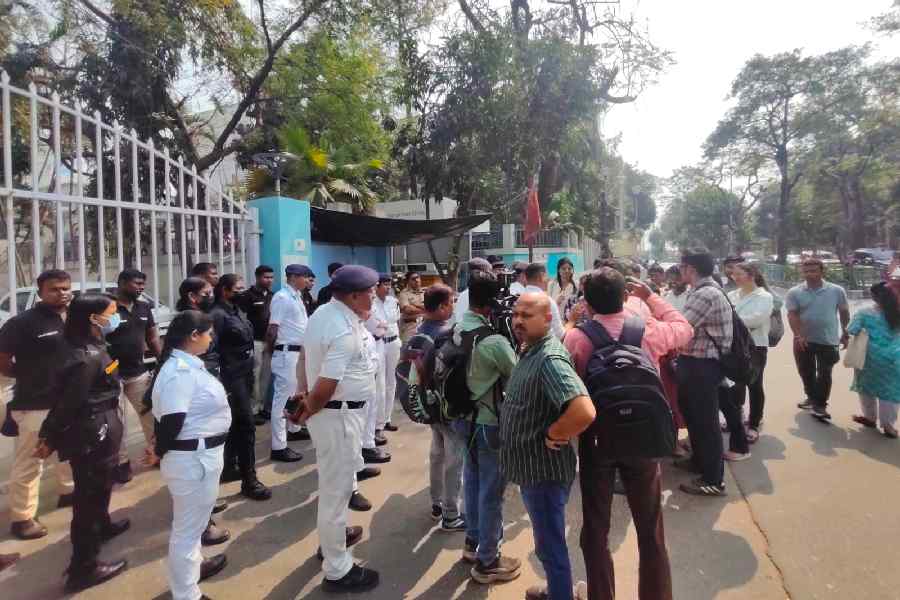
Members of WBJDF and a section of junior doctors stand outside the Swasthya Bhawan amid heavy police guard Sourced by The Telegraph Online
Panda flagged the new process as a ploy to create “back-channel and under-the-table dealings” for doctors to get their preferred postings. He alleged that doctors can now pay their way to be posted in their preferred locations or to avoid difficult postings.
“Posting of newly trained specialist doctors in far-off hospitals where they won’t get the chance to practice their skills will have an impact on their future. Their skills will not be properly utilised for the lack of facilities. Imagine a radiologist or a specialist surgeon getting posted in a primary rural centre where there is no operation theatre. What will they do during the entire time?” Parichay asked.
“All this is being done to cover up the shortage of MBBS doctors in the state, as the administration is quietly shifting their work onto the senior residents,” he added.
Barrier to higher education and associate professor roles
According to the National Medical Council guidelines, a senior resident, in order to qualify for the post of Assistant Professor, has to serve their three-year bond posting — one year in a medical college or a government hospital with a minimum of 220 beds, and the remaining two years can be served at a rural or district hospital.
Panda pointed out that the administration is breaking the “back of the medical education system,” robbing senior doctors of a chance to qualify for associate professor roles while serving their bond postings.
The new SOP also makes it harder for doctors to pursue further degrees.
Panda explained that doctors, while serving their bond, prepare for higher exams to pursue advanced degrees. There is a legal precedent allowing medical professionals to leave their bond to pursue further education, provided they return after completing the degree to serve the remainder of their bond.
“Courts have always said that states can’t stop medical candidates from pursuing higher studies by withholding no-objection certificates just because they are under a bond,” Parichay said.
The new rules mention that no-objection certificates will not be handed to candidates pursuing fellowships or other degrees that require them to study in other states.
“The refusal to grant NOCs for higher studies is completely arbitrary and a systemic overreach,” said the doctor.
The row between the Bengal government and junior doctors has continued for over a year despite legal interventions by the Supreme Court and the Calcutta High Court.
In the aftermath of the RG Kar incident, WBJDF has alleged that new postings for senior residents are being used as a form of retaliation for the Abhaya protest.
Dr Debashis Halder said that initially, he, along with Dr Aniket Mahato, and Ashfaqulla Naiya had taken legal measures to stop the unjustified postings made by the Bengal government.
“The main basis of our legal argument in Aniket Mahato’s case is that we established in court that the postings being made by the administration violated their own guidelines, which mandated merit-based counselling. Hence, the administration changed this year’s SOP only so that the same legal remedy can’t be used again. This is all being done in revenge.”
The state health secretary NS Nigam did not respond to calls and texts sent by The Telegraph Online.