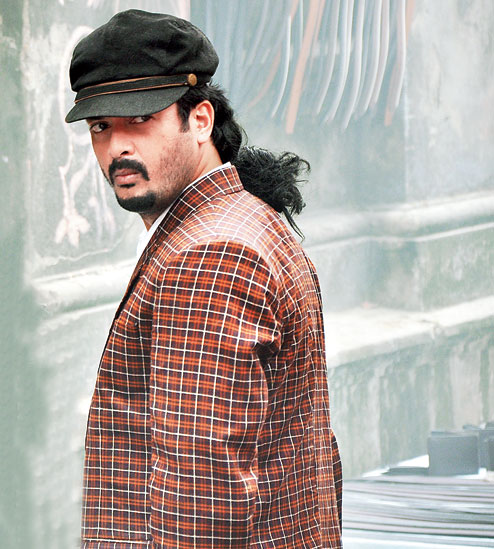

8 pm on an October evening and Anjan Dutt is not looking for a quick smoke. The singer-songwriter-actor-filmmaker who enjoys his smoke and drink has been off it for more than two weeks. “We had a show in Bangalore on Ashtami and I drank 7-8 pegs of vodka, neat, till 3am. I had too much vodka. I was overdoing it. On Dashami I was in some pain from an ulcer. But I’m waiting for the day when I’ll start again. I don’t have any withdrawal symptoms. I don’t have any problems. I know I have to get well,” he smiles.
Fresh off the success of his last film, Byomkesh O Chiriakhana, Anjanda is busy rehearsing for Medha, his “last directorial venture in theatre”, which premieres on November 4 at Gyan Manch. “I’ll produce, maybe I’ll act, but I won’t direct for the stage anymore, because I seriously need to concentrate and make some nice films. If I had the money I’d have produced films for other people. For now, I’d like to be the ideal producer for two-three people in theatre, give them the freedom, guide them, give them the space.”

A t2 chat at Anjanda’s Beniapukur home.
How do you look at the success of your Byomkesh films?
Byomkesh is the saving grace for me because thanks to that I get to make some other kinds of films. If I have a franchise which works, I can recover costs. But it’d be sad if I have to keep doing it every year.
And if the industry revolves around a Byomkesh, a Feluda, a Shibu-Nandita or a Srijit Mukherji film, then what happens to all the other filmmakers and actors?! It becomes a very sad case. There has to be space for all kinds of films. The space for the alternative is going away.
Has the success of the Byomkesh films and the commercial failure of films like Hemanta trapped you as an artiste?
Yeah, very honestly it has. Of course financially Byomkesh is helping me. It is giving me scope to do more things. But I have to make the other films successful too. I am committed to Byomkesh. I will never make it with a lot of gloss and glamour. I will go back to that old, detective fiction. Because that is what the audience has identified with.
Apart from Jisshu Sengupta, Saswata Chatterjee and Ushasie, who play Byomkesh, Ajit and Satyabati, why repeat the same set of actors — like Sagnik, Ankita, Priyanka, Shantilal — from the previous film, in Byomkesh O Chiriakhana?
It is very important to build an ensemble. I am looking at good actors and not just different faces all the time. Good actors who can be made into a villain, or a suspect. An ensemble always works. Look at (Quentin) Tarantino or the films by Coen Brothers. One needs to work with certain actors three-four times to get the best out of any actor. Audience wants content. Byomkesh is an iconic character and I’ve made it slightly into an old-fashioned, detective story. I wanted to retain the nostalgia and the old-world charm. Ekhon aami Jisshu ke khub beshi boli na. It’s for him to find out. I let the chemistry happen between Jisshu and Saswata.

How would you sum up this year in Tollywood?
The movement towards believable, sensible, popular cinema has somewhere gone wrong. The audience also has got a little confused. Rituparno Ghosh, Aparna Sen, later on myself, Kaushik Ganguly, Aniruddha Roy Chowdhury, Anik Datta… in various ways we brought in a certain kind of believability, sensibility in popular cinema. And we never really cared about being flashy, showy, being melodramatic… the gimmicks of commercial cinema were not there. It was an honest effort.
There was an audience that responded to our films. But somehow the later filmmakers tended to move towards hardcore commerce... lots of gloss, glamour, tricks and fancy shots, a high dose of violence. That kind of diluted the whole movement, it diluted the growth of sensible popular cinema in Bengal. There has been a tendency to get into the superficial rather than looking at logic, or building a nice script. Everything has to be a blockbuster now, otherwise it is not cinema. That is wrong. There should be films that carry on and slowly pick up money in four weeks. And there should be space for films that make money in five days!
Digitalisation has given us the power to do a lot of things. We can shoot endlessly... it has given us all kinds of cameras, it has given us drones… we can do a lot of things. But at the end of the day why are we doing it. The basic logic of cinema is getting lost.
We have been led to a confusing area where the movement is going through a crisis. We have to go back to sensible cinema. Our audience is limited… we have not made inroads into Delhi, Bombay, Britain, New York. And one cannot make films for satellite rights. You have to recover your costs from the halls. DVD, satellite rights… that’s ancillary. And if my audience is limited, then my budget has to be limited. Why are we taking limitations as a negative thing? Why are we losing that ability to make sensitive films? Why are we trying to be a wannabe?
Are the 2016 Bengali films making more money than, say, when you were making The Bong Connection 10 years ago?
No, we are not getting back more money. A lot of money is being wasted and recovery is not happening. We are just hyping up our budgets. Only the ticket prices have gone up. That’s the difference. Are we achieving good cinema? Are we getting a good audience? Are we getting a vision into the future? We are just trying to survive on hype. Most of the big-budget films are not getting back any money. I think everyone is trying to hit a six and getting bowled out. I think there is more surplus money than before. There is more unaccountable money in the industry now. That is giving us the licence.
So, what is the way forward?
In the long run you have to give audience content. See, television has killed it... killed general taste for good theatre, reading, everything. The shows are basically being made for the suburbs. They are catering to a backward, regressive audience. Same thing happened in the West… the mindless idiocy… that’s why it was referred to as the idiot box. It was a disaster for cinema. Slowly cinema recovered from it. And now television in the West has reinvented itself again. And films like Bela Sheshe and Praktan are like big-screen television shows. Shiboprosad Mukhopadhyay’s film will work, but if everyone tries to do it, then it won’t work. And I believe this audience won’t watch Dosar or Choker Bali or Open Tee Bioscope. In our attempt to fight the market, to fight television by creating this big glossy thing, we are losing out on content. The industry cannot survive with Byomkesh and Bela Sheshe and Praktan.
Byomkesh Bakshi 2017
Anjan: The next Byomkesh Bakshi film — based on Agnibaan and Upasanhar, two consecutive stories — will have a lot of action… Park Street, nightclubs, gunfights, backstreets of China Town, bars, jazz… that’s Koknad’s world, and the next film will have all of that. Koknad is Anukul. He was the opium seller in the first Byomkesh story who was sent to prison. In Upasanhar he comes back from prison and wants to take revenge on Byomkesh. The name Koknad comes from cocaine.