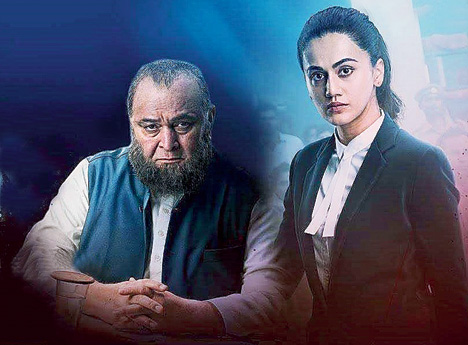

After a landmark romance (Tum Bin) and a superhero biggie (Ra.One), Anubhav Sinha has shifted gears to make the political film Mulk. Starring Rishi Kapoor and Taapsee Pannu, Mulk dwells on Islamophobia and a Muslim family’s struggle to reclaim its lost honour after one of them is branded a terrorist. t2 chatted with Sinha — a staunch critic of right-wing politics — on the August 3 film.
The trailer of Mulk has met with both praise and trolling…
Mostly — about 80 per cent — of the people I’ve met want to watch the film. ‘Emotional’, ‘relevant’, ‘dramatic without being over-the-top’… these are some of the adjectives I’ve heard in the last one week. Of course, there is the 20 per cent who have trolled me — for some of them, I’m anti-Hindu… for some others, I’ve been branded anti-Muslim. Some have said it’s funded by Dawood Ibrahim or the RSS. I just want to say it’s not funded by either… not even by the Congress.
But when you set out to make the film, you must have been prepared for adverse reactions?
Yes, I was. But you still hope (laughs). I knew that when the trailer came out, some people would look for reasons to feel offended and not want this discussion to happen in a healthy environment. But I was never afraid or wary of making this film. I always knew that I wanted to make it.
Mulk is based on true events. Was there a trigger that pushed you to make the film?
I grew up in Benaras, which is a Hindu city, and then I studied at Aligarh Muslim University. Those were the times when communal riots would happen every year, in some city or the other. I happened to see these riots from both sides — from being a majority in Benaras to being a minority in Aligarh. And I realised that most people in both religions didn’t want riots… they wanted to live in peace. I grew up with that realisation.
Over the last few years, some headline or the other has captured my attention. We’ve all written Facebook posts or posted tweets whenever we have felt strongly about something. I realised those tweets I was putting out were not making a difference. So the film is a result of events rooted in my childhood and what’s been happening around us over the last few years.
My theory is that Islamic terrorism, in a very organised manner, has been converted into a brand and marketed. There’s so much afflicting the world and everyone only talks about terrorism because that sells. Malnutrition and poverty don’t sell. The industry of arms will die if there are no wars… so they are in the business of triggering wars. And then, you have oil. You put all three together and develop a brand called Islamic terrorism. I’m not saying terrorism doesn’t exist; of course it does and it’s exceptionally condemnable, but it’s also a concerted campaign.
You have a stellar ensemble cast. What made you pick them?
Taapsee (Pannu, who plays a lawyer) and I had been talking about doing a film together for quite some time. When I wrote Mulk, I bounced off the story with her and she really liked it. She was the first one to read the script. When you write some characters, some faces invariably show up and Chintuji’s (Rishi Kapoor) face just showed up when I wrote the character of Murad Ali Mohammad. I couldn’t think of anyone else in that role. And then, of course, is the cliched answer that the script chose the actors.
Have you made the film you set out to make, or have you had to pull yourself back so that you don’t ruffle any feathers?
I haven’t pulled back at all; otherwise, there would have been no point in making this film. If I had to silence myself, then I would have continued making Bollywood potboilers all my life; I wouldn’t have made Mulk.
But you also have a censor board to contend with…
I have a very sympathetic stance towards our censor board. They have to still abide by the rules of the Cinematograph Act of 1952. Society has changed tremendously and they have to work within the framework of archaic rules… it’s a very tough job for Prasoon (Joshi, CBFC chairman) and his board. They have to go by a book that’s almost redundant now. Then they have to contend with societal and political pressure. I think the chair Prasoon is sitting on is not an easy one.
You engage on a daily basis with social media trolls. Is that really the best way to deal with them?
(Laughs) You know what, two of them actually became my friends at the end of all the trolling! They started off abusing me, but after engaging with them for about two hours, they actually wished me luck for the film. I just have fun with them. In fact, I only feel pity for them because they must be lonely and sad people. So I thought let me create some humour for them… I was basically being an entertainer.
I don’t do this very often though. The negativity does get to me sometimes. On social media, someone once called me a terrorist. That was very offensive. You do get upset, but then you realise after a point that these people are paid to tweet such things.
Are you looking at Mulk changing a few perceptions?
It’s too much to expect that out of a film… it’s a film at the end of the day. But one has seen people getting affected by movies and movie stars. I still have people coming up to say, ‘Because of that scene in Tum Bin, this changed in my life’. Hopefully, Mulk will also mean something to some people.