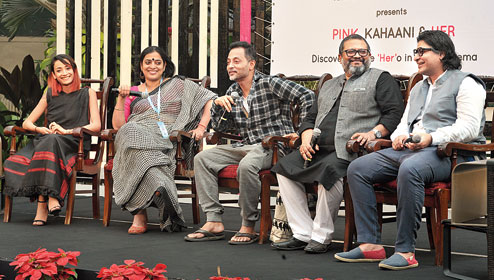

Sujoy Ghosh and Aniruddha Roy Chowdhury have one thing in common — in their films, both make way for women characters who lead from the front. Sujoy and Aniruddha got together at Daga Nikunj on January 27, with Pink actress Andrea Tariang and screenwriter Ritesh Shah, to take part in Pink, Kahaani and Her — Discovering the ‘Her’o in Hindi Cinema. Presented by the Ladies Study Group and Tata Steel Kolkata Literary Meet, the talk moderated by Kalam director Malavika Banerjee was a part of ‘celebrating 50 years of LSG’.
Malavika Banerjee: Sujoy, apart from Kahaani and Kahaani 2, your other films also had characters who had a certain spunk in them. For example, Juhi’s character in Jhankaar Beats had a certain feistiness. Were the women you grew up with like that?
Sujoy Ghosh: Growing up, I was surrounded by women who took care of me, guided me. Who took control of every situation. While making Jhankaar Beats, for me, Juhi was like my Dida who had a huge bunch of keys tied to her anchal. That signified strength. That set of keys has always been there in my head. For me Juhi was the key. There has always been a woman involved in shaping our lives. And that’s how I write. I don’t know if I write it intentionally.
Malavika: From this world to a Hindi film industry where women don’t hold the keys to that universe. How difficult was it to cast Vidya Balan in a film like Kahaani, where she was in almost every frame? How difficult was it to sell that concept to Bollywood and get a producer?
Sujoy: See, we are trying to think of new subjects. Trying to create a new image for cinema. But the sad part is cinema still needs money. It still needs somebody to invest in order to get it made. Rightfully so... when you go to a person with money he’ll tick off some boxes. With Kahaani, none of the boxes were ticked. I almost knocked on everybody’s door with Kahaani. They didn’t give any money to make Kahaani. Ultimately I had to borrow money and make it on my own. After the movie came out, a lot of people came up to me and said, ‘Man, what an ending! Mind-blowing’, and I am thinking, ‘Dude, I narrated the script to you and you refused to give me money’. It was so insignificant for them that they had forgotten the script.
I could make Kahaani because of one woman and that is Vidya Balan. I was then a flop director. She stood by me. And she was the biggest star at that time. I would bug her every day to buy me cigarettes and coffee. She patiently bought me everything. And that’s how we made Kahaani.... We are from middle-class Calcutta families. Nothing comes easy to us. So nobody gave anything to me on a platter. Whatever we did, be it my studies or getting the gas cylinder, it has always been a battle.
Malavika: This brings me to your muse — Vidya Balan. Why is she the go-to person for directors like you?
Sujoy: She has been a friend for a while. Vidya instinctively knows what will excite her, what will encourage her to give her best. She goes for that. She goes with what she believes in. We can only do what we believe in. And then you have people who stand by you and let you do what you believe in, like Vidya. It’s all about taking that one call which may or may not turn out successful.
Malavika: Tony (Aniruddha), what made you do films like Anuranan and Pink which have strong women characters? Have they changed you a bit?
Aniruddha: I studied in South Point and I used to talk a lot in class. So my teacher made me sit among the girls. I used to sit between two girls and I would talk even more! Girls were friendly to me, and I was to them. And all my friends would tell me that I understood women. Anuranan happened like this — one of my friends got married and went for her honeymoon. I went with them. Three of us in Ranikhet. From there the germ of Anuranan came to my mind. A lot of people asked me why I went there. So many things go unnamed. You cannot always name a relationship. There are relationships that go beyond the husband-wife and boyfriend-girlfriend space. I like to make films from my personal experiences.
Coming to Pink, I started noticing a change. You see television and you get to know about the horrible things happening across India. You read the newspapers and become agitated. You feel humiliated as a man. I can’t go out and hit those guys. So I decided to make a film, tell a story. If we keep our eyes and ears open, we can see Pink everywhere.
Malavika: Andrea, what appealed to you about this script?
Andrea Tariang: Initially, I was a bit hesitant... I don’t how to speak the language (Hindi)... but my father told me to go for the auditions. Then Tonyda asked me to meet him at Starbucks, he told me to do a scene. I was so shy but I did it anyway, and almost broke a few cups in between! Being from the Northeast, I was very, very proud to be representing them because there is a lot of talent there.
Malavika: Why did it take decades for women to come and be the ‘her’ in hero? Why did it take so long for these characters to come in?
Ritesh Shah: The market determines what it gets. The moment a lot of women became a part of the workforce and had more flexible income to spend, they became a big ticket-buying audience. Bollywood has warmed up to the idea that there is a huge audience for women-centric films, where women can be heroes. Suddenly these films are successful in the last three-four years. Kahaani, Queen, Dirty Picture, NH 10. There is an audience out there who’ll also determine what they want to see... strong female characters. Pink is a success because of them.
Aniruddha: My mother, jethima, pishima were extremely strong and progressive. A woman’s inner strength is much more than us. People who buy tickets have also started recognising this. That’s the most encouraging part. The mindset is changing.
Malavika: Is it a good time to be an actress?
Andrea: It’s great that women are being put out there instead of a man. Women are stronger than men in many many, many ways. But then I also see that women in general have this tendency to bring each other down. Don’t you agree? Once that stops, and we all get together and work as one, I think that will be a great thing. We all should be one to fight for this.

Pictures: Pabitra Das