 |
 |
| Qubani ka Meetha and Paneer Pasinda; |
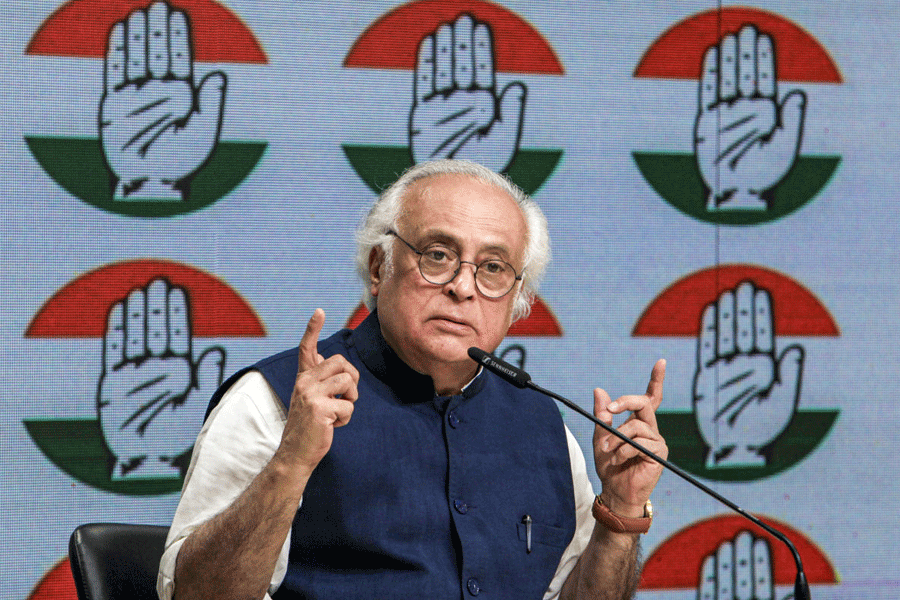
Kunwar Rani Kulsum Begum, consultant chef with the ITC group, is a descendant of the Salar Jung family of Hyderabad married into an Awadhi family. She was in town recently to host Nazakat, a food festival (on till September 23) featuring Nawabi Hyderabadi cuisine at Eden Pavilion, ITC Sonar. t2 caught up with her on the intricacies of the Nawabi food of north and south India.
You said the prime characteristic of Hyderabadi food was that the dishes and recipes were designed consulting the hakim, or the court doctor. What would they recommend?
Well, it was mostly about what was healthy. Say they’d recommend gajar for better eyesight… or nuts for their health benefits. So we’d make halwa and murabbey out of them. They even recommended when to eat them. There were little tips too — like soaking badaam overnight and discarding the skin, because they are warming food and this way they don’t cause stomach upset. They’d recommend the same for mangoes — they can be more cooling if soaked in water. If it is a particularly warming ingredient like meat, you’re supposed to prepare it with dahi (yogurt) to balance it out. They also kept in mind one’s body type when they recommended a certain kind of food and the right time to take it.
 |
Lucknow and Hyderabad: how are the two cuisines different?
The cuisines are different because the climatic conditions are different. Awadh or Lucknow has a Delhi-like weather, with extreme summers and winters. Summers are not just extreme, there’s loo blowing throughout and it’s a very long summer. Hyderabad is more temperate with just two months of incredibly hot summer, after which there’s an even temperature. It never gets too cold either. That made all the difference to the food. Hyderabad, thus, doesn’t have too much of seasonal variety in its food. Lucknow does — they don’t use methi in summer months. They use meetha attar for its khushboo, they use more milk products and sometimes use sarson ka tel, which they don’t in Hyderabad.
Okay, let’s put it this way: Awadhi or Hyderabadi Biryani, which is superior?
(Laughs) That is for you to decide. Only you can judge whose flavour appeals to you more. I can tell you what the differences in cooking techniques are. In the Awadhi style, the meat is cooked like a korma and put on top of the rice. We place uncooked pieces of mutton on the bottom of the pan, then put rice over it and then cook it in dum. This changes the colour of the rice.
The so-called biryani that you get with potatoes is not biryani at all, but tehri. Here the meat is cooked separately, the potatoes are cooked separately... it’s a completely different process.
The use of yogurt in preparing the meats is another key difference.
What about the something as rich as the nihari (a slow-cooked broth)?
Yahan ke nihari mein bhi bahut farq hai. The one in Lucknow used to be made in kadwe tel (mustard oil) and the Hyderabadi in meethe tel (peanut oil or sesame oil). Ours was adapted to our climate, we use different masalas in potlis like the patthar ke phool (kalpasi), which is not used in Lucknow. Our garam masalas are also different.
And the use of souring agents?
Khatar (sourness) thandak laati hai. Souring agents are cooling in nature. Imli or tamarind, or lemons or unripe mangoes or yogurt... even as they sour the food, they are cooling in nature.
How are the desserts different?
They are quite different. The north has more milk-based sweets. Our desserts reflect more of an Iranian and Iraqi influence. They are mostly based on sugar syrup, like Double ka Meetha, or a lot of dry fruits, like the Qubani ka Meetha (soaked apricots in sugar syrup).
Other royal households have brought out books detailing their secret recipes. Do you have any such plans?
No not as yet. Convincing my grandmother to part with 300 recipes was difficult enough! Besides, just knowing the recipes won’t help, as it involves a lot of techniques. If you don’t learn it from someone who knows, it will just not be authentic.
Traditionally these recipes were not shared with the daughters, as they got married into a different family, and shared with the daughter-in-law. I do hope that one of my daughters takes it up though.
What’s your favourite food in this cuisine?
I like sour things. I like chugar. It’s the bud of a tamarind plant that grows just after all the leaves have fallen. That chugar is delicious with fish or chicken. You only get it for a month as the leaves grow soon after. Another favourite is Gosht Ki Resha. It’s cooked beef that is torn off the bone after cooking. It’s lovely with parathas for breakfast.
Malini Banerjee
Pictures by Rashbehari Das
Enjoy the festival between 7pm and 11.45pm at Rs 1,800 (plus taxes) per person.