BEN-HUR 3D (U/A)
Director: Timur Bekmambetov
Cast: Jack Huston, Morgan Freeman, Toby Kebbell, Nazanin Boniadi, Rodrigo Santoro
Running time: 124 minutes

For any filmmaker foolhardy enough to embark on a remake of Ben-Hur, the kitschy 1959 sword-and-sandals epic that captured 11 Oscars and elevated Charlton Heston to Hollywood sainthood, the first order of business is to create a bigger and better version of that movie’s climactic chariot race.
The best thing about the reimagined Ben-Hur, directed by Timur Bekmambetov (Wanted, Abraham Lincoln: Vampire Hunter) from a screenplay by Keith Clarke and John Ridley, is that it delivers a contest as thunderously stirring as any action sequence from the Fast and Furious franchise.
As bodies are trampled and dragged on the track, and squealing horses topple in clouds of dust amid the deafening clamour of amplified hoofbeats, the 10-minute scene powerfully captures the savagery of life-or-death spectacle and the delirium of a mob swooning with blood lust.
To a contemporary audience, conditioned to accept previously unimaginable degrees of screen and television carnage, this Ben-Hur feels disturbingly and appropriately up-to-date. What makes it all the more horrific is the film’s lack of a strong redemptive counternarrative and the absence of even a pretence of holiness. At the very end, it timidly tries to preach a message about revenge and forgiveness, but its heart just isn’t in it. Violence is its calling card.
The contestants — Judah Ben-Hur (Jack Huston), a Jewish prince in Roman-occupied Jerusalem, and his adoptive brother, Messala (Toby Kebbell), who falsely accuses Judah of treason and leaves him to rot on a Roman slave ship — were embodied in the 1959 movie by Charlton Heston and Stephen Boyd. Playing Judah, Heston reached his career pinnacle as a sweaty symbol of virtuous heroic masochism and super-masculine beefcake with a halo.
Years after the movie was released, Gore Vidal, one of the original, uncredited screenwriters, wrote about the gay subtext, suggesting that Boyd’s Messala was Judah’s spurned lover. As you watch it today and notice Boyd hungrily eyeing Heston, it seems clear that the homoerotic overtones were intentional, though Heston furiously denied it. They lent the movie a frisson of sexual tension and a lurking question: What if?
The remake bends over backward to erase any hint of gayness. Instead of childhood friends, Judah and Messala are kindred souls of different faiths, and their dispute, which is barely explained, is purely religious.
There’s a cavernous difference between this film and previous screen adaptations of Lew Wallace’s 1880 novel, Ben Hur: A Tale of the Christ. Earlier iterations camouflaged the brutality under a thick fog of piety. This latest version pays only lip service to the weepy religiosity of the previous adaptations, which include a mini-series, two silent films (including the 1925 blockbuster starring Ramon Novarro), an animated version and the 1959 juggernaut. Here, a handsome, moist-eyed Jesus (Rodrigo Santoro) pops up now and then to mouth nuggets of sage wisdom and compassion to anyone who will listen, but his followers, one of whom is Judah’s sweetheart, Esther (Nazanin Boniadi), are barely noted.
The movie pauses just long enough to observe the Crucifixion, which, like every other biblical element, comes across as a rushed, perfunctory nod to tradition, devoid of emotional or spiritual resonance. The fates of Judah’s mother and sister are treated as items on a checklist of familiar characters to be cited and then forgotten.
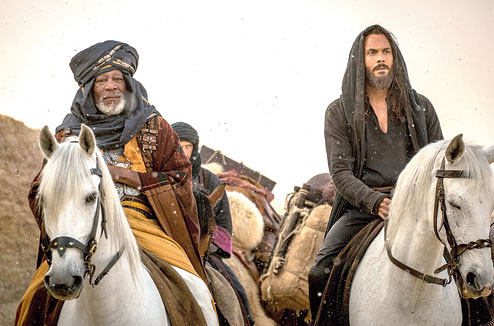
The best-known actor here, Morgan Freeman, coiffed in long grey dreadlocks, plays Sheik Ilderim, a horse trainer, who becomes Judah’s coach and champion as the big day approaches. He also serves as the film’s occasional narrator.
Huston’s performance, however competent, is no match compared with Heston’s heaving, oratorical gravitas, which gave even casual remarks the ring of Scripture declaimed from a mountaintop. If anything, Huston’s Judah is smaller than life.
He seems physically too fragile to withstand the horrors of being shackled on a slave ship where he and his fellow prisoners row to an incessant, booming drumbeat as their captors stand over them with whips. It is in these galley scenes that the new Ben-Hur finally finds its rhythm after a frustratingly long and confusing dramatic setup.
Overseen by a director not known for his human touch and lacking a name star, except for Freeman, Ben-Hur feels like a film made on the cheap, although it looks costly. It needed a star like the Russell Crowe of Gladiator to provide dramatic heft. What is Ben-Hur without a platform of moral grandeur? Not much.