
Photo: Gajanan Dudhalkar
It was an arena where “good” girls never dared venture. But now, as the music blasts out louder than ever, women deejays are boldly moving behind the console and calling the dance-floor moves.
On a Friday night, Delhi’s Summer House Cafe is crammed and buzzing with youthful vibrancy and body heat — the discotheque has zoomed up the popularity charts since Cold Play’s Chris Martin staged an impromptu gig here a few weeks ago. But the dance-floor’s empty until Ma Faiza, a burly woman with a red Mohawk, steps behind the music deck. Suddenly, the dance floor erupts with energy — so much so there’s practically no place to stand, let alone dance. A 20-something frenzied fan is screaming “I love you Ma Faiza” while gyrating to the music as if under a hypnotic spell.
Women deejays? That’s not the doctor, lawyer or engineering profession many Indian parents would want for their daughters — or still want for that matter. “Parents of young girls have reservations about deejaying as they see it as a combination of late-nights, alcohol and drugs,” says Ma Faiza, 44, Africa-born, UK-brought-up and now India-based, who is one of the pioneer woman deejays.
.jpg)
Photo: Rupinder Sharma
She, incidentally, became a deejay by accident. She was selling cassettes of music which she liked in Goa. Many people bought the tapes, loved the selections and started calling her to play at parties and her career was launched. While Ma Faiza was a rare figure in the deejay field back then, now women think nothing of taking the command post behind the console.
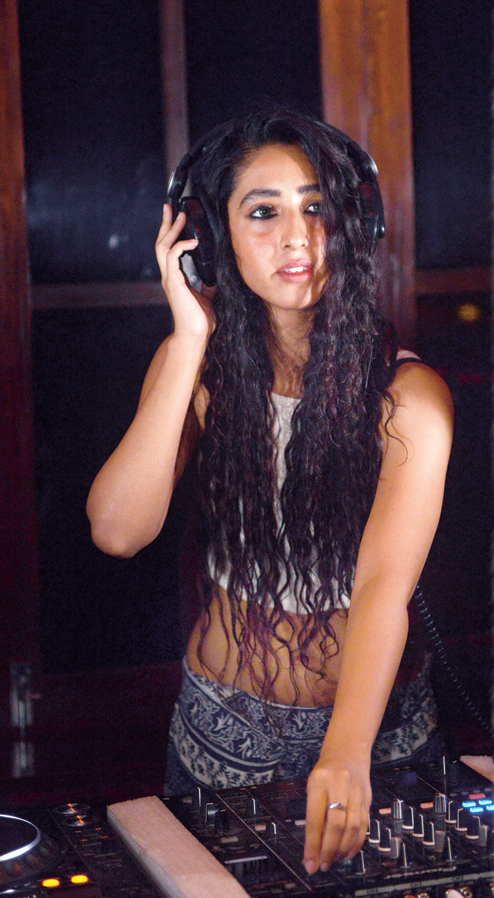
Ma Faiza has been joined by a slew of younger deejay stars like Sanaya Ardeshir, who also plays electronic music under the name Sandunes, and Anastasia, who made her way from Japan, where she was born and raised, to India as she loved the country’s vibe. Others dance to the beat as delicately beautiful Tasnneem Docctoar gets the music going. Docctoar kick-started her career by appearing on MTV India’s reality show Splitsvilla 5. And Mumbai-based Kini Rao is a self-taught deejay, who criss-crosses the country playing in different cities.
But it’s a high-pressure job and women at the console often receive unwelcome attention from boorish men. “Some partygoers are immature and this sort of thing happens,” Anastasia says. Also, with its nocturnal hours, social and family life takes a hit. Docctoar, who’s been performing for 18 months, says: “I can’t even think of being with someone for the next two years as I am so wrapped up with music. I’m constantly digging out music, playing the keyboard.”
.jpg)
But on the plus side, “the audience is politer to women as opposed to men deejays who can be booed down,” Rao says. But apart from that, she says, life as a deejay for a woman is not very different from any other profession. “Pursuing a career in music is equivalent to any other career, artistic or otherwise, such as marketing, advertising, journalism or graphic design. The women-centric challenges are pretty much the same everywhere,” she says.
Adds Rao, who’s played in London, Berlin and Copenhagen: “Skill, dedication and imagination are qualities that are not gender-based. So, everyone’s equal in that aspect.”
Still, few people in the past recognised that deejaying could be an art form but that has changed considerably. “A lot of work goes behind it. You have to understand a place’s vibe and choose songs accordingly. A deejay isn’t a person standing behind the deck pulling one sound after another,” says Docctoar.
And new audiences who have more exposure to diverse sounds are setting the stage for the explosion of women in music — both deejays as well as singers. Ma Faiza, who since her debut has mostly been performing abroad, says she saw the change starting half-a-dozen years ago with a rush of new nightclubs and other hangouts.
.jpg)
Photo: Gajanan Dudhalkar
Ma Faiza has a hard-core fan base that regularly turns up for her events. Bangalore-based Parakram Dutta has attended each of Ma Faiza’s performances since 2007. “She plays psychedelic and progressive trance — something I’ve been following since 2003. Incidentally, she’s also a great human being and great friend,” he says. Dutta, 29, has accumulated a vast amount of Ma Faiza memorabilia, including seven recorded sets.
Ardeshir, who has performed all over India as well as in Europe, the US and Sri Lanka and has a fan following among younger disco and nightclub-goers, says: “People are getting used to the idea of a woman at the deck.” Says electronic music artist and fan Tarana Marwah, 21: “Her music is very thought out and planned and she’s got a wide soundscape (a lot of sounds in her music) which makes for great listening.”
Each of these women deejays have their own styles and tastes they bring to the console. Anastasia, who with mentor and husband deejay Whosane released their first EP called Blockbuster in January, says she loves “testing all genres — techno, commercial, house — you name it.” Rao, on the other hand, sticks to electronic music — mostly house and techno. Docctoar favours the latest genres like new disco, deep house, techno house and techno.
To succeed, female — and male — deejays must be adept at gauging the tastes and mood of the crowds. Docctoar, who fell in love with electronic music when she went to the 2013 Goa Music Festival, says: “I scout out the venue and I plan accordingly. If the venue is rock or grungy, then the music will primarily have dark sounds. If it’s a beautiful, well-lit venue, happy, bouncy numbers are more suited.”

and house
Photo: Jagadeesh NV
Docctoar, who’s played abroad in locales like Dubai as well as to audiences in big Indian cities, starts choosing her numbers a couple of days before each gig. Ardeshir, who plays house, techno and Bollywood, goes more by her gut feel. “There’s a track framework but it’s usually completely improvised. What’s played is based on decisions made in the moment!”
Rao, too, makes instant decisions: “Within the genres, I collect a set of tracks I know will work for me and I play them according to the time and atmosphere. There are some tracks I know I’ll definitely play but I don’t plan any order. I play it all by ear and the party vibe.”
When deejays aren’t making music, they’re checking out newer, fresher sounds or exploring new technology to make the sound better. Many deejays are also producing their original music. Docctoar, for instance, is working on 25 original tracks she aims to produce.
In a country as vast and diversified as India, naturally there are region and city-based tastes. Ma Faiza says there’s a clear north-south divide in music preference. “The north is entrenched in Bollywood. In Bangalore and Hyderabad, people respond well to electronic music while the east loves music in all forms.” And while the bigger cities are more open to different styles of electronic music “the passion, excitement and energy in the smaller cities is awesome”, she says.
Docctoar reckons Bangalore is the most advanced city when it comes to different music followed by Mumbai, while Delhi likes Bollywood a lot.

“In B-towns, Bollywood music is dominant so you have to be a little edgy to grab attention outside their comfort zone,” Anastasia says. She also believes that a deejay can create a vibe. “At a techno gig, for instance, you play a Bollywood track to change the mood,” she says.
Ardeshir, who released an EP, Good To You, in 2013, says: “In metros there’s more exposure and people are open to newer sounds so deejays are ready to take more risks. In smaller cities, you play safe or get unpopular; straightforward music works better.”
And for anybody who might think life as a deejay is a party, it’s actually a tough slog and involves a lot of commitment. “Deejaying needs both hard work as well as time. I’m constantly searching for new music as well as technology to improve it,” says Anastasia. There’s also a learning curve involved. Docctoar learnt mixing and production from Beatworx, Bangalore, and composition theory and keyboard from Tanveer Seghal at Audioqube, Mumbai. She says her study stint helped her get a grasp on the software involved and how to put the music together.
But just technical qualifications are not enough to make a great deejay. Ma Faiza, who has made one
album, Liquid Dreams, with her own music and also 50 CDs of recorded sets from her events, believes playing the music you love is a vital ingredient of success. “Be present in the moment and make eye contact to connect with the crowd. You also need to bring your personality to the music. If you’re playing 20 songs, it’s like combining 20 chapters from different books into one story but you need to have a connection running throughout,” she says.