|
 |
| Mukesh Ambani moved into his $1-billion 27-storey home Antilia (above) |
Are they the running dogs of capitalism or swashbuckling entrepreneurs who put up wodges of cash, take all the risks and keep the wheels of industry turning at a brisk and prosperity-creating pace? Whichever way you look at them, one thing’s for certain — India’s wealthiest plutocrats are definitely not dull dogs. Almost without exception they are larger-than-life
characters who fill out the frame and contribute to the exchequer — and the gaiety of the nation.
Graphiti takes a look at how the country’s super-rich spent 2010 and their mind-boggling riches:
Mukesh Ambani
Once upon a time Mukesh Ambani was the more retiring of the two scions who inherited the Reliance empire. He still likes to stay hidden from the intrusive gaze of the media but the elder of the two battling brothers, who was reckoned to be worth $27 billion at last count, is working hard to make sure nobody forgets just how much he’s worth. He moved into his 27-storey, $1-billion home and promptly ran up a Rs 70 lakh electricity bill in the first month — the lights are always on in this beacon of capitalism.
Perhaps corporate analysts should be devoting more time to figure out why he named the asymmetrically stacked and cantilevered building Antilia after a mythical Atlantic island. Enough has been written about Antilia’s mother-of-pearl floors, its terraced gardens with marble canopies set amidst lotus pools — there’s a bird park too — and its grand ballroom that might have given Louis XIV a few ideas for Versailles. That’s apart from the 50-seater movie theatre and swimming pools, the Krishna temple on the ground floor and Mukesh-bhai’s personal library which stretches out across the top floor.
But don’t worry about the Ambanis overspending. Wife Nita has lately given in to what writer Shobhaa De admiringly called her “practical Gujju housewife” instincts by flying off to Sri Lanka to shop for a 25,000-piece crockery set, trimmed in 22-carat gold and platinum by Japanese porcelain-maker, Noritake. Why Sri Lanka? Because it would cost her some 70-odd per cent less than it would have at Noritake’s Kemp’s Corner store down the road.
Azim Premji
 |
| Wipro’s Azim Premji has set new highs in philanthropy for others to match |
The low-profile chief of Wipro is the poster boy of the Indian billionaire class. He lives a relentlessly modest life-style and it was no different this year. Hold it. That isn’t quite true. He did splurge on an extraordinary scale by donating Rs 8,846 crore or around $2 billion to his Azim Premji Foundation which funds rural education. This drove one commentator to remark admiringly: “That’s classier than building the world’s most expensive residence.” That wasn’t all on the philanthropic front — Premji’s also planning a private university in Bangalore and hopes it’ll help to create a pool of education and development professionals.
Shashikant and Ravikant Ruia
 |
| Shashikant and Ravikant Ruia added to their wealth and became the richest Indian Marwaris |
It’s official. Brothers Shashikant and Ravikant Ruia, owners of the oil-to-power Essar group, are India’s richest Marwaris ahead of the Birlas the Goenkas and other fabulously moneyed families of this trading caste. It doesn’t matter that they mostly speak Tamil at home and breakfast is usually idlis or appams. The Ruias who live as a big joint family didn’t spend the year sitting on their riches. They criss-crossed the globe scouting for places to spend their newly accumulated wealth. The aim is to build an infrastructure conglomerate that straddles the Blue Planet. So they snapped up coal mines in Indonesia, the US and Mozambique and plunked down cash for a stake in the Zimbabwe Iron and Steel Company. And that wasn’t all by any stretch of imagination. They’re planning to prospect for oil and gas in Indonesia and are also in talks to acquire three oil refineries in Europe.
Anil Ambani
 |
| Both Anil Ambani (seen above with mother Kokilaben) and Vedanta’s Anil Agarwal (below) saw their fortunes slip in 2010 |
 |
 |
The Queen of England called it her annus horribilis. Anil Ambani probably hasn’t spent much time learning Latin but he might echo the monarch’s sentiments after an eminently forgettable year. Just a year ago he was in the third spot not far behind his elder brother in the wealth charts. Now he’s slipped to sixth place and his fortune at $13 billion is reckoned to be half the size of his brother’s.
Anil’s still in recovery mode after losing the court case with his brother over gas supplies from the Krishna-Godavari basin. Could it have been a coincidence that he decided to splash out and hold a night of revelry and merrymaking on the same evening when Mukesh was holding a housewarming party for the crème-de-la-crème of Mumbai society at Antilia. Mother Kokilaben had to dash from one party to another. The telecom sector too hasn’t been in the best of health and his Reliance Telecom is feeling the pinch. But he isn’t sitting still. Last heard, he had tied up nearly $17 billion credit to fuel Reliance Power’s ambitious power plans.
Sunil Mittal
The telecom industry’s had a thrill-filled year what with scams and vicious dog-eat-dog competition. But does Sunil Mittal look worried about the future? Not at all. He’s finally patched in a call to Africa after snapping up the Kuwait-based Zain Group’s African assets for an awesome $10.7 billion.
Now Airtel has its ringtone in 16 countries in Africa from Nigeria to Sub-Saharan Burkina Faso — and it’s also become the fifth-largest telecom company in the world, according to Mittal. Helping to integrate the African operations — it’s the second-largest global acquisition ever by an Indian company after Tata Steel’s Corus deal — is Shravin, one of Mittal’s twin sons, who chucked up his job as an analyst at JP Morgan Cazenove in London to join Bharti Airtel International as manager.
Need more evidence of how far Mittal has travelled from his days as a bicycle parts seller? Well, Unilever recently announced that it’ll be inducting Mittal as non-executive director on its global board of directors.
Pallonji Mistry
 |
| Tata Sons’ single-largest shareholder Pallonji Mistry had the unusual distinction of being Ireland’s richest man in 2010 |
If there was a prize for the most reclusive billionaire of them all it’d almost certainly be scooped up by Pallonji Mistry, who’s best known for being the single biggest shareholder of Tata Sons (where he’s also known as the Phantom of Bombay House). Pallonji’s privately held construction company, Shapoorji Pallonji, is thought by corporate observers to be doing well from the building boom in this country. Mistry does have one unusual distinction: he was the richest person in Ireland in 2010 — he became an Irish citizen in 2003 through his Irish-born wife. But the importance of being Pallonji Mistry lies not just in the fact that he comes in as the country’s 12th richest person. It’s that he holds the biggest single stake in Tata Sons — and he’s also the father-in-law of Noel Tata, tipped by many to be the next chief of the Tata empire.
Anil Agarwal
 |
| Sunil Mittal’s Airtel is adding customers in the millions and is also busy conquering Africa |
Anil Agarwal’s ambitions are well-known: he wants to create a giant globe-straddling empire in minerals and metals rather like Brazil’s Rio Tinto Zinc and BHP Billiton. On the credit side of the ledger he’s pulled off a surprise coup and made a bid for Cairn Energy the feisty oil company that struck black gold in Rajasthan. But the debit side of the books is longer. Agarwal has run afoul of activist environment minister Jairam Ramesh and a government-appointed committee which says he shouldn’t be allowed to mine bauxite in Orissa’s Niyamgiri Hills (Agarwal says he can make the world’s cheapest aluminium if he’s allowed to mine there). A court’s also struck down his proposal to acquire tracts of land to set up the Vedanta University in Orissa. And it became clear that Agarwal was out of favour with the powers that be when Rahul Gandhi took aim at Vedanta’s alumina refinery for flouting norms.
Shiv Nadar
 |
 |
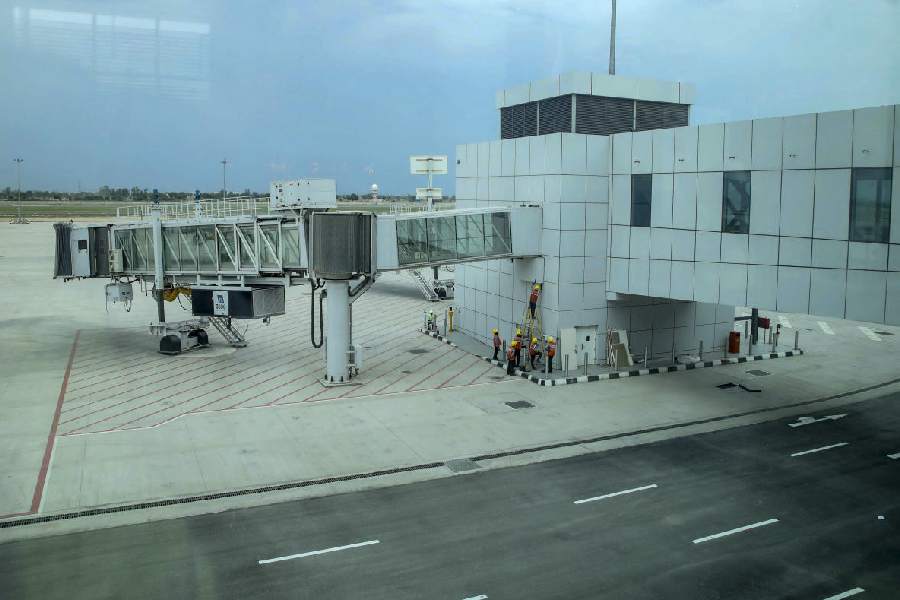
| Kalanithi Maran’s flying high after buying Spicejet and scoring a superhit with Rajnikanth’s Endhiran; (above) G. M. Rao’s ambitious Terminal 3 at Delhi airport is facing the public test |
Shiv Nadar is one more tech billionaire who, after conquering the world, is now turning to philanthropy and art and the finer things of life. Early in 2010, the art world was agog over his purchase of a work by superstar artist Anish Kapoor. The work is now a star item in his wife’s Kiran Nadar Museum of Art.
Nadar believes in running social enterprises — he spends about 40 per cent of his time on them — like business organisations. And he isn’t afraid to think big. So the Rs 600-crore Shiv Nadar University, spread over 270 acres in Greater Noida, is slated to open its doors in July 2011. He’s also splashed out big-time by donating Rs 580 crore to his Shiv Nadar Foundation (it’s building free residential schools in rural Uttar Pradesh, among other things) by selling about 2.5 per cent of his stake in HCL Technologies. Looking into the future, he’s promised to donate 10 per cent of his wealth for his philanthropic ventures — and no, he didn’t have to be prodded by Bill Gates or Warren Buffet to do this.
Kalanithi Maran
The Dravida Munnetra Kazhagam (DMK) party may be under a cloud in the aftermath of the 2G scam but M. Karunanidhi’s grand-nephew and media baron, Kalanithi Maran, made sure the sun continued to shine on his business empire in 2010. His ambitions took fresh wing when he splurged some Rs 750 crore to acquire a controlling stake in low-cost airline SpiceJet. Then, his Sun Pictures hit the sweet spot when he made a winning bet on the Rs 160-crore Rajnikanth-starrer Endhiran or Robot.
The sun spots are bound to flare up further as the first family of Tamil Nadu politics orbits into election mode next year. Will it be Kanimozhi versus Kalanithi’s younger brother Dayanithi? Kalaignar TV (the channel promoted by the Karunanidhi family) versus Sun Network? Watch out for the action on screen and off.
G.M. Rao
 |
| HCL Technologies’s Shiv Nadar gives lots of time and money to his social enterprises |
G. M. Rao was definitely far ahead of the curve. Long before his peers, the low-key businessman from Andhra Pradesh figured out that India’s future lay in building super-smooth highways, bigger and better airports and giant power stations. But this year, Rao’s GMR Group faced its biggest and highly public test. It had to complete the long-awaited New Delhi airport in time for the Commonwealth Games. Reactions to the new airport have been mixed. While it’s large with plenty of room for the millions flying in and out of India, its design isn’t really cutting-edge. Critics suggest that Rao could have taken a few quick flights to Singapore, Hong Kong and even Beijing to get an idea of what the airport of the 21st century should look like.