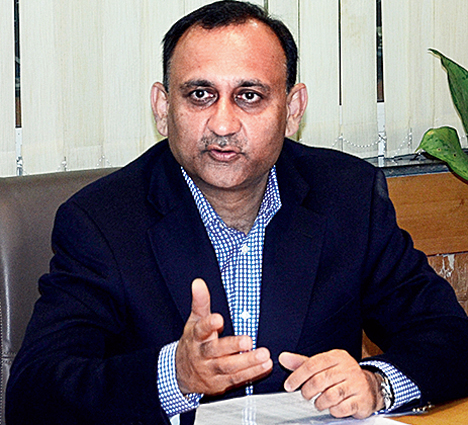

I HAD ALWAYS WANTED TO BE AN ACTOR
When I was young, we had a very large joint family… my father was a jeweller… right back to my great great grandfather, all of them were jewellers. So I am a fifth generation jeweller. During the Seventies Naxalite movement, most of the family left, there was an exodus from Calcutta… by 1979 most of the family had exited and moved to different parts of the world. The condition was not very good in Calcutta… the great depression and everything… so there were mixed emotions growing up.
In those years there were many ups and downs, then my father died in 1985… I had just come back from boarding school, St. Paul’s Darjeeling. The whole company was in a financial mess… I was confused about what I wanted to do.
I actually had wanted to act, I wanted to get into the movies… I was a huge theatre buff… even in school I was into elocution and drama and all that. So I took it for granted that I would be in the acting space. I was very passionate about acting. I had learnt to play the sitar for 17 years, so I was into classical music. Then suddenly my father passed away and my whole world crashed in front of me.
For a brief stint I went to look at clothes, because I was in the creative sphere, so I thought I would do clothes. I went and worked in a menswear factory, making shirts. Then I went to Hong Kong to work for a jewellery company, in a factory in Hung Hom. They paid me $200 a month, which was nothing. But for the first time I looked at international jewellery, and that’s when I honed my sensibility, of interacting with stones, playing with them, feeling my way.
Then I made a trip to Europe, to look around. I went to Paris, spent some time looking at the beautiful stores over there. That’s when I kind of knew that there was something calling out to me, that my real thing was coming back to jewellery in India, so that’s when I came back. Very briefly I went to Bombay, to learn diamonds. Then in 1990-91 I left for Europe, to go and set up this company called Solitaire, in Belgium. I lived there for nine years. This was a company we set up to deal in diamonds, basically buying rough diamonds, sending them to India for cutting, then importing cut diamonds from India and selling them to factories all over the world…. That’s where I saw the most beautiful jewellery. Then something within me was crying out to come back… that creative side, where I could sit down and create jewellery…. So in 2000 I came back to India and started my label in 2001.
The store was set up by my great grandfather, this particular store has been there since 1914, before that we were across the road where Moulin Rogue is now, from 1880 to 1914. We had a branch in Japan and one in Lucknow… those went when the family separated.
 I HAVE GROWN UP SEEING BEAUTIFUL JEWELLERY
I remember my grandmother had very beautiful jewellery… I didn’t see much of her, I was very young when she died, my mother used to tell me stories about her jewellery. My mother, my chachis, my other aunts inherited it… we were a very large family, so it got distributed.
Growing up I remember seeing the chic, elegant ladies of Calcutta… when I used to come home from boarding school for the winters. So Calcutta is where fashion started, in the ’50s and ’60s… I still remember the elegance of the bouffant, the chiffon saris, the beautiful jewellery you saw floating around in Calcutta society… people wore those with so much style. Calcutta sort of honed my sensibilities and then I was let loose into the world. I went to Bombay and saw jewellery there, then Hong Kong, then Europe… so I had done a full circle.
I HAD TO CREATE THE RAJ MAHTANI LOOK
I never had any formal education in jewellery, I never went to an institute. So I learnt my craft on the ground, looking at stuff, feeling my way around. I used to look at shops wherever I went, I used to visit the jewellery factories in Italy.
There I was exposed to a lot of modernity, in terms of clothes, in terms of style, even jewellery. And in India we made such beautiful traditional old-world stuff. So I had to put two and two together, what was really on my mind was how do I bring the two together to arrive at something new, because at every point in life you are looking for something new, the world is looking for something new. And I really wanted a USP.
By then my sensibilities were developed, and I was anyway very good at sketching, so even during my formative years in Calcutta, I saw that Satramdas Dhalamal was making jewellery for the Bengali bhadralok and society ladies; quite European, very English sort of feel. If you see a picture of our store on Park Street then, the store also looked very European.
I really give a lot of credit to that period when we grew up in Calcutta, I think no other city was like Calcutta growing up in the ’60s and ’70s. The romance of that period was so magical… it shaped me in a certain kind of way and made me the person that I became.
On coming back from Europe I knew I had to do something new, so the first thing I did was to revamp the store. I did it up in all white, because I was so influenced by the stores in Europe. My mind was buzzing with ideas. I would take old traditional jadau pieces and blend it with the gold, my entire collection was in dull gold, to create a heritage look, which became the iconic Raj Mahtani look. Then I started exporting them to Dubai and from there it went to the rest of the world through this one company. So I started taking these old designs, twisting and tweaking them around to arrive at something very modern. So it would be telling very contemporary stories using old traditional elements.
I was hugely inspired by the Ottoman Empire, the Regency period, the Mughal Islamic motifs, and I realised I could take those motifs and use them in Indian jewellery. To make them more contemporary yet traditional, but not ethnic. Every woman I would meet would say that their wedding jewellery was lying in the locker, so I thought, why would you buy jewellery and not wear it? That set off that thought in my head that I needed to contemporise it. I started this revolution of contemporising jadau jewellery; that’s what I am known for around the country. A lot of jewellers all over the country today recognise and respect the work we have done with jadau. A lot of jewellers come to us for their family weddings, that’s a huge compliment.
Coming from a traditional background, being very artistic and having moved out to Europe for a few years led me to design jewellery that were so modern yet steeped in tradition. Women started loving the jewellery. I knew I had stumbled upon something new. Then I started experimenting with these big stones, very baroque. I kind of mastered it and came to be known for that look. It was a completely new style that I developed and I gave it to the country. Then it became a challenge to me, to use very traditional Indian elements, like the meenakari, the Bengali taar er kaaj, the filigree, and put them along with diamonds and gold, to arrive at this explosion of design. But all of this within a very tight framework, to have a common thread running through my work, like all artists have. To set a particular design sensibility that would be known as mine.
The body of work that we bring to the table is iconic. My single biggest achievement has been taking the traditional aspects of jewellery and modernising them.

PRITI PAUL’S WEDDING WAS MY FIRST BIG BREAK
One of my very first clients was this European lady who had gone back to Europe, a French lady who came to India and bought my jewellery. Then I did a few weddings, I did jewellery for the Ranbaxy family. My first big wedding was Priti Paul’s wedding. She gave me a complete free hand to interpret her jewellery on every occasion of the wedding and I have still kept her wedding card with me as a special memento. I had to dress her up for the morning, the afternoon and the evening, so that gave me total freedom. We arrived at something so exotic, because it was Moroccan, yet it was Indian, yet it was international… it was a truly luxurious experience.
That was the first luxurious tryst I had… because it was Raj Mahtani with a different designer for every occasion; Rohit Bal with Raj Mahtani, then Tarun Tahiliani with Raj Mahtani, then an international designer… I saw my jewellery come alive on a different canvas, which gave me a new perspective. And I knew my dream was coming true. Priti made it a defining moment for me for the sheer volume of work I did for her. That gave me a lot of recognition.

ALL IMPORTANT FAMILIES OF CALCUTTA HAVE SUPPORTED ME
I think Neeta really loves my designs, she is very appreciative and she always tells me, ‘Raj your stuff is very different’. She is very encouraging. She likes the chunkiness, the volume, the fact that it is very different. She is also very experimental with her style, the way she has groomed herself and changed herself over the years is remarkable. She was always beautiful, but she has transformed herself, to someone who is casually chic. She loves everything that is unique and appreciates the fact that I am very original.
A long time back at her birthday party she asked me to do a show with Tarun. There were about 450 people at the party, and we brought in Shah Rukh Khan’s birthday. All the people there were stumped with the jewellery; that was a huge boost, a defining moment.
A lot of the families have been coming here, but I don’t want to be guilty of names-dropping. All important families of Calcutta have supported us. I am truly humbled and appreciative of all the support I have got from these people, because to build a brand you need support.
I WANT TO SHOCK PEOPLE OUT OF THEIR STUPOR IN DESIGN
It’s a huge challenge to be a jewellery designer in this country for two reasons. First, a jewellery designer by profession is usually somebody who has been to a design school and has studied accessory design; there are not many schools teaching you jewellery design in this country. It’s a very nascent thing, it’s not like there’s years of experience in this. And somehow because we come from middle-class or upper middle-class families by and large, we don’t have the luxuries of looking at jewellery. You will see clothes, but you won’t walk into a store to see jewellery.
The second challenge is to keep reinventing yourself and doing something new. I will show you how I am reinventing myself.
[Raj brings out some new out-of-the-box pieces he has done. An innovation called ‘Serpentine’ bracelets with precious stones, to go round the wrist; a line of ‘Floaters’ for the neck and wrist, in gold and table-cut solitaire diamonds.]
This year at The India Story [the annual exposition at Swabhumi] this is what I am showing; the starting point is Rs 70-80,000. So this is how I keep reinventing. I have taken the very traditional elements but just look at the end result. You can wear it with a dress and wear it anywhere in the world. Sometimes I do go through this design fatigue in my head and then I hit upon something. Then I get into it with full gusto and end up spending a lot of money on it (laughs)… I feel this design development is very, very important for a designer.
Like now I am coming out with a completely new look — a new cut, with diamond, emeralds and ruby… to shock people out of their stupor in design. For people who are thinking Raj Mahtani has been there and done that. Because people think Raj Mahtani can only do uncut stones, so I am doing cuts like no one else can. Nowhere have you seen this kind of jewellery. I am going to shock them with this collection; it’s a different level of luxury. The whole meaning of luxury is how you keep redefining yourself; you realise there’s a new world to be explored.

I OWE MY TALENT AND SENSIBILITY TO CALCUTTA
The pluses of being in Calcutta outweigh the minuses. Coming from Calcutta, which is such a culturally rich city, from the heritage to the architecture, the art to the music scene, it’s quite unlike any other city in the country. So for me, years and years and years of attending the Dover Lane Music Conference, or to know all the classical music instruments is Calcutta. I think we have been sort of left in a very certain kind of way, untouched to a large extent, which I think is wonderful. A lot of people might think we have been segregated or left behind, but that’s not true.
I think it’s wonderful to leave certain things as they are, there’s a certain romance, a certain beauty in leaving things as they are. I don’t see why everything has to develop with equal gusto all over the country and sort of compete to look the same. And honestly, to be able to amble down Park Street, walk through the stores, and stop for a cup of tea and pastry and then move on, is so much more refreshing than walking into an air-conditioned mall and walking up and down the escalator.
Professionally, the pluses are that we have such good labour here, the Bengali craftsmen are the best in the country. These are the only people that create beautiful jewellery, they have art in their veins… so it’s very easy to push them in a certain direction.
The minuses of course may be that Calcutta is not as much exposed as the rest of the country, and because we are in the east, we are out of the Bombay-Delhi sort of reckoning… even the physical distance… so there’s that limitation. But I also think that has become the advantage, because it lets you be.
I almost think of Calcutta like Florence… like Rome and Milan are a different kind, but when you want that extra thing you would go to Florence, for your mind, for therapy for your soul… it’s an experience to exist in Florence. I think Calcutta has that ability. If we in Calcutta stop being obsessed about breaking down everything and building malls, that’s what gives you the strength of character being from Calcutta and that’s why you see so much talent coming out of Calcutta.
For me, I really owe that talent, that sensibility to Calcutta. The minute you say you’re from Calcutta, a certain intellectualism comes through and I just love that.

JEWELLERY SHOULD WALK THE FASHION WAY
Subconsciously I have always wanted to do clothes, but I haven’t had the time; also I don’t have the technical knowledge to do clothes. But I do influence people to do clothes… say if I am sitting with Manish (Malhotra) I will tell him why don’t you do this… or if I am sitting with Anamika (Khanna) I would bounce off ideas.
I have come to the realisation that jewellery without the appropriate clothes and clothes without jewellery do not make that luxury statement. If you want to belong to the couture luxury space you need both. And fortunately I have worked with the best in the country… Rohit Bal, Tarun, Anamika… and I am very fortunate that they are fond of me. Tarun I have worked with for almost the last 15 years. I have had the good fortune of them trusting me completely and giving me the freedom to showcase my work, and giving me the respect to share stage with them. No other jeweller walks on the ramp with designers in their shows.
Internationally, I have worked with Diane van Furstenburg, with Roberto Cavalli… so I have worked with the best. I also feel that being a part of the fashion industry excites me; I have always felt that jewellery should walk the fashion way.
WE ARE EXPANDING
My Bombay store is up and running, but we haven’t had a formal launch. Next we are planning a store in Delhi and I am re-doing my store in Calcutta. The two stores I would love to have are in Hong Kong and New York.
Our Bombay store [in Kemps Corner] is like a museum of modern art… it’s a beautiful store, like a private salon. It’s not intimidating at all, very intimate, it allows you to be. With each store we are putting in a lot of thought about how it will be and the content we are going to keep. So each store will be an experience. The stores will go by the name of Raj Mahtani, we are changing the name of the Calcutta store too, though it will have a Satramdas Dhalamal section.

My Muse
I’ve always wanted to dress Madonna, because of her free spirit, how she is as a person. She’s not somebody very young, but I am very intrigued by her mind, how she’s dressed in the past, so the possibilities are immense. She’s iconic, her songs are iconic. For me she would be a muse to reinvent.
My stone
Diamond. Because it’s colourless it gives me the power to control other colours. Diamond is a very powerful stone.
My it piece
The necklace... the Raj Mahtani necklace is iconic. For me a necklace changes the way a woman looks.
My Black
I work with so much of colour all the time that I am able to get clarity if I have black as a background. That’s why I mostly wear black. It sets the tone for me to see all the other colours properly.
My brands
I am not a huge brand person. Tom Ford for jackets, Prada for shoes, T-shirts from Uniqlo... I love their heat-tech and super-dry tees; what I love about their brand is that they don’t plonk their logos everywhere.
My music
I am into four or five genres of music. I played the sitar, so I love classical Indian and western music. I go into a dreamy mood when I am listening to bass music or when I
am listening to the old hits from the ’50s or ’60s, the saxophone... jazz.... Right now I am also crazy about house music
My film
Gone with the Wind.
My Book
The Fountainhead by Ayn Rand.
My food
I love Chinese food and I love my home-cooked Indian food.
My luxury
Going back home to my mom, who welcomes me back every single day and waits to have dinner with me. She turns 90 next year. Everything that my mother cooks for me is true luxury.