
Depending on where in India we were this summer, most of us have been roasted, charred, or steamed. Now, as the rains are upon us, the summer season, also known as the tourist season, has just begun in Ladakh, one of the highest and driest regions on planet Earth. But, to paraphrase Antoine de Saint-Exupery a little, what makes this ‘desert’ beautiful is that somewhere it hides a lake. Quite a few, to be precise.
Our 154-km drive from Leh in the heart of Ladakh to reach Pangong Tso, the most popular of Ladakhi high-altitude lakes, includes crossing the Chang La, or the Chang Pass. At 17,586ft, it is one of the world’s highest motorable passes, on the heels of Khardung La (18,380ft).
A couple of hours after Chang La, fat, furry animals start popping up from the long stretch of green grassland along the roadside. Beady-eyed and buck-toothed, the marmots, for that is what these giant squirrels are called, are quite aware of their popularity with tourists. One even sits on its haunches and poses for a shot.
.jpg)
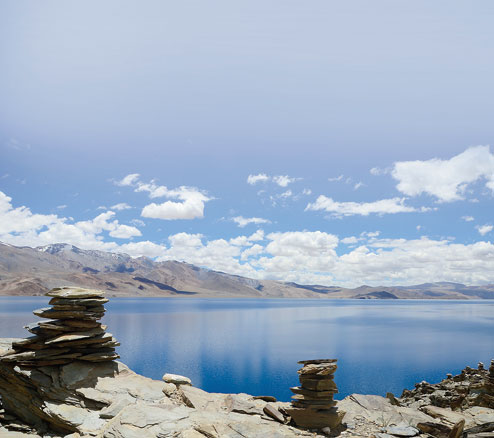
Barren mountains in shades of beige, brown and purple part like stage curtains to reveal a molten jewel. In late afternoon light, Pangong Tso, tso being the word for “lake” in Ladakhi, is a deep cobalt. Even as we watch, the water changes colour. It’s now ultramarine blue in the distance, reflecting the burnt sienna of the barren ranges. Nearer the shore, the shades change to a cerulean blue.
The Tibetans call it Banggong Co, or the “long, narrow, enchanted lake”. Ladakh holds a third of the 134-km long Pangong. The rest is in China-occupied Tibet.
Given Pangong’s popularity, tiny home-stays have sprouted at both Lukung and Spangmik villages. But even though the nights are cold at 13,900ft we choose a tent at Spangmik for our stay as it’s closer to the lake.
At night, the mountains are eerie silhouettes in the light of a quarter moon. A freezing wind turns the short walk to the dining tent into a fast trot.
At first light, tourists are out by the lake. A bird with a tiny pair of black horns keeps watch and a brown-headed gull swoops down to the water to rise again with a silver fish.

READY RECKONER
♦ How to get there: You can drive to Leh from either Srinagar or Manali (HPTDC runs semi-deluxe buses from Manali). A number of airlines fly to Leh from Delhi.
♦ Where to stay: Leh has hotels for all budgets. Near Pangong Tso, Lukung and Spangmik villages have home or tent stays. So does Korzok village by Tso Moriri.
♦ What to see: Hemis monastery, Thiksey monastery, Shey Palace, Pangong Tso, Korzok monastery, Tso Moriri, Tso Kar.
The sun’s rays dance on the waves like a thousand little diamonds and just under the crystal-clear water, the pebbles are delightfully multi-coloured. So are the souvenirs we pick up from the Army’s little shop at Lukung as we retrace our route to Leh.
The Tso Moriri Wetland Conservation Reserve is around 250 km from Leh. It’s a long, scenic journey, with a tea break at Upshi, and a lunch break at Chumathang. We skip the hot spring at Chumathang, pausing instead to marvel at Tso Kiagar. It’s a small lake ignored by tourists, but nevertheless holds the reflection of a snow-covered mountain.
Tso Moriri (15,075 feet) is the largest high-altitude lake in the Trans-Himalayan region. Its proximity to the Indo-Tibetan border is marked by the sentry post at Korzok, a village by the lake. There aren’t many tourists and the lake and the adjoining marshland belong to bar-headed geese, brahminy shelducks and gulls.
The flowering meadow stretching to the lake covers labyrinthine colonies of mouse hare. Their presence underground is given away by neat round holes peppering the grass. The inmates pop in and out constantly.
.jpg)
.jpg)
Above ground, living facilities for travellers are basic. We put up in a tent again. The toilets are common to all, and 20 steps away from the rows of tents. It seems 20 miles at night, as the freezing wind tries to slice my nose off my face. The wind howls all night, sneaking in through tent corners.
The morning sun brings relief.
On the mountain slopes, a Changpa nomad boy herds sheep and the narrow village paths smell of dry dung. In the 400-year-old Korzok monastery, the statue of Shakyamuni Buddha catches a sliver of the morning light and gleams. Strange masks hang from the walls.
Outside, the lake sparkles. Thousands of flowers in the meadow wave their yellow, purple and white heads. We cannot help crushing some underfoot and, in return, they smear our sneakers with fragrance.
Returning to Leh, we do not follow the River Indus, but drive past the Tso Kar, or the “White Lake”, at 15,280ft which is 50km from Tso Moriri. The shores of the river leading us to the lake are covered with a white, fine grain. These are salt deposits, explains our driver. In Ladakhi, karra means salt. Hence, the name Tso Kar, or White Lake. Khampa nomads, local herdsmen who graze cattle and yak, earlier exported this salt to Tibet.
The area around Tso Kar, known as More Plains, is a haven for birdwatchers and ibex; snow foxes and snow leopards live in the surrounding hills. We spot a herd of Kiang, the Tibetan wild ass. I desperately crawl behind a pair of Tibetan Sand Grouse and finally manage to capture them on my camera.
We halt at a tea stall by the lake that has yak hair hanging from the stone walls, and the skull of a sheep with arching horns tied to a post. From the flowering, fragrant shores of Tso Moriri, akin to the Lake Districts, we have transitioned to a Wild West ambience. Suddenly, it’s clear why the Khampa nomads were also called Chinese cowboys. But on this sunny morning, their horses don’t throw up a dust storm.
Instead, one of their clan now app-roaches us with a smile, and two cups of sugary black tea.
Photographs by author