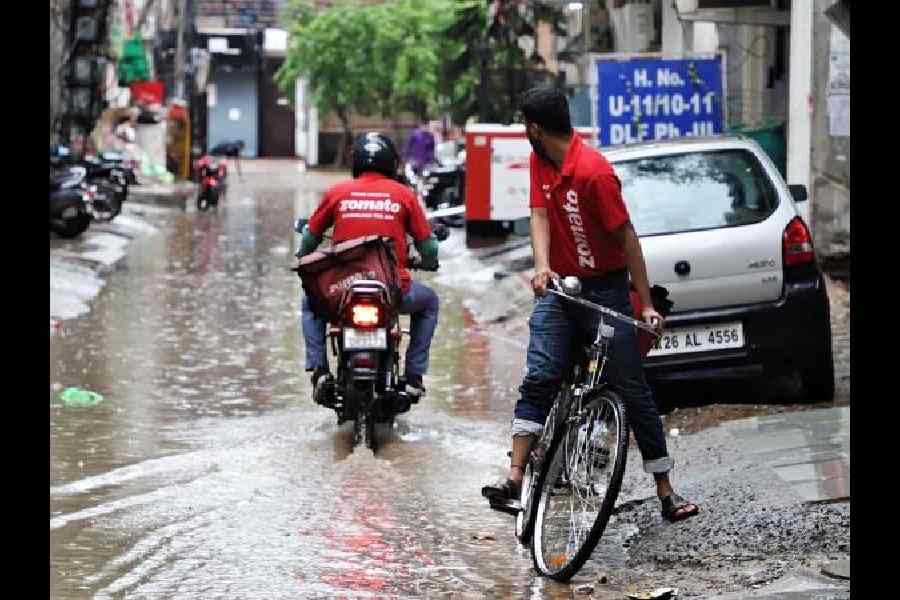
The debate over earnings and working conditions of delivery partners in India’s fast-growing food delivery and quick commerce sectors has intensified, with Zomato CEO Deepinder Goyal’s defence of the company’s gig work model drawing sharp criticism from the Telangana Gig and Platform Workers Association (TGPWA), which has termed the prevailing conditions as “not decent work”.
In a post on social media platform X, Goyal said delivery partners on Zomato earned an average of ₹102 per hour in 2025, up 10.9 per cent from ₹92 in 2024, with the metric showing steady growth over a longer period. He clarified that the earnings-per-hour calculation includes the total time logged in on the platform, including waiting time between orders.
Goyal said delivery partners have the flexibility to choose their working hours, retain 100 per cent of customer tips and are not pressured into unsafe driving by 10-minute delivery promises. He added that the average driving speed for Blinkit orders is estimated at 16 kmph and 21 kmph for Zomato orders.
On social security, Goyal said Zomato and Blinkit spent about ₹100 crore on insurance coverage for delivery partners in 2025. He added that the companies also provide other support measures, including a two-day period of rest for women delivery partners, assistance with income tax filing and access to a gig-variant of the National Pension System (NPS).
“Now tell me, is this unfair? Especially for an unskilled job, which is largely part-time and has zero barriers to entry,” Goyal posted on X.
Counter-claim
The Telangana Gig and Platform Workers Association, however, disputed the company’s claims, arguing that once costs such as fuel and vehicle maintenance are factored in, net earnings work out to about ₹81 per hour. This, the association said, translates to roughly ₹21,000 a month for a delivery partner working 10 hours a day for 26 days.
The association said delivery partners do not receive paid leave, accident insurance cover or provident fund (PF) benefits. On the issue of quick commerce delivery timelines, it argued that while platforms may claim not to pressure workers, ratings, penalties and the fear of losing orders significantly influence delivery behaviour rather than official speed data.
It also flagged low tipping levels, stating that tips amount to just about ₹2.6 per hour, with only around 5 per cent of orders receiving tips. “This is not decent work,” the association said.