Tariff tantrums
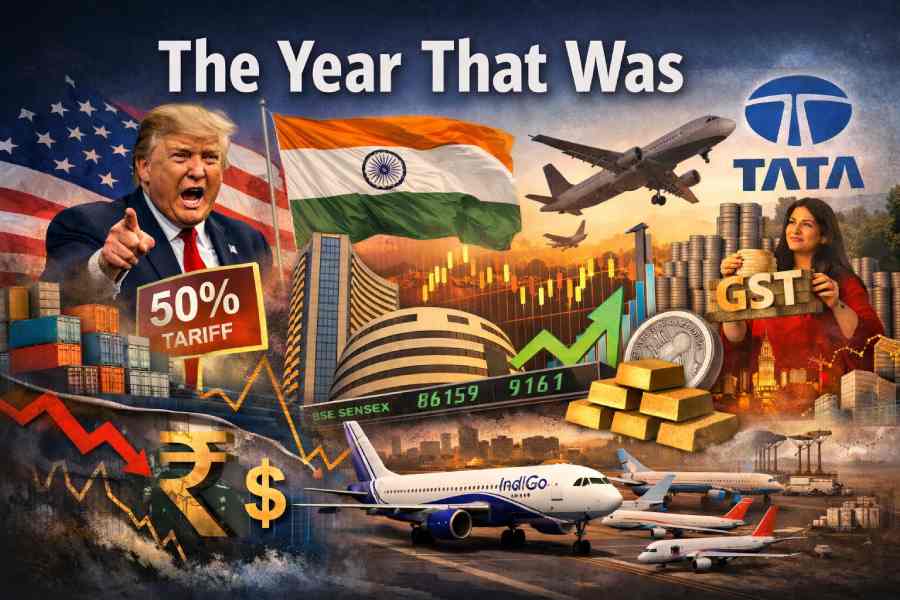
US President Donald Trump upended global commerce on April 4 when he imposed sweeping “reciprocal” tariffs on dozens of countries, an audacious attempt to shrink America’s widening trade deficit that has redrawn the contours of international economic policy.
India has been the hardest hit, with a punitive 50 per cent duty applied from August 27 on more than half of its goods exports to the US.
Despite half a dozen rounds of negotiations, three leader-level calls post tariff hike and a series of missed deadlines, a bilateral trade deal remains out of reach. The stalemate has cast a long shadow over labour-intensive sectors — including textiles, fisheries and leather — where livelihoods are increasingly at risk.
The uncertainty has also weighed on financial markets, leaving the rupee the weakest performer among emerging-market currencies against the dollar.
Rupee Record
In 2025, the Indian rupee weakened sharply against the US dollar, breaching historic levels of 91 per dollar on December 16, marking its weakest performance ever amid sustained depreciation pressures.
Over the past year, the rupee has changed by over 5 per cent, trading within a 52-week range of 83.76 to 91.08.
The fall was driven by persistent foreign portfolio outflows as investors sought safer assets abroad, a widening trade deficit with strong demand for dollars for import bills, stalled US-India trade negotiations that dented sentiment, and heavy import demand, including energy and bullion.
For the economy, a weaker rupee increases the cost of imports, fuelling inflationary pressures and higher costs for foreign travel, education and imported goods, though it can slightly boost exports.
Looking to 2026, with global monetary easing, fiscal support and potential trade progress, the rupee could stabilise or strengthen modestly, though volatility will persist if risks remain.
Trade Ties
While the US remains conspicuously absent from India’s trade roster, New Delhi notched up three free trade agreements over the past year and accelerated negotiations on several others.
In addition to Oman, India clinched accords with the UK — the most economically significant of the trio — and with New Zealand in the final weeks of the year.
None has yet taken effect, with each deal awaiting domestic regulatory clearances, though officials expect them to be operational in 2026.
The agreements promise wider market access for Indian exporters and, in Oman and New Zealand’s case, improved mobility for skilled professionals.
Urban consumers stand to benefit from cheaper Scotch whisky, New Zealand wines and meat. Industry, meanwhile, hopes 2026 will finally deliver long-sought deals with both the US and the EU.
Metal shine
Gold and silver have surged to record highs in both global markets and India, driven by safe-haven demand amid geopolitical tensions, expectations of interest-rate cuts, currency volatility and central bank buying.
Globally, gold has crossed historic levels above $4,500 per ounce and silver above $77 per ounce.
In India, bullion prices have smashed records with spot gold around ₹1.37 lakh per 10 gm and silver exceeding ₹2.2 lakh per kg on the MCX on December 25 against ₹76,244 per 10 gm and ₹85,694 per kg, respectively, on January 1, 2025.
For buyers, the rally meant higher costs for jewellery, potentially dampening retail demand even as investors sought bullion as a hedge against market volatility. The surge also impacts import bills and the trade balance in India.
Looking ahead to 2026, most analysts expect continued strength in precious metals if global uncertainties persist — but prices may fluctuate with changes in monetary policy, macroeconomic data and supply-demand dynamics. Silver’s industrial demand and gold’s safe-haven appeal could keep markets buoyant, though corrections remain possible.
Rare-earth quake
China’s dominance of rare earth materials, controlling 90 per cent of processing capacity and export licensing, has tightened global supply chains and exposed India’s dependence on Chinese imports for critical components like rare-earth magnets used in electric vehicles, electronics and clean-tech industries.
Export curbs in 2025 disrupted India’s automotive and EV supply chains, raising production costs.
Faced with this vulnerability, the Indian government moved to reduce reliance on China by approving a ₹7,280 crore plan to boost domestic rare-earth magnet production, aiming to establish an annual capacity of about 6,000 tonnes.
Markets peak
In 2025, Indian equity markets delivered a strong performance with the BSE Sensex and Nifty 50 touching record intraday highs of 86159 and 26325, respectively, on December 1, reflecting high domestic investor confidence underpinned by easing inflation, monetary support and optimism around economic growth.
However, the 52-week range for India VIX was between 8.8625 to 23.1875, reflecting high volatility.
Analysts forecast continued momentum in 2026 with many projecting further gains as private capital expenditure gains momentum, corporate earnings recover and structural reforms deepen market appeal. But volatility and global risks are worry points.
Sebi steps
In 2025, Sebi introduced several major reforms to modernise India’s capital markets, strengthen governance and boost investor confidence. Key changes include an overhaul of the stockbroker regulations to simplify compliance and reduce regulatory burden, revised mutual fund regulations with clearer fee structures and streamlined IPO norms with shorter prospectus requirements to encourage listings.
Sebi also expanded its frameworks to attract foreign investors through simplified registration and the new SWAGAT-FI single-window framework, and enhanced governance and transparency standards for market infrastructure institutions.
Legislative proposals like the Securities Markets Code Bill, 2025, aim to further broaden Sebi’s powers, increase its board size and improve oversight. Other initiatives focus on technology oversight and quicker investor grievance resolution.
Reform momentum
In 2025, India implemented wide-ranging tax and economic reforms to simplify taxation, boost demand and attract investment. There was a major overhaul of GST, rationalising multiple slabs into primarily two rates — 5 and 18 per cent (with a higher demerit rate for select goods) and removing the compensation cess while easing compliance.
Essentials such as household goods, healthcare items and some services now attract lower or nil GST, like insurance.
On the direct tax side, significant income tax relief was announced in the Union Budget. Under the new tax regime, salaried individuals earning up to ₹12.75 lakh annually will pay no tax due to a higher rebate threshold and higher standard deduction.
The revision was aimed at expanding disposable income and stimulating economic activity. Another major reform was the passage of the Income Tax Act, 2025, replacing the older law to modernise and simplify the direct tax system and reduce disputes. It is set to take effect from April 2026.
Parliament also passed the Sabka Bima Sabki Raksha (Amendment of Insurance Laws) Act, 2025, raising the FDI limit in the insurance sector to 100 per cent, expecting to draw foreign capital, enhance competition, spur product innovation and deepen insurance penetration.
FM Nirmala Sitharaman has indicated that the government will next pursue tax reforms in the customs sector.
Tech tonic
In 2025, major US tech companies — Microsoft, Google & Amazon — unveiled landmark investment commitments in India, underscoring the South Asian nation’s strategic role in AI, cloud and digital infrastructure.
Microsoft pledged $17.5 billion over four years — its largest investment in Asia — to scale cloud and AI infrastructure, expand data-centre capacity, and boost skills training.
Amazon announced plans to invest over $35 billion by 2030 in India, with a focus on AI, exports and operations expansion.
Google committed $15 billion over five years to build an AI data-centre hub in the South.
Put together, these proposals reflect the largest tech capital inflows into India yet, intensifying big-techs’ engagement with the country.
Policy push
It was an action-packed 2025 for RBI under governor Sanjay Malhotra, with the monetary policy committee pursuing an active easing cycle, cutting the repo rate by 125 basis points from 6.5 per cent to 5.25 per cent, the most significant easing in years.
This reflected RBI’s efforts to boost economic activity, make borrowing cheaper and support growth amid external headwinds such as trade tension and currency volatility.
The reduction in interest rates was possible on account of persistently benign inflation, well below the RBI’s target range.
Tata means trust
Tata Trusts, one of India’s largest philanthropic trusts that controls a majority stake in salt to software Tata Sons, was embroiled in a high-profile governance dispute that spilled into public domain.
A faction of trustees led by Mehli Mistry, a close confidant of late Ratan Tata, clashed with Noel Tata, chairman of the Trust, over board appointments and communication between the Trusts and Tata Sons.
The conflict peaked when the board blocked the reappointment of Vijay Singh as a Trust nominee on the Tata Sons board, prompting Singh to resign from that seat.
Subsequently, Mehli Mistry’s own reappointment as a trustee was rejected by a majority, leading to his effective ouster from the Sir Dorabji Tata Trust and Sir Ratan Tata Trust.
Senior Tata leaders, including Noel Tata and Tata Sons chairman N. Chandrasekaran, met Amit Shah and Nirmala Sitharaman, who urged stability given the group’s systemic economic importance.
Air pocket
In December 2025, IndiGo, India’s dominant carrier with over 65 per cent domestic market share, triggered one of the worst disruptions in Indian aviation history after failing to adapt its crew roster to new Flight Duty Time Limitation (FDTL) safety rules, cancelling nearly 4,500 flights and leaving thousands of passengers stranded, especially during peak winter travel season.
The crisis exposed how heavily India’s air travel rests on one airline and its duopolistic market with Tata-owned Air India.
The DGCA temporarily relaxed crew roster norms and intervened with fare caps, refund orders and inquiries to stabilise air travel.
The turbulence in the Indian sky also raised questions about corporate governance in India’s premier airline.
Compiled by Sambit Saha and Pinak Ghosh