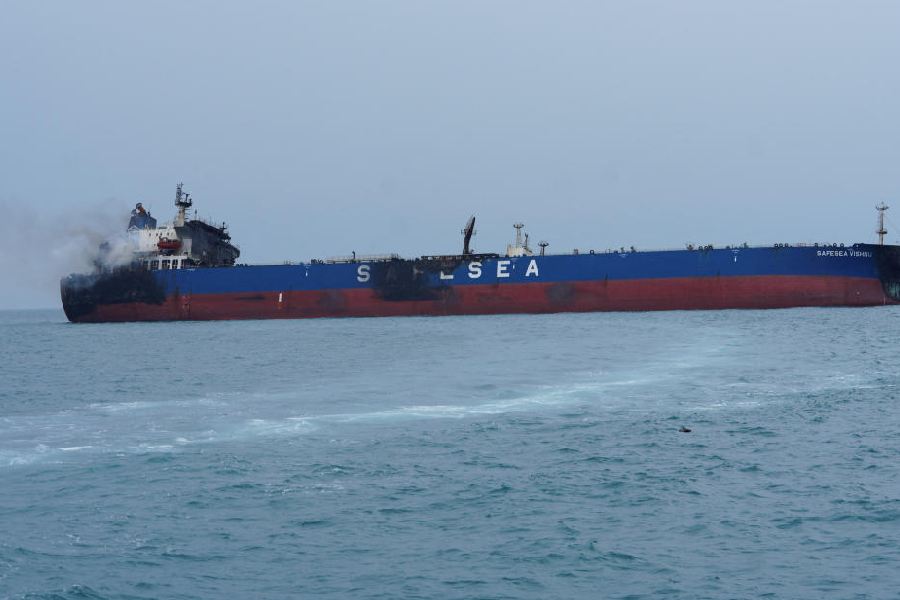
A vessel carrying Iranian crude oil has changed course mid-voyage to China from its previously signalled destination of India, where it would have been the first such shipment in nearly seven years.
The Aframax tanker Ping Shun, built in 2002 and sanctioned by the US in 2025, is now heading towards Dongying in China instead of Vadinar in Gujarat, which it had indicated earlier this week, according to marine intelligence firm Kpler.
According to Sumit Ritolia, lead research analyst, (refining and modelling) at Kpler, the change in destination mid-voyage highlights the increasing sensitivity of trade flows to financial terms and counterparty risk, even as such changes are not unprecedented with Iranian crudes,
“Per market sources, the shift appears to be payment-related, with sellers tightening terms, moving away from the earlier 30–60 days of credit window toward upfront or near-term settlement,” Ritolia observed.
Industry sources said, the cargo could still make its way to an Indian refinery if payment issues are resolved. Vadinar is home to a 20-million-tonnes-a-year oil refinery of Russian oil giant Rosneft-backed Nayara Energy.
“However, the episode underscores how commercial terms are becoming as critical as logistics in determining Iranian crude flows to other countries apart from China,” Ritolia added.
Iran emerged as a destination to import petroleum products for India after the US lifted sanctions on seaborne oil from March 20 to ease supply squeeze in the global market due to the war in West Asia.
Historically, India was a major buyer of Iranian crude, importing significant volumes of Iranian light and heavy grades due to strong refinery compatibility and favourable commercial terms. China is the main buyer of Iranian oil now.
Following sanctions tightening in 2018, imports ceased from May 2019, with volumes replaced by West Asian, US and other grades. At peak, Iranian crude accounted for 11.5 per cent of India’s total imports according to Kpler.
While the US waiver allowed countries to purchase Iranian barrels, it is unclear how payments will be made. In contrast, Russian crude flowed freely to India when the US lifted sanctions on seaborne Ural crude earlier in March.
Industry pointed out that Iran remains cut off from SWIFT (Society for Worldwide Interbank Financial Telecommunication) — a global messaging network used by banks and financial institutions to securely send and receive information about financial transactions.
Last purchases from Iran were done in Euro using a Turkish bank as a go-between but that option no longer exists, according to PTI.
Iran was cut off from the SWIFT system in March 2012 following European Union sanctions over its nuclear programme, with the move forcing the disconnection of multiple Iranian banks and severely restricting global financial transactions.