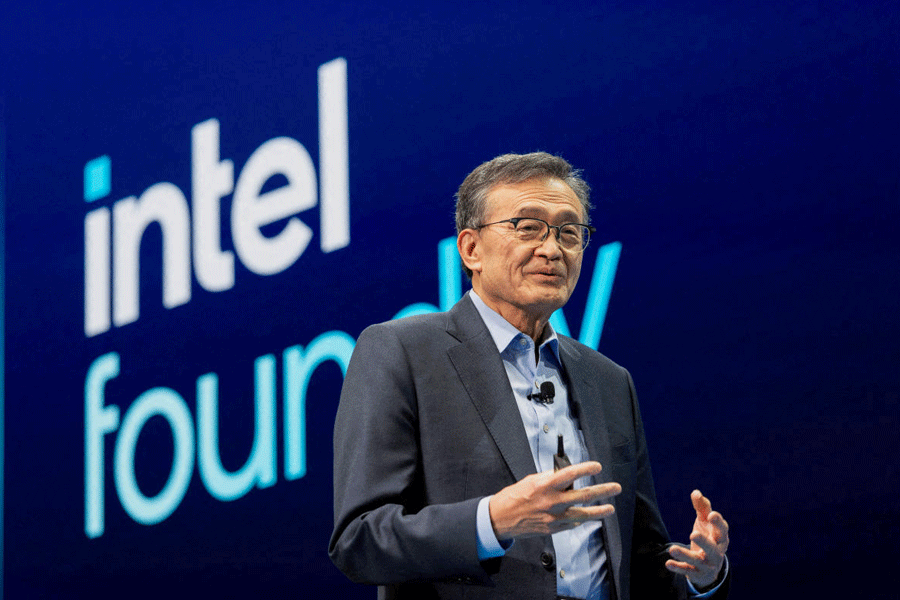
When the chairman of AI chip startup Rivos wanted Intel to bid for the company, he had no need to phone the chip giant. That’s because the chairman of Rivos was also Intel’s CEO: Lip-Bu Tan.
Tan had pitched Intel’s board on buying Rivos in the summer of 2025, but he had no luck. The board told Tan he had a conflict in representing both Rivos’ interests and Intel’s, and he lacked a strategy on artificial intelligence to justify a deal, three people familiar with the events told Reuters.
Tan asked one of his lieutenants at Intel to pitch a new AI plan, leading to partnership talks with Rivos, the people said. But now there was a problem: social media giant Meta had been stalking Rivos and made an offer for the company.
Meta’s interest spurred Intel to make its own offer. Meta countered with a sweetened bid. The competition for the startup drove the deal and incentives above the $2 billion valuation that Rivos had sought in fundraising earlier this year. Some of the sources pinned this package at around $4 billion.
Meta announced plans to buy Rivos in September. By then the bidding process had boosted the startup’s returns at Meta’s expense.
Reuters was unable to determine how much the Intel CEO profited personally as a Rivos shareholder because the financials are not public. But in a blog post on its website, Tan’s venture-capital firm, Walden Catalyst, touted how he had delivered a “successful outcome” for its investors and congratulated the Rivos team for their “remarkable achievement.”
The events show one of at least three instances where Intel has pursued deals that benefit Tan financially either by exploring bids for startups or investing in them directly through Intel’s investment arm, Intel Capital, said two of the sources.
Intel declined to make Tan available for an interview for this story. Meta did not respond to requests for comment, and Rivos declined to comment.
Venture capitalist as CEO
Intel hired Tan in March in part for his experience as a venture capitalist and unparalleled industry connections as a longtime investor in tech companies. Those connections have helped Intel clinch a $5 billion investment from Nvidia and a $2 billion investment from SoftBank.
Since Tan’s arrival, Intel has implemented policies requiring Tan to recuse himself from participating in investment decisions where he might benefit, two sources said. Specifically, Tan cannot attend or vote in decision meetings of Intel’s board or Intel Capital’s investment committee if he has a conflict in a venture or company-wide transaction, the sources said.
Such recusals are commonplace in industry. But they had not been an issue to the same degree at Intel because its leadership prior to Tan had fewer potentially conflicting investments, three of the sources said.
In the event of a Tan recusal for Intel Capital, the first two sources said, decision-making authority for the venture unit’s investment committee goes to Chief Financial Officer David Zinsner, who reports to Tan.
Intel declined to make Zinsner available for an interview.
Intel’s board knew when it appointed Tan that his web of investments in chip and technology companies could create conflicts, but the board accepted this, hoping that Tan can revive the iconic U.S. chipmaker, which lost $19 billion last year, one of the people said.
Intel’s 11 independent board directors did not individually comment on Tan, but in response to Reuters queries, an Intel spokesperson said: “The Board of Directors believes it’s important that Intel fully leverage his vast network and position Intel to capture the next wave of industry innovation and opportunity.”
Tan’s dealmaking comes as the administration of President Donald Trump agreed to make an $8.9 billion investment for what would be the largest ownership stake in the chipmaker, designating it as strategic to the U.S. and effectively making its citizens shareholders.
Some chip-industry analysts have said in research notes that they welcomed Tan’s industry relationships. “He has a wide view across the ecosystem,” said Bernstein analyst Stacy Rasgon in an interview with Reuters. “And that’s helpful for Intel.”
Tan does not perceive his dealmaking at Intel to be conflicted, said two of the sources, who are familiar with his thinking. Tan believes that his roles at these startups and at Intel make him uniquely able to negotiate transactions that benefit all parties, the people said.
In a statement, an Intel spokesperson disputed that Tan’s dealmaking posed any problem. “The company has an unwavering commitment to the highest standards of corporate governance, integrity, and accountability,” the spokesperson said. Tan’s “extensive relationships across the global semiconductor ecosystem are invaluable as Intel positions itself to capitalize on a rapidly evolving industry landscape.”
The Securities and Exchange Commission would not require Intel to disclose related-party transactions that could involve Tan until the spring of 2026, a year after its last disclosure, which took place the week after his start date.
U.S. regulations require such disclosures when transactions personally benefiting corporate officers exceed $120,000, though experts have said smaller dollar amounts can be material to investors if the information would inform a decision to sell or purchase stock.
Deals to revive Intel’s AI strategy
Tan believed Intel needed to buy Rivos because earlier in-house efforts to enter the AI chip market had failed, one of the sources said. In the statement, the Intel spokesperson said Tan was “advancing its AI strategy” and “revitalizing its engineering-centric, customer-first culture.”
Rivos was one of the major targets for Intel where Tan had interests on both sides of the deal. Tan also pitched Intel’s board on buying the troubled AI computing startup SambaNova, where Tan served as executive chairman, the first three sources said.
The rationale - debated inside Intel - was that SambaNova also could provide more tech and talent to build AI chips, the sources said.
SambaNova declined to comment on any talks between the startup and Intel. “While we’re always exploring strategic options, our focus remains on accelerating the roadmap, delivering products to market, and supporting our customers,” a spokesperson said.
Intel also declined to comment on the SambaNova talks.
Tan’s portfolio has drawn scrutiny before. In April, Reuters documented how Tan’s investment firms had stakes in more than 600 Chinese companies, some with military ties, drawing a rebuke by Trump that the U.S. chip manufacturer’s CEO was "highly CONFLICTED.”
According to a White House official, Tan subsequently cleared up Trump’s concerns in an Oval Office meeting, which paved the way for collaboration on U.S. national and economic security. In September, Trump publicly celebrated Intel’s rising share price following Tan’s Nvidia deal.
Intel’s share price has roughly doubled since Tan’s appointment, outpacing the percentage gains of the S&P 500 and chip leader Nvidia in that time.
Taking control of Intel capital
Soon after his appointment as CEO, Tan took direct control of Intel’s investment arm, Intel Capital, reversing a plan to spin it off. Instead, he reorganized the company so that Intel Capital would report to him, according to two of the sources, for reasons Intel has not disclosed. Its investment committee would be composed solely of Tan and one of his direct reports, finance chief Zinsner, said three people familiar with the change.
Since then, Intel Capital has invested in several companies in which Tan has a stake through his investment vehicles or venture capital firms, which include A&E Investment LLC, Celesta Capital and Walden International, three of the sources said. Some Intel staff have felt an obligation to explore such deals to win Tan’s support, two of them said.
One such investment was in proteanTecs, which announced a late-stage, Series D funding round in September. Intel Capital upped its existing stake in the startup, helping increase the value of Tan’s holdings through A&E Investment and Celesta Capital, funding data shows.
ProteanTecs declined to comment. A&E Investment, Walden Catalyst and Walden International did not respond to requests for comment. In a statement, Celesta Capital said Tan "has always acted with integrity and a commitment to doing what is right for all stakeholders.”
Before Tan became CEO, Intel Capital co-invested with him or his investment firms at least 12 times since 2019, funding announcements show.
Intel is not alone in having a venture capital arm. That’s common at large technology companies, including Nvidia, Microsoft, Alphabet and Qualcomm. But unlike those other companies, Intel is unusual in having a CEO who oversees its venture unit while also leading unrelated investment firms, a Reuters review of leadership at those companies shows.
Reuters was unable to determine how much Intel’s recent investments had in total increased Tan’s net worth, estimated to be well over $500 million.
Two corporate governance experts consulted by Reuters said Tan’s dealmaking raises red flags due to the conflicts inherent in forging deals with his own portfolio companies.
One of them also said that Intel could benefit from Tan’s connections. “You don't want to preclude making good investments because your CEO is well connected,” said Daniel Taylor, a professor at the Wharton School specializing in corporate disclosures and insider trading.
Tan touts his book
The Intel CEO has consistently highlighted his portfolio in public appearances. In one of his first presentations as the Intel chief in March, he talked up his 251 chip-related investments, an online video from the occasion shows.
At an October chip conference in Phoenix, Tan gave a speech representing Intel that featured slides touting still more holdings, including in proteanTecs and SambaNova.
Intel’s code of conduct encourages executives to disclose potential conflicts to the company’s board and top legal and compliance officers for resolution. “We avoid situations that interfere or appear to interfere with our ability to act in the best interests of Intel,” the code of conduct states. It adds that staff must mind conflicts arising from “an ownership interest in an Intel supplier, customer, or competitor” and from “outside employment that interferes with your obligations to Intel.”
The two corporate governance experts said Tan should have dropped his portfolio investments, placed them in a blind trust or set up a special committee of the board to remove potential conflicts with his investment portfolio. Some lawyers have said special committees are not always necessary, and some scholars argue outside board roles apprise executives of strategic information.
Intel declined to say if Tan had taken any such measure.
The Intel board’s independent Audit Committee “actively monitors, reviews, and approves, as appropriate, any related-party transactions in strict accordance with Intel’s rigorous Related-Party Transactions Policy,” the company spokesperson said.
The policy has exceptions. Transactions in which an Intel executive owns less than 10% of a company that is party to a deal, whose value does not exceed $1 million or 2% of that company’s revenue, are deemed to be “pre-cleared,” the policy states. It was not clear how many investments by Intel, if any, fell under this policy, which pre-dated Tan’s leadership.
Intel explores bid for a struggling startup
In 2018, SambaNova was a startup with lofty ambitions to build an AI computing system that could rival Nvidia’s AI hardware and software ecosystem. Tan’s venture firm Walden International co-led SambaNova’s $56 million Series A funding round that year, which secured Tan’s position on its board.
Over the years, SambaNova hoovered up money from investors: more from Tan’s venture firm and, around 2021, a big check from SoftBank, where Tan served as a board director until 2022. The $676 million Series D round led by SoftBank valued SambaNova at around $5 billion and gave Tan’s holdings a healthy increase on paper.
SoftBank declined to answer if Tan had a role in persuading it to invest in SambaNova.
But the startup’s ambitious vision wasn’t panning out, three people familiar with the matter said. Customers had more demand for Nvidia’s chips, which are good for a wide variety of uses in AI. That contrasts with the silicon from SambaNova, which is designed for more specific AI applications.
In 2024, Tan stepped in as SambaNova’s new executive chairman in the hopes that he could help grow its business faster. The company was poised to run out of its cash, three people familiar with the matter said. It laid off 77 people in California, or reportedly about 15% of its staff, in April.
The chip startup tried to drum up interest for another funding round, but found few takers, two sources said. Its revenue meant it would have to fundraise or go up for sale at a lower valuation, said the people and a third source. Bankers pegged its worth at $2 billion to around $3 billion at most, two of the sources said.
Tan asked Intel to look at a deal with the chipmaker over the summer, three sources said.
In recent weeks, some of SambaNova’s investors provided additional financing to tide over the startup, two people familiar with the insider round said.
In a statement to Reuters, a SambaNova spokesperson confirmed the startup recently secured additional funding, adding its business “is performing really well.”
Deal talks with SambaNova are ongoing, two of the sources said. Intel and SambaNova have signed a non-binding term sheet, one of them said.