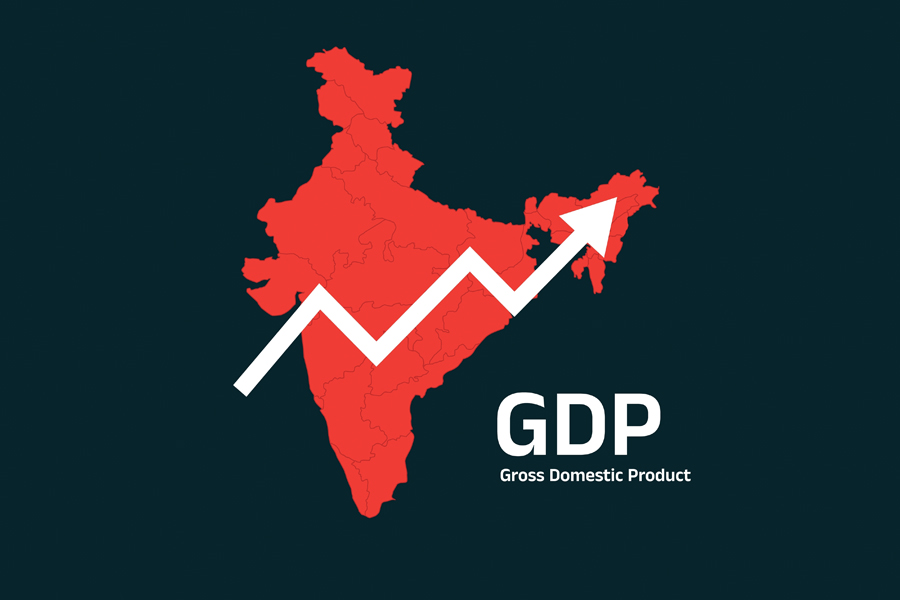
India is set to transition to 'upper-middle income' country in next four years in 2030, joining the ranks of China and Indonesia, and become the third largest economy even earlier in 2028, an SBI Research report said on Monday.
The World Bank classifies nations as low income, lower-middle income, upper-middle income and high-income countries based on their per capita GNI (Gross National Income) in US dollar.
In 1990, of the total 218 countries classified by the World Bank, 51 belonged to low income, 56 to lower-middle income, 29 to upper-middle income and 39 to high-income categories.
The latest data in 2024 shows only 26 countries as low income, 50 as lower-middle income, 54 as upper-middle income and 87 as high income. The transition clearly shows countries have moved up the income ladder over the years.
India took 60 years to transition to lower-middle income in 2007 from low-income country. Its per capita GNI increased from USD 90 in 1962 to USD 910 in 2007, an annual growth rate of 5.3 per cent, said the report.
It further said India took 60 years since Independence to reach USD 1 trillion, USD 2 trillion in another 7 years in 2014, USD 3 trillion in 2021, and USD 4 trillion in another 4 years in 2025.
India is likely to be USD 5 trillion in another about 2 years, it said.
The report further said India achieved USD 1,000 per capita income in 62 years since Independence in 2009, USD 2,000 per capita in next 10 years in 2019, and took another 7 years to achieve USD 3,000 per capita mark.
"India is set to touch USD 4,000 per capita in another 4 years in 2030 to transition to an upper-middle income country and join China and Indonesia at current classification," the report said.
According to the report, India’s growth journey in the last decade shows that its percentile rank in the cross-country distribution of average real GDP growth has increased from the 92nd percentile over a 25-year horizon to the 95th percentile implying a rightward shift in its relative position that places the country deeper into the upper tail of the global growth distribution.
"If we consider the current per capita GNI threshold for high income country of USD 13,936 to be reached by 2047 (as per Viksit Bharat vision), India’s per capita GNI has to grow by a CAGR of 7.5 per cent. This seems achievable as India’s per capita GNI has grown by a CAGR of 8.3 per cent during the last 23 years (2001-2024)," the report said.
However, it added that the threshold level for high income country will also get changed by then.
If the threshold for high income country gets changed to USD 18,000 then India’s per capita GNI needs to grow by a higher rate, CAGR of around 8.9 per cent in the next 23 years for it to become the high-income country by 2047.
Assuming 0.6 per cent average population growth and average deflator of China, Japan, the UK, the US and Euro area of around 2 per cent (average between 1992-2024), this translates into growth of nominal GDP in dollar terms of around 11.5 per cent for the next 23 years.
"India should continue its reform agenda so that we can get higher incremental growth required to reach the high-income bracket," the report added.
Clearly, it said India can and will transition to the upper-middle income country, which has the threshold per capita GNI of around USD 4,500.
Growth of nominal GDP in dollar terms required to achieve this is around 11.5 per cent which is achievable as this growth has been around 11 per cent before the pandemic (FY04-FY20) and around 10 per cent during FY04-FY25, it said.
SBI Research said that the US remains the biggest economy followed by China, with India transitioning to become the third largest economy beating Germany by 2028.
India transitioned from 14th rank in 1990 to fourth in 2025.
The report said India is likely to become a USD 5 trillion economy by 2027/FY28 and USD 10 trillion by 2035/FY36.
Except for the headline, this story has not been edited by The Telegraph Online staff and has been published from a syndicated feed.