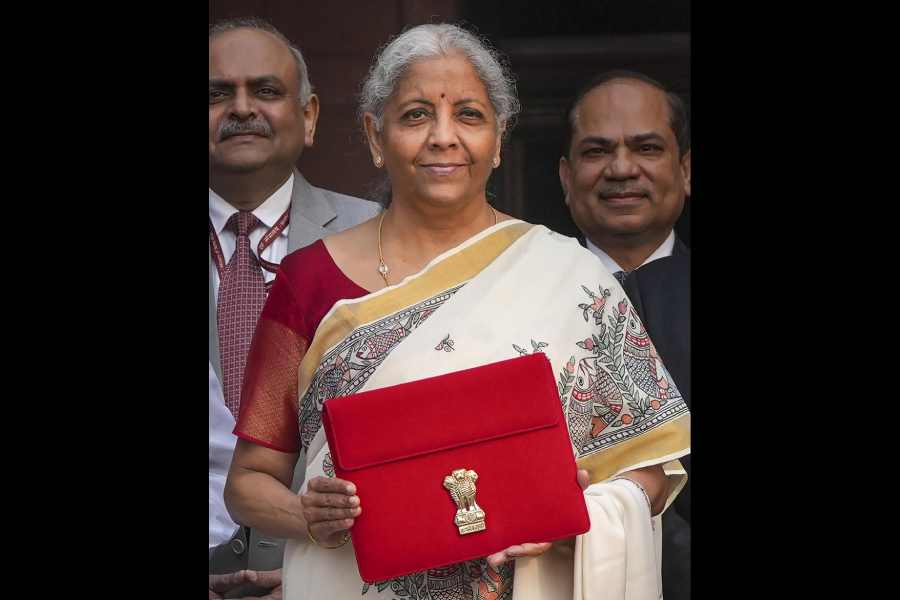
Finance minister Nirmala Sitharaman, who will present her ninth consecutive Union budget at 11am on Sunday, will have to do a delicate balancing act between the Centre’s commitment to fiscal consolidation and debt management and the need to sustain growth at a time the global economy is grappling with uncertainty and trade frictions.
The focus will be on how the government prioritises growth-enhancing capital expenditure, manufacturing and exports while preserving macro stability and shore up investor confidence amid intense revenue pressures and external headwinds.
The government has pegged the fiscal deficit at 4.4 per cent of the GDP for 2025-26 and reiterated its intent to keep the deficit at such levels between 2026-27 and 2030-31 to bring the debt-to-GDP ratio down to around 50 per cent by March 31, 2031, the penultimate year of the 16th Finance Commission cycle.
Revenue pressures are, however, mounting. An estimated ₹1 lakh crore foregone from income tax rationalisation announced in the previous budget and ₹47,700 crore from GST changes aimed at boosting consumption are likely to weigh on net tax collections in the current fiscal, alongside underachievement in disinvestment.
While the Reserve Bank of India’s record surplus transfer of ₹2.68 lakh crore will provide a cushion to overall receipts, Sitharaman will need to prioritise expenditure in key areas while maintaining fiscal prudence.
Industry body Ficci has urged adherence to the fiscal consolidation glide path, prioritisation of growth-enhancing productive capital expenditure with a focus on defence and social sector spending, and leveraging revenues to contain debt risks.
The Economic Survey pegs India’s medium-term real GDP growth potential at 7 per cent and projects 2026-27 growth in the range of 6.8-7.2 per cent. The Centre’s capital expenditure is expected to remain a key growth driver even as policymakers seek to crowd in private investment.
The government has budgeted capital spending of ₹11.21 lakh crore in 2025-26, and SBI group chief economic adviser Soumya Kanti Ghosh said central capex could cross ₹12 lakh crore in 2026-27, marking a year-on-year growth of around 10 per cent.
To stimulate private investment, industry is hoping for an extension of the production-linked incentive (PLI) scheme to new technology sectors such as artificial intelligence (AI), space and robotics, with public infrastructure investments in these areas expected to catalyse private capital. Targeted incentives for emerging industries are seen as crucial to drive innovation and attract domestic and foreign investors.
A renewed thrust on manufacturing is also central to job creation and export diversification. Economists expect continued PLI support for strategic sectors, measures to secure critical minerals, simplification of regulatory compliance and rationalisation of customs duties to boost domestic value addition.
With Indian goods facing 50 per cent US tariffs, competitiveness has eroded against peers such as Vietnam and Bangladesh, hitting MSMEs in textiles, leather, chemicals, gems and jewellery and specific policy measures aimed at supporting MSMEs are also a key ask from the industry.
While the cabinet has approved a six-year Export Promotion Mission with an outlay of ₹25,060 crore and the government has signed FTAs to diversify exports, industry is seeking a simpler customs duty structure and a dispute resolution scheme under customs law.
Foreign investors will watch for clarity on tax domicile and treaty benefits after the SC ruling requiring Tiger Global to pay tax in India on its Flipkart stake sale, overturning relief under the India-Mauritius treaty.
On tax stability, major direct tax reforms are unlikely after last year’s higher tax-free threshold. Markets are seeking a higher long-term capital gains (LTCG) exemption for equities to ₹2 lakh, and restoration of LTCG with indexation for debt funds. The SBI Research has proposed parity in the tax treatment of deposit interest and capital gains.