
New Delhi, Oct. 3: The hike in natural gas prices for October till March will benefit PSU explorers ONGC Ltd and Oil India, but fertiliser subsidy will go up at a time the government is stretched to meet its fiscal deficit target on account of a slowdown in growth.
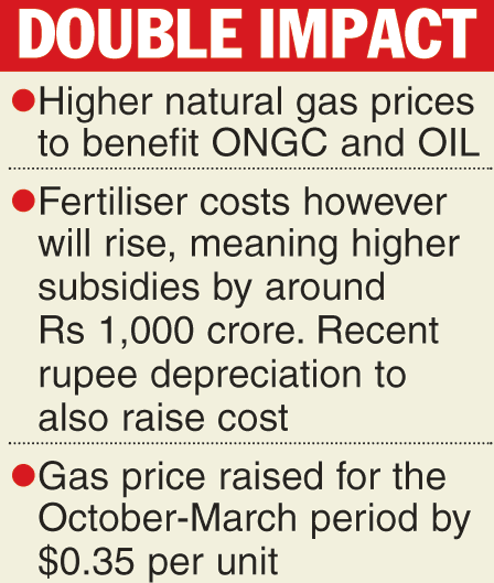
The fertiliser subsidy could increase about Rs 1,000 crore during the second half of the fiscal, while the revenue of exploration firms such as ONGC and Oil India would go up Rs 1,300 crore because of the hike in domestic natural gas prices for the first time since 2014, when a new pricing formula was adopted.
"The recent revision in domestic gas price will lead to an increase of $0.35 per mmbtu (million metric British thermal unit) in the pooled gas price for the fertiliser sector for H2 FY2018 (second half of fiscal year 2017-18, which is October to March). The cost of production for fertiliser sector should increase in the second-half owing to higher pooled gas price coupled with recent depreciation of the rupee against the dollar," K Ravichandran, senior vice-president at Icra, said.
"The increased cost of production should lead to an increase in subsidy outgo for government by Rs 1,000-1100 crore in the second half of this fiscal year and an increase in working capital borrowings for the industry," he added.
"While higher working capital borrowings should result in higher interest costs, reimbursement of energy savings at higher gas prices should more than offset the higher interest charges for the efficient players in the industry," Ravichandran said.
"The price of domestic natural gas for the period October 1, 2017 to March 31, 2018 is $2.89 per mmBtu on gross calorific value (GCV) basis," the oil ministry's Petroleum Planning & Analysis Cell had notified. The prices have been hiked from the present rate of $2.48 per mmBtu.
The government's mid-year expenditure statement tabled in Parliament in August had said fertiliser subsidy would remain the same for 2018-2019 and for this fiscal at Rs 70,000 crore, which was announced by finance minister Arun Jaitley in the budget.
The expenditure statement has, however, projected the lowering of petroleum subsidy by 44 per cent to Rs 10,000 crore in 2018-19 from the budgeted Rs 18,000 crore for this fiscal.
However, for the gas producers the hike in domestic prices would result in additional revenue from their upstream activity, boosting their margins.
"The recent gas price increase would lead to an increase in revenue for domestic gas producers by around Rs 1,300 crore during the second half of 2017-18," India Ratings and Research (Ind-Ra) said.
It said "producers have been benefiting from lower rig and vessel rentals for renewed contracts because of soft crude prices. The operating cost remains close to realisations from its sale. Hence, this increment would bolster domestic producing companies' margins".
Oil India and ONGC, which contribute around 80 per cent to the total domestic production, would be the largest beneficiaries of the price increase.
GAIL India could also see about Rs 1,500 crore higher trading revenue from the sale of domestic gas.
However, exploration firms have argued that the current price levels are below their production costs, though it will provide some relief.