Book name- VIKRAM AND VETALA: A TRANSFORMATIVE RETELLING
Author- Douglas J. Penick
Published by: HarperCollins, Price- Rs 699
Douglas J. Penick’s book recovers one of pre-colonial South Asia’s most restless philosophical documents — the ancient Sanskrit story cycle known as the Baital Pachchisi — and carries it, with considerable lyrical intelligence, into contemporary English. The book’s central argument is not stated but enacted: that the original text’s refusal to resolve its own moral questions is not a failure of ancient storytelling but its highest achievement, and that a faithful retelling must preserve that irresolution intact. Penick largely succeeds, producing a work that illuminates the philosophical architecture of the original while revealing, in its own seams, the costs of crossing civilisational distance.
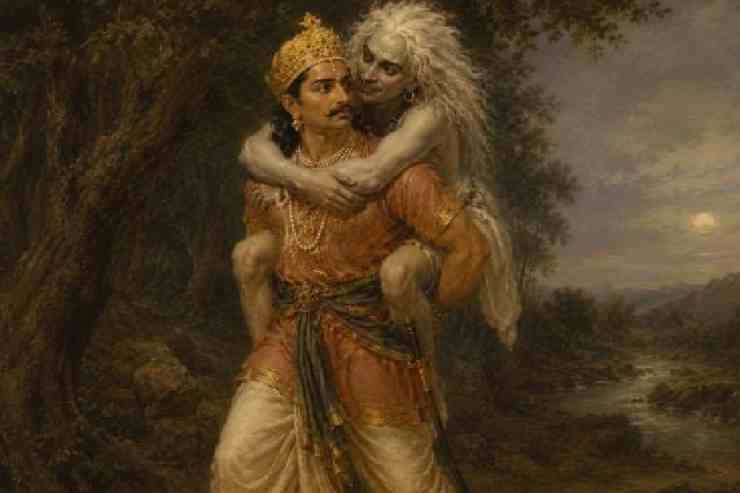
Penick structures the book around the ancient frame story in which King Vikramaditya carries a corpse-demon, the Vetala, through a haunted forest. The Vetala tells the king a story, poses an unanswerable question, and returns to its tree the moment the king speaks. Penick argues, through his prose choices rather than explicit statement, that this structure is the book’s real subject: the king believes he is transporting the body; the body is transporting him. In Penick’s retelling, the Vetala functions as what Lacanian theory would call the Real — the irrepressible force that returns each time one believes it has been contained.
Across the 25 stories, Penick demonstrates that the Baital Pachchisi makes five persistent philosophical claims. The original text insists that love is an external seizure rather than an internal state; that justice requires the willingness to interrogate rather than merely observe; that political authority must perform the fiction of moral finality even when that finality is false; that identity is narrative rather than biological or spiritual; and that some suffering has no guilty party, a reality rulers must publicly deny for law to function. Penick’s most significant editorial decision, one that distinguishes this retelling from more accessible versions, is to leave all five of these propositions unresolved.
Penick understands that the Baital Pachchisi’s incompleteness is not a gap to be filled. Where many translators of ancient Sanskrit material instinctively reach for clarification, Penick’s prose maintains the original’s temperature: cold, ceremonial, resistant to reassurance. His restraint in the face of the Vetala’s unanswered counterarguments constitutes the retelling’s most honest and most difficult achievement.
However, Penick’s framing essays reveal a limitation that the retelling itself partially obscures. Penick positions the Baital Pachchisi as a text that the contemporary Western reader needs to recover, implying that the text required discovery rather than acknowledgment. This reading does not fully account for the specifically colonial dimensions of why such recovery is necessary in the first place. What also remains underexplored in Penick’s framing is the institutional violence through which the oral transmission networks, Sanskrit universities, and philosophical patronage systems that kept this text alive and contested were dismantled by colonial administration. To receive a retelling of the Baital Pachchisi as a recovered marvel without registering the violence that made recovery necessary is to allow aesthetic pleasure to perform the work of historical forgetting.
A further limitation emerges in Penick’s handling of gender. Penick’s retelling does not correct the Baital Pachchisi’s structural cruelty toward women, which is defensible as a fidelity to the source. But Penick’s prose inflections amplify the existing imbalance: female transgression is rendered with a prose of contained alarm that male transgression does not receive. This reading is limited because it treats an asymmetry that belongs partly to the ancient text as though it is natural rather than as a choice that the retelling actively reproduces.
Vikram and Vetala: A Transformative Retelling makes a genuine contribution to the growing body of serious literary engagement with pre-colonial, South Asian, philosophical literature in English. Penick’s book is most valuable not as an introduction but as an argument, a sustained demonstration that the Baital Pachchisi’s refusal of resolution is itself its most urgent contemporary relevance in a cultural moment when ancient Indian philosophy is routinely domesticated into wellness content.
So let me leave you with the questions the text actually demands. If virtue only exists in the space where obligation has run out, what does that mean for a world that has converted almost everything into a transaction? If the self is purely its accumulated narrative, who owns the rights to your story? If a king’s word must be the last even when wrong, because order requires a useful fiction, what is the difference between law and organised lying? If Enlightenment disenchanted the world and replaced myth with the mythology of progress, what legitimacy does it retain as the world’s default epistemology? If spiritual wisdom is being sprinkled as MSG across a culture desperate for flavour but unable to sustain nourishment, who is the yogi, Ksantisila, in that situation, and who is the king being tricked into carrying a corpse? And if the charnel ground is where all hierarchies finally collapse, what does it mean that we have hidden death inside hospitals, removed the pyre from the city, and located the cremation ground firmly in the unconscious, which is exactly where the Vetala lives, and which may explain why the dead keep finding ways to speak anyway?