Sumita Mashi or Chhoto Mashi, as I called her, spent her mornings talking over the phone, evenings watching serials and nights snoring. I had thought I would never get used to her snores. I was soon amazed at my own capacity to adjust. Initially, I would wake up when the pitch of the snore reached a crescendo and then gradually again fall back to sleep when it hit a long decrescendo.
Now, I slept through the crest and trough of the sound waves reverberating through the house, sometimes wondering if I was snoring myself. I was worried because I had a few things in common with Chhoto Mashi. We were both dusky, although my mother was fair. Mashi remained unmarried till 35. She was the only one among my mother’s three sisters who had a job, that too in a government department. That’s why even now, she drew a pension and that was used to buy her own medicines, which was a considerable amount every month. Her son, on whom she had doted all her life, did not send her a single penny from Australia. I couldn’t be impolite and ask her to pay up for her food and lodging, share the electricity or gas bill. She was my aunt, my family, how could I do that?
Sometimes I looked at her, watching TV, reading a book or doing crochet with a nostalgic smile curving her lips. She was making a sweater for Alvira. She saw in her the granddaughter she missed all the time. She had last met her granddaughter five years back, the last time her son had visited her, and now the child was of Alvira’s age.
In my house, at least someone cared for the little girl. I had started having doubts about Anish or his wife’s sense of responsibility towards their daughter. Because, on some pretext or the other, he was always dumping her at my home. I didn’t mind, actually I loved being around her, but after the incident that day, when I lunged at my mother and pulled her hair in front of the child, I did not know how to face Alvira. I kept worrying about what she thought of me now.
The calling bell rang. When I opened the door, the security guard was holding two packets. One was huge, sent on an international grocery app in my Mashi’s name, and the other was a big envelope left by the detective agency I had appointed, in the name of Reyna Basu.
Mashi rushed to the living room, snatched the packet from my hand and tore open the brown paper. At least 15 packets of chanachur emerged from within the brown paper. My Chhoto Mashi looked ecstatic like she had discovered a gold mine.
She was diabetic and loved to eat sweets and fried food. She absolutely hated me interfering with her eating habits and frequently complained to her son about it. To pacify her, he often sent these supplies. Now, for the next few days, she would be on the phone telling the world how much her son loved her and was sending these goodies all the way from Australia. This was a shipment of chanachur, sometimes it would be potato chips, sometimes chocolates, sometimes mishti from some famous Calcutta shop. Instead of getting angry, I decided to see the funny side of this arrangement. How mom and son were keeping the delusion of love and care alive.
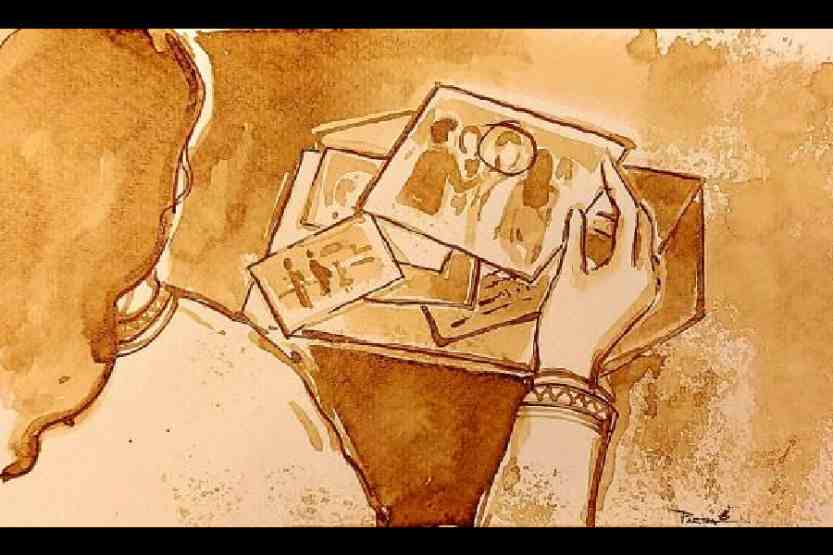
At least I was not delusional about love anymore. I hadn’t believed a word of what Anish told me after he suddenly reappeared in my life. I opened the envelope sent by the detective agency. It had around five photographs. Anish and his wife Chandana walking hand-in-hand, like engrossed lovers. Alvira, walking in front holding on to a bunch of balloons and an ice cream, completed the happy family picture.
The date on the pictures ratified that it had been taken three days ago. I wasn’t shocked to see Anish in such a romantic mood with his wife; what struck me was how happy Alvira looked with them. I suddenly felt like the outsider, hankering for the affection of a child who would never be mine. Maybe she even hated me, like my mother said.
My eyes welled up thinking of the possibility. I rebuked myself for getting so attached to her. In my life, that had suddenly turned upside down after I moved back to Calcutta from Singapore, she was perhaps the purpose I was looking for, the straw I was holding on to. And that was turning out to be dangerous, something I was realising the hard way. My motherly instincts had suddenly been awakened, although I had long buried any intentions of marriage.
I picked up the neatly typed-out report where the detective agency confirmed that the divorce case was indeed going on in the family court between Anish and his wife Chandana. She was asking for ₹1 crore alimony. And then this photograph. Things just didn’t add up.
I was sitting at the desk, pouring over the photographs when Chhoto Mashi walked in, of course without knocking on the door. This etiquette did not exist in my home. Before I could hide the photos, her ever-inquisitive eyes had spotted Alvira.
“O maa ki mishti lagcchey Alvira key. Eta ki Anish er bou? (Alvira is looking so sweet. Is this Anish’s wife?),” she asked.
I gritted my teeth.
“Do you need anything?” I asked.
“Oh, I needed some change,” she said and picked up my handbag from the table. She opened the zipper, fetched out my purse. Then suddenly she got distracted by the perfume bottle inside, brought it out, sprayed it on her wrist. Took a deep breath.
“What a lovely smell. Can I use this?” she asked.
It was a small bottle of Chanel. The way my consulting career was taking off in a slow pace in Calcutta, I was pretty sure it would be some time before I could afford another bottle of Chanel.
“Take it,” I said with a smile.
She fetched out a slim cannister now.
“Is this a deodorant?” she asked as she opened the cap.
“No, no don’t open it,” I said in a hurry.
“It’s a toilet spray. It’s for sanitising a public toilet before I use it. Not a perfume,” I clarified.
Her expression told me she believed I was bluffing her because I wanted to keep that perfume for myself.
I quietly took the bag from her. She had a habit of rummaging through my things. My mother had it too. They belonged to a generation of Bengali women who had no idea of personal boundaries. In my teen years, I wasn’t allowed to close my bedroom door, and if by any chance I did, it was opened without knocking. Any slow mail that came to me was opened and read. What I found cringeworthy was normal for them.
Mashi even had a habit of going through my phone. I locked my phone. This convinced my mother more that I needed to hide my messages to Anish and that was why I took that step. I did not refute it.
Happy with the bottle of Chanel, Mashi left the room. I got up and bolted the door.
Suddenly, I remembered that Anish had also gifted me a Chanel on my birthday once. I did not know the price of the perfume then, otherwise I would have asked him where he had got the money from.
I went back to the envelope. I pulled out another photo. It was from Rishit’s wedding where Anish had made his dramatic return. With a marker, a face had been circled in the crowd. It was Chandana, his wife. He had told none of us that he had brought his wife along that day.
His sudden return was turning out to be more and more mysterious.
(To be continued)
Amrita Mukherjee is the author of the novel Exit Interview, short-story collection Museum of Memories and the crime non-fiction book The Secret Diary of a Criminal Lawyer. She blogs at amritaspeaks.in
Partha Mukherjee, popularly known as Kolkatacoffeeman, tells stories through coffee art. Through mindful listening and coffee-art sessions, he is creating unique conversations around mental well-being. Follow him on Instagram @kolkatacoffeeman