Fifteen years ago, in the summer of 2011, Julie Banerjee Mehta reintroduced Rabindranath Tagore’s Dak Ghar to theatre audiences in Toronto, where she taught World Literature and Postcolonial Literature to university students. Her translation and stage adaptation was witnessed by hundreds over the course of a month at the Berkeley Street Theatre. The translation won the King Edward Tea Society Award in Toronto the same year. Julie also received recognition as one of the Sixteen Most Influential South Asians in Canada.
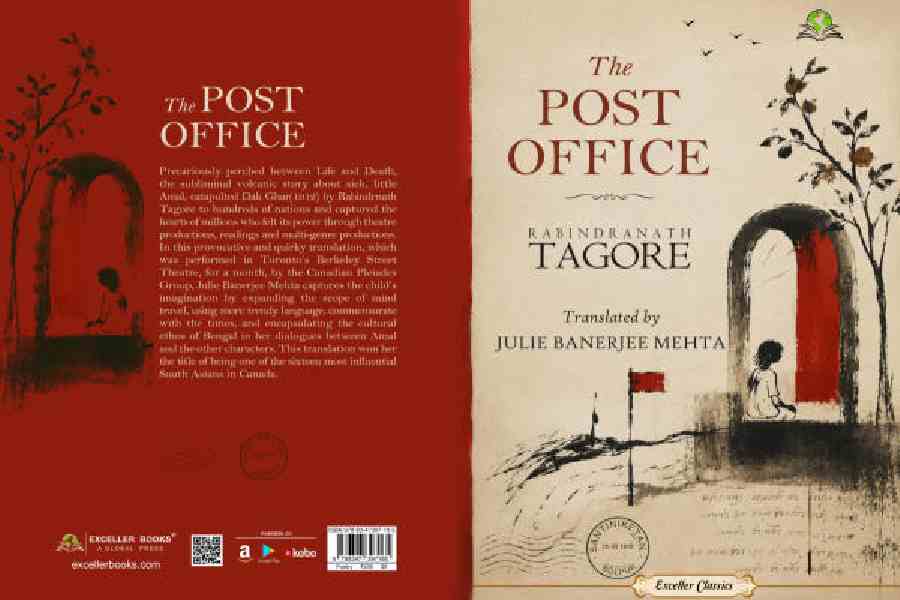
Cut to the summer of 2026. The t2 columnist and author of Dance of Life, and co-author of Strongman: The Extraordinary Life of Hun Sen, brings the world of Amal — lonely but full of imagination and hope — back to our reading lists. A tête-à-tête with Mehta on the stage adaptation that bowled over Toronto and her new book, The Post Office, published by Exceller Books, which will be launched at the Bengal Arts and Literary Festival (BALF) tomorrow.
The Post Office and Death
I first read Dak Ghar in school, in Bengali class at Loreto House. I recall that I could not sleep for several nights as I thought of little Amal. It was a sledgehammer that hit me. The thought of loneliness, of being in a bubble and being deprived of spending time with playmates, was frightening. There was a phase in my teens when my father and I had long discussions about death. I was as aware of death as I was of being alive. As I entered young adulthood, I began to understand how being alone and facing death affected our whole universe. Facing death was universal. I was always curious about death after my first reading of Dak Ghar.
The play took the world by storm after it was written by Tagore in Bengali in 1911, and W.B. Yeats wrote the preface to the English translation by Devabrata Mukherjee. We can see why so many of us are captivated by this brief but transformative play. The Post Office captures the terrible grief and overwhelming fear of death. As Tagore said: “I don’t know how it happened that early one morning between 2am and 3am my heart stood on the rooftop and sprouted wings. I felt a great premonition of a momentous event, perhaps death. I felt as if I had to jump onto the platform of a train station, as if I were leaving immediately. I was saved. When the call was so strong, how could I resist? The call to go somewhere and the mystery of death is what I expressed in Dak Ghar.”
Toronto’s tryst with Amal
One summer’s day in 2010, when the sky was a molten blue as only a sky in Ontario could be, I heard the postbox downstairs clang. It was a letter. The envelope bore the stamp of the Stratford Theatre Festival of Canada. It was a letter from the director of the Stratford Festival requesting that I translate a play by Rabindranath Tagore to be performed in Toronto. It was Tagore’s 150th birth anniversary and I had been selected to contribute the central component. I was delirious.
In the meantime, the mystery of how Stratford had chanced upon my name was gently revealed. The Canadian Bharatanatyam performer and professor of dance, Lata Pada, a dear friend and recipient of the Order of Canada, had mentioned my book, Dance of Life: The Mythology, History, and Politics of Cambodian Culture, to people in the Canadian theatre community. But the journey of The Post Office did not stop at Stratford.
Although the director of the Stratford Festival had commissioned me to do the translation, his sudden replacement opened up new possibilities for the play. I received a call at home from Andrey Tarasiuk, the former associate artistic director of the Stratford Shakespeare Festival. Andrey showed a keen and urgent interest in my translating the play for the Pleiades Theatre, and introduced me to his colleague, John Van Burek, a well-known theatre personality in Canada, who would direct the play.
Fresh perspective
The whole world seemed to be looking for a fresh perspective on the subject of ultimate loneliness. I wanted to present the play within Rabindranath’s cultural ethos. I was a specialist in postcolonial and world literature, but I also wanted to present Dak Ghar in language that would be appealing and accessible to a global audience. This is ‘World Literature’, or Weltliteratur, as J.W. von Goethe had imagined.
The Post Office was translated into French by André Gide and was read on the radio the night before Paris fell to the Nazis. During World War II, there were 105 performances of The Post Office in concentration camps in Germany. Perhaps one of the most noteworthy was its staging by Janusz Korczak, a Polish-Jewish educator who ran a Jewish orphanage in the Warsaw Ghetto. There, the play was performed for children just a few weeks before they, along with Korczak, were deported to the Treblinka concentration camp.
Back in May 1913, when The Post Office opened at the Abbey Theatre in Dublin, reviewers noted its Irish character. Even European audiences perceived the play’s Irishness. In his study of Tagore, Ernest Rhys, the Welsh-English writer, commented that The Post Office had “a partly Irish, instead of an Indian, characterisation of its village humours”. I aspired to break away from the old form, be more inclusive, and reach readers across the planet.
Make it accessible
What enthused me on the first day of auditions in downtown Toronto was the multicultural ensemble. Mina James, who played Amal, is a prominent Toronto-based stage and screen actor who is highly active in the Canadian theatre scene. Sugith Varughese played Madhab Dutta and is an award-winning Indian-born Canadian actor, writer and director. Patricia Marceau, who played the curd seller/headman, is a Canadian actress and director known for her versatile television and film roles, including Dr Chenard in the medical thriller series ReGenesis. Errol Sitahal, the healer/royal messenger, is a Trinidadian actor who has appeared in numerous stage productions in Montreal, Toronto and the Caribbean. Then there was Sam Moses, who played the old man or fakir, and had acted in Fiddler on the Roof, Ghostbusters, and Canadian television commercials during the 1980s. Dylan Scott Smith, the watchman and royal healer, is known for portraying Sepp in TNT’s I Am the Night, Jasper in Maze Runner: The Death Cure, Daniel in Lemonade, and Largo Brandyfoot in The Lord of the Rings: The Rings of Power. The production also featured Jennifer Villaverde as Sudha.
She is a second-generation Filipino-Canadian actor who has appeared in The Handmaid’s Tale, The Understudy and DeSync.
As I watched the readings, I smiled at the irony of being a Bengali girl from Calcutta teaching at the University of Toronto and seeing Gurudev’s play directed by a Polish director. This was the praxis I was living in, the multicultural Canadian dream.
There were moments during rehearsals that tickled my funny bone. When Patricia, playing the curd seller, asked me: “Julie, am I saying it right? Mishtee doiii?”, I think by the end of the 30-odd rehearsals, Patricia and I both knew it would always be doi with a hard ‘d’.
My aim, right from the start, was to make the play accessible to young children. The fertile imagination of the schoolchildren who came to watch it, and their comments that they could relate to the colloquial vocabulary, earned us brownie points. The play ran for almost a month, from May 7 to June 4, 2011, at the historic Berkeley Street Theatre Downstairs in Toronto. The set was designed by Teresa Przybylski, costumes by Milan Shahani, lighting by Robert Thomson, music by Debashis Sinha, and choreography by Hari Krishnan.
Stage Adaptation
It was not merely my reading of the play 20 times over, nor my deconstructing Tagore’s own translation from Bengali into English, but the meticulous checking of every word and its broader context, mulling it over overnight, and John and I bouncing ideas off each other that sharpened and polished the transfer of the ethos, meaning and philosophical luminosity of the work. Having been taught the mystery of translation by Meenakshi Mukherjee during my college days in India, I remained alert and true to her admonition that anuvad, or translation, should carry not only the meaning of a word but the totality of the cultural ethos it transports. It was an exercise beyond words.
For instance, when the little boy Amal asks the curd seller whether he too could become a curd seller, I understood the pride and sense of self conveyed in those lines. The fact that a little boy could see the poor curd seller as a possible ideal transformed the demeanour of the doiwala. I also recall one grey afternoon, just as we were about to wrap up for the day, when it occurred to me that Amal was not merely fearless in the face of death, but actually looked forward to his release from the four walls through the window to distant lands conjured by his imagination.
Literary light
Writing fiction is about telling a story that is yours, one that can be as weird and quirky, devastating or magical as you wish. You have no written score to adhere to, no rules of veracity or commitment to what lies before you. In translation, however, you are required to stay on track and be a mirror image of the meaning in a language that may not be your own, while also looking at the original through a fresh pair of eyes. The greatest challenge is to remain true to the original, not alter its meaning, yet open it up to a broader and more inclusive readership. Hard work cannot be substituted, nor can a deep understanding of both languages. You need to be a whale and an elephant at the same time.
Stage vs Book
Writing for the stage requires a sharper, smarter style, a faster pace, and more action because the available time is shorter. Even if you wish to portray inaction,such as a man lying on a bed throughout the play, think of Whose Life Is It Anyway? Were The Post Office to be written as a short story, I would argue that its deeply philosophical, powerful and sledgehammer-like reality would suffer because it would lose the tautness of dialogue. The performative quality lends greater urgency to the work, and for this particular tale, theatre is the most suitable genre.