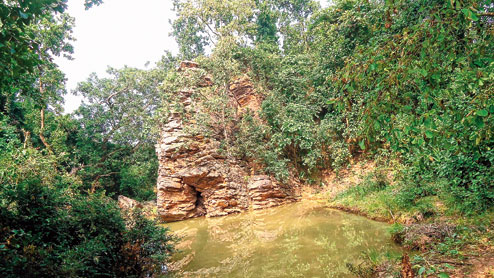

could have been a tourist attraction. Picture by Nalin Verma
Bhimbandh, spread over 682sqkm of the undulating Kharagpur hills of south Bihar's Jamui and Munger districts, doesn't look like a dangerous place. You can see peacocks mating on the edge of a pond surrounded by lush forests. Monkeys with baby monkeys tucked in their tummies frolicking from trunk to trunk.
The only reminder that this is in the heart of the Maoist's Red corridor through Bihar is when a CRPF officer tells you: "Don't stay here for long. Please go as soon as possible, otherwise you will create trouble for us."
Incredible India's writ runs small here. Few leaders, campaigners or officials have ventured to visit the village around
Bhimbandh after the Maoist guerrillas - referred to by most here as "janata ke sipahi (people's soldiers)" - killed Munger superintendent of police K.C Surendrababu and six other policemen in a landmine explosion in January 2005. Even now, the sound of gun battles between the guerrillas and CRPF jawans, who have set up camp here for a decade since the SP's murder, shatters the sylvan silence at times.
"Raat-din sab ghumait rahat hey, pataa na kahan kaha jaa hai (The men keep roaming the jungle day in and day out. I don't know where they go)," says Hema Malini Devi (24), with her only child, her one-year-old daughter, on her lap. "I have only a daughter in my four years of marriage. I
want to have sons, but my husband is a janata ka sipahi who seldom lives with me."
It was not clear if she was named after "Dream Girl" Hema Malini, now an MP.
Strangely in this village that belongs to a forgotten India - it has no access to cell phones, TV, electricity or proper roads -
Prime Minister Narendra Modi is a household name. Most of the people The Telegraph spoke to were not even aware of the candidates contesting for the Jamui Assembly constituency the village is part of. They have heard about Nitish Kumar and Lalu Prasad, but they have not seen them. Most people have seldom voted, as the Maoists have been boycotting elections here for the past 20 years.


Gurudeo Singh (25), a daily wage forest guard and the only adult male this reporter could spot, declares he will vote for Modi. "Sunait haun ki bahut bahadur aadmi chhai. Garib ke baat karait hai (I've heard he is a brave man, he talks about the poor)," Singh says. Jitani Devi, a 70-year-old woman, too said: "Lalu kuchh na kailak, Nitisho kuchh na kailak, Modiyo ke dekh lela hai (Lalu and Nitish have not done anything. Let us try Modi)."
Most had no idea whether the impending election was for the state Assembly or for the Lok Sabha. But they were eager to vote, and kicked that some officials escorted by CRPF jawans had given them, for the first time, electoral photo identity cards. "I had voted in many polls 20 years ago. I have got a chance to vote again," says Jitani.
The CRPF jawans are setting up a polling booth in the primary school at the village. "But let us see if voting takes place," says a CRPF jawan who doesn't want to be photographed.
The picturesque village of Bhimbandh is named after the Mahabharat's Bhim, who is believed to have built it when the Pandavs lived in exile in this forest. With hills and lush green forests, hot and cold water streams gushing through the rocks, it could be a tourist attraction. But that 8km mud track through the deep woods connecting it with Sawlakhababa temple village on the Munger-Laxmipur-Jamui highway, passing through 12km of valley, is enough to deter the most intrepid tourist.

The village children virtually have no access to education. There is a primary school, but it had neither a teacher and nor student when this reporter visited it about 12 noon on October 5. Hema Malini, with her baby, was sitting in the school's verandah. The villagers say a teacher comes to the school once or twice a month. "As you know, this is a Naxalite area... teachers and other officials are wary of visiting," says a CRPF jawan.
It is hard to decipher Modi's recall value here. Paradoxically, Bihar's familiar caste identity politics and awareness of political parties and candidates become more pronounced as you move out of the jungle areas into the thickly inhabited settlements of people on the Laxmipur-Khadagpur-Jamui-Munger road and towns in Jamui, Sikandara, Jhajha and Chakai Assembly constituencies in Jamui district.
"Main toh Modi ko vote dunga. Jitan Manjhi uske saath hain (I will vote for Modi. Jitan Ram Manjhi is with him)," says Sahdeo Manjhi (28), a Musahar, at the Musahar-Manjhi-dominated Sonai village, 30km from Bhimbandh on the Jamui-Lakhisarai highway.
The only reason Sahdeo prefers the BJP is Manjhi, his caste man who was "kicked out" by Nitish. But Sahdeo's co-villager and another Mahadalit, Binesh Manjhi, counters Sahdeo. "Nitish has given us road, school and electricity. My mother gets old-age pension. I will vote for Nitish," Binesh says.
In the Mahadalit-dominated Sonai village, it appears that the Mahadalit community that Nitish has nursed as his constituency is divided between the BJP-led NDA and the JDU-RJD-Congress Grand Alliance. Only Jitan Ram appears to have made a dent in Nitish's grip on the Mahadalit vote.
The streets of Jamui, Chakai, Sikandara and Jhajha are agog with Yadavs, Kurmis, Dhanuks and Bhars - all backward castes - emphatically predicting the Grand Alliance candidates' victory, and the upper caste Rajputs, Bhumihars and Brahmins pitching for the BJP-led NDA's nominee in what looks like a keen contest in this south Bihar region.
Jamui, Sikandara, Chakai and Jhajha vote on Oct. 12