|
| Modi: Bihar’s ‘Wall’ |
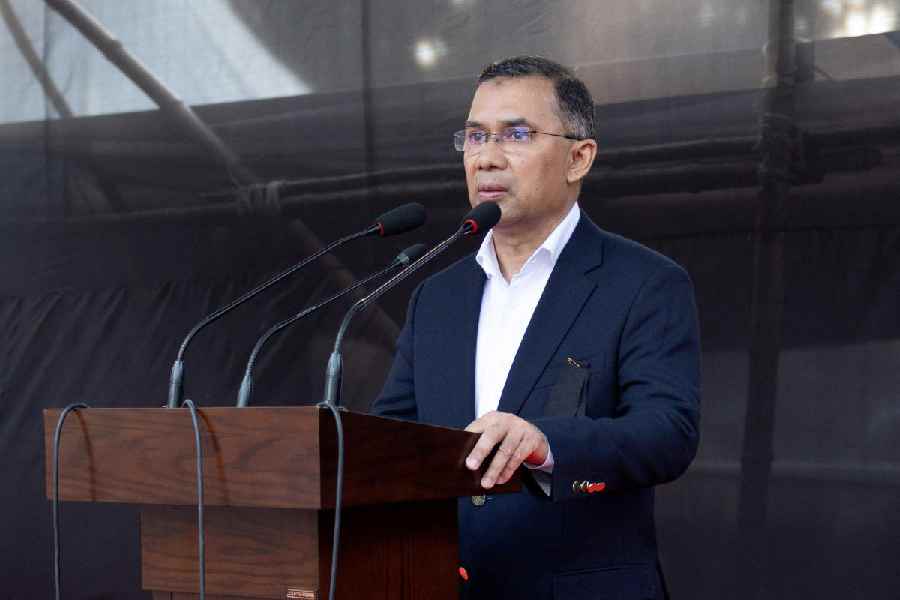
Patna, June 11: Fanfare marked chief minister Nitish Kumar’s departure for Delhi en route to China; RJD workers celebrated with pomp the 64th birthday of their boss Lalu Prasad. But deputy chief minister Sushil Modi, true to his style, quietly moved in to take charge of the state during the weeklong absence of Nitish.
“He (Nitish) is an extremely hard working leader. It is always tough to manage the affairs he handles in his absence. But I am happy working as an integral part of the set-up that is doing so well in Bihar,” Modi told The Telegraph. “I have tried to perform to the best of my capacity for the state,” he added.
Nitish often refers to Modi — also his finance minister — as Bhamashah, the trusted lieutenant who provided much needed financial help to Maharana Pratap during the Rajput warrior’s war with Emperor Akbar. Of late, NDA insiders have begun referring to the deputy CM as the “Rahul Dravid of Team Nitish”.
Reason: Despite his solid performance as a political leader for over three decades, Modi has often been overshadowed by his more flamboyant peers such as Lalu Prasad and Nitish, much like Dravid, who has remained in the shadow of the Sachin Tendulkars and Sourav Gangulys.
Modi, who has been working as a “loyal” deputy to the chief minister for the past six years, has, unlike his more charismatic colleagues, including Lalu Prasad and Nitish, never lost an election in his life — be it for the Lok Sabha, Assembly or even students’ bodies. Modi, though six years younger to Lalu Prasad, was general secretary of the Patna University Students’ Union of which the RJD leader was president in early 1970s.
Modi was a “taller” leader than even Nitish during the Jaiprakash Narayan-led movement which culminated in the defeat of Indira Gandhi’s government at the Centre in 1977. The movement threw up several leaders such as Lalu, Nitish and Modi. Lalu won the Lok Sabha elections in 1977 but Nitish lost, despite the JP wave. Modi did not contest.
Nitish, despite his dislike for the BJP’s hard-line philosophy, shares a comfort zone with Modi. The chief minister, not a fan of Narendra Modi, the Gujarat chief minister, has openly said: “What is the need of Modi from Gujarat when we have our own Modi (Sushil).” On his part, Modi played what is described in the NDA circles as the “biggest” role in ending the bitterness that cropped up between the JD (U) and the BJP in the wake of Nitish attacking Narendra Modi and stopping him from campaigning in Bihar ahead of the Assembly elections in 2010.
Nitish, source said, trusts his deputy more than he does many of his party colleagues.
Be it the setting up a unit of Aligarh Muslim University in the state, fencing of Muslim graveyards or re-opening the cases against the culprits of the 1989 Bhagalpur riots, Modi has been behind Nitish despite his hardliner colleagues, at times, accusing him of “compromising” the BJP’s ideologies.
“See, governance should always be kept above the confines of ideologies and dogmas. The people have massively voted for the NDA to get better governance and development. We should bow to the wishes of the people and the need of the state rather than blowing the trumpet of dogmas,” Modi said.
Modi has more similarities with Atal Behari Vajpayee than LK Advani, in whose camp he veered to during the NDA’s reign at the Centre. Modi married a Christian woman and maintained his moderate image even during the time of the demolition of Babri Masjid in 1992. While several of his colleagues, including Ramadhar Singh (who recently resigned as a minister), were charged with making inflammatory speeches, Modi has seldom been found making speeches with communal connotations.