|
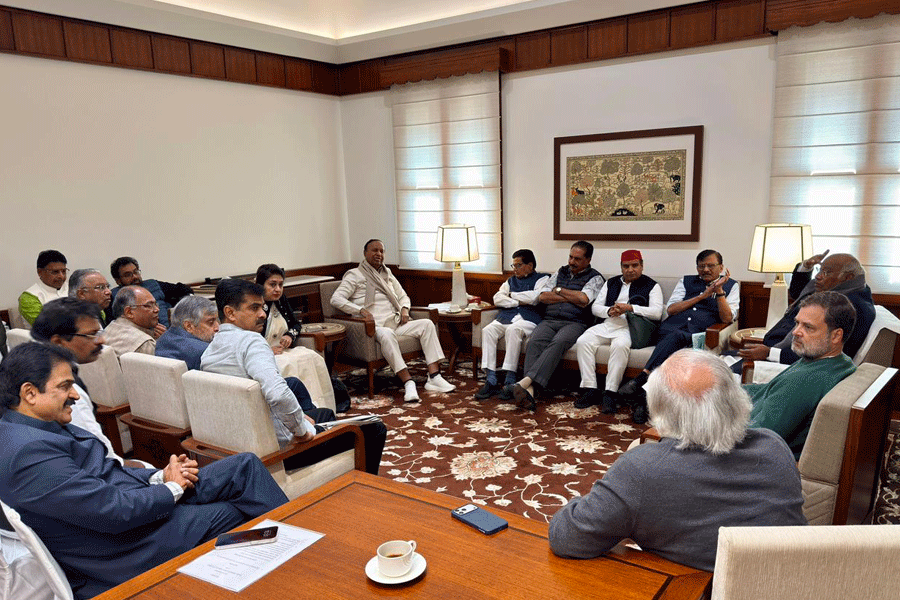
| Teachers from different schools at a felicitation ceremony organised by Rotary Club of Patna City on Tuesday. Picture by Sachin |
We celebrate Teachers’ Day as a tribute to the contribution of teachers to society. It is also the birthday of Dr Sarvapalli Radhakrishnan, a diplomat, celebrated writer, second President of India and, above all, a teacher. Radhakrishnanan preferred to be called as a teacher rather than anything else. This showed his respect for the profession.
To preserve this high esteem, teachers need consistent support and encouragement from the community.
However, during the last two or three decades, teachers in India have moved from being respected and revered members of society to roles of disempowered government functionaries, that too of the lower rungs of the administrative hierarchy.
There was no ambiguity in the policy of the Kothari Commission, 1964, or the National Policy Education Document, 1986, regarding the importance of ensuring a minimum standard and upholding the professional status of teacher. But in reality, we have moved some distance from the policy framework. Now, we are struggling to ensure survival of teachers as a professional cadre.
The pressure of governments to universalise education on the one hand and a resource-crunch on the other has cleared the way for a low-cost arrangement, euphemistically called para-teachers or contract teachers. Originally, this scheme was launched to address the problem of paucity of teachers in remote rural areas and it was purely transitional. The big boost came in 1997, when the Madhya Pradesh government introduced Education Guarantee Scheme. It guaranteed a school within 90 days of receiving a written request from a panchayat. The cost and legal hassles of running such schools were minimal. Teachers were appointed on contract at a low salary. Encouraged by the initial success, the Madhya Pradesh government declared formal schoolteachers as a “dying cadre”. Several state governments adopted the model. The Government of India legitimised and supported it through a central scheme for the establishment of “transitional schools”. It also became an integral part of mass literacy campaigns like the Sarva Shiksha Abhiyan, introduced in 2001.
Such teachers constitute almost 75 per cent of the teaching strength at the school-level in Bihar. Despite the commonly held view that these teachers are less qualified, a recent study has shown that the academic qualifications of contract teachers are often higher than regular teachers.
Appointing low-cost contract teachers has analysed by Amartya Sen and Jean Dreze in their book India Development and Participation. The authors claimed that such a development is unstable and a threat to equal distribution of the benefits of education.
The recent Annual Status of Education Report (ASER), 2011, is a pointer that all is not well with the mass education. The report reveals that the quality of education in the country, especially in Bihar is abysmally low. But the report has failed to generate the kind of debate among the larger stakeholders as expected.
Quoting ASER and other reports, some of the administrators brand schoolteachers “work-shirkers” and blame them entirely for poor quality education. But such a view ignores the other problems facing the education system. To a large extent, the conduct and attitude of the teachers reflect the general condition prevailing in the society. To expect that the teacher community alone will behave ideally when every section of the society has severely compromised their conscience is unrealistic.
Recently, there was furore when the Planning Commission announced Rs 32 and Rs 26 per capita income per day as respective poverty lines for urban and rural areas. The deputy chairperson of the commission, Montek Singh Ahluwalia, said: “It is not all that ridiculous” but had to retract because of mounting political pressure. Schoolteachers in Bihar appointed after 2006 might agree with Ahluwalia because their starting salary is Rs 6,000 (approximately 20 per cent above this abhorred poverty line). Even this meagre salary is released to them after a gap of six months. In such a situation what motivation do we expect from schoolteachers?
The National Common Minimum Programme of UPA I pledged to raise public spending on education to at least 6 per cent of the GDP with at least half this amount being spent on primary and secondary sectors. Since 2004, Indian citizens have been paying a 2 per cent education cess. But the particular goal of spending 6 per cent GDP on education has always remained elusive. It has hovered around 4 per cent.
This dichotomy is not limited to the Centre. The Bihar government had announced the formation of a commission headed by former foreign secretary Muchkund Dubey to present a report on the Common School System. While declaring the formation of this commission, chief minister Nitish Kumar had quoted the socialist leader Ram Manohar Lohia: “Rashtrapati ki ho ya chaprasi ki santan, sabko shiksha ek samaan” (Be it the child of the President or a peon, all have a right to equal education).
In its report, the commission stated that the nation, society and the governments — both at the Centre and the states — will have to come to terms with the inevitability of mobilising resources on the required scale for school education if India is to survive as one nation and claim its rightful place in the comity of nations. Should we not give serious thoughts of implementing such reports on this Teachers’ Day?