|
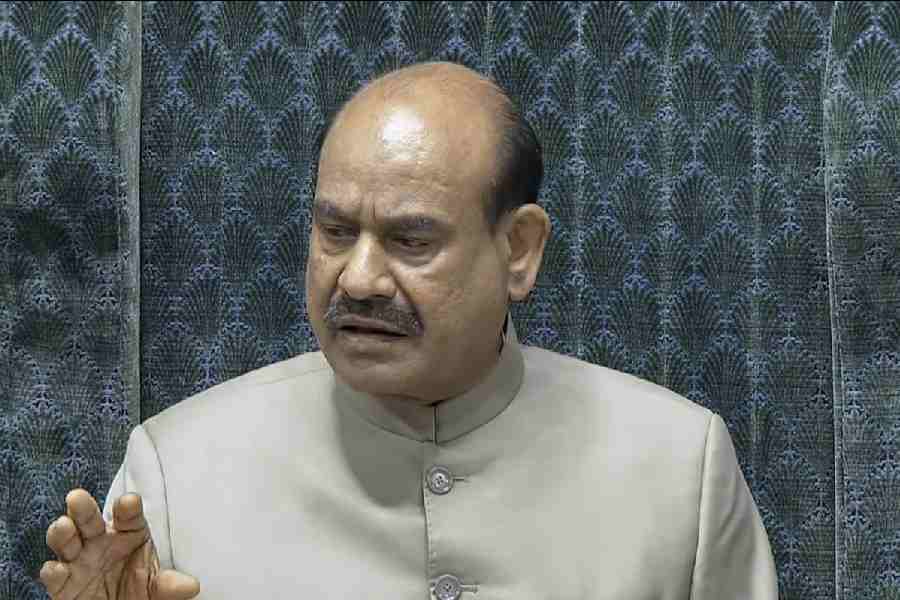
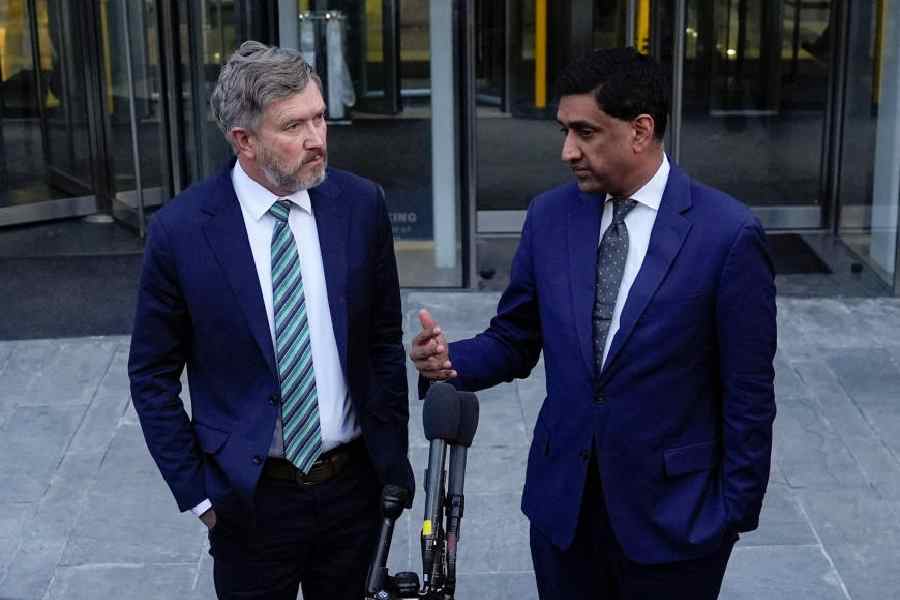
| Delegates at the national seminar at Millat College in Darbhanga on Thursday. Picture by Mohan Mahato |
Darbhanga, July 14: A two-day national seminar on Urdu scholar, poet and dramatist Faiz Ahmad Faiz organised by Millat College under Lalit Narayan Mithila University on the premises of the college concluded today. The University Grants Commission (UGC) and Jahan-e-Urdu of Darbhanga jointly sponsored the programme.
Former Union minister, member of Congress Working Committee (CWC) and national Congress spokesperson Shakeel Ahmed inaugurated the programme by lighting the traditional lamp yesterday.
Distinguished Urdu scholars from around the world, including M.J. Warsi of Washington University, USA, Shabir Ahmed from Aligarh, Abujr Hashmi from Calcutta, Abubkar Abbad from Delhi, Masihujma from Ahmedabad, Aftab Ahmed Afki from Varanasi and many more, attended the occasion and shared views on the Faiz’s literary art.
Vijay Mishra, a lecturer of English in Millat College, said Faiz emerged as an eminent scholar of Urdu literature though he used to be an English teacher with diverse knowledge of English literature. Mohammad Ehsaan, a scholar, said English literature had a great impact on Faiz’s Urdu poetry. For instance, break in lines was not prevalent in Urdu literature before Faiz. But he introduced it in Urdu poetry, Ehsan added. The tradition of breaking lines continues till today. Faiz even borrowed the concept of syllabic meter in Urdu most probably from English literature.
The principal of Millat College, Mustaq Ahmed, told The Telegraph: “Faiz was different from his contemporary poets in the sense that he blended imagery and the real world. He not only raised his voice against the British rule but also advocated against capitalism.” He added that a revolution came in the history of Indian literature in 1936, when a programme on the situation and direction of Indian literature under the leadership of Prem Chand was organised in Lucknow and many budding scribes assembled.
Faiz’s aggressive writing style proved to be a hurdle and he was exiled from Pakistan. At such a juncture, he had to spend the rest of his life in European countries before finally being given shelter in Russia. His writings were translated into different languages, including English, French, Russian, Chinese, Japanese and Arabic.