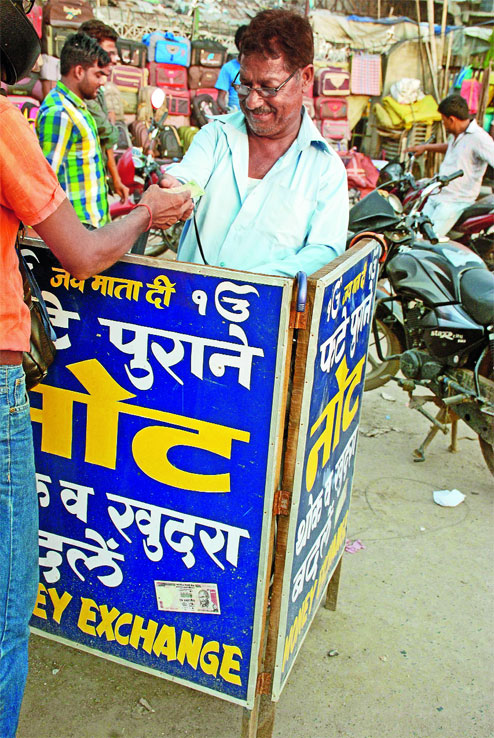

Forget the queue at banks to exchange an innocuous yet torn Rs 10 note. Walk straight to the innumerable vendors outside Patna Junction for a cool exchange, but with a rider.
The moneychangers - all unauthorised - outside Patna Junction will swap a Rs 10 note for coins totalling Rs 8. The agents take Rs 2 as changing commission, which varies depending on the amount one seeks to change. The agents also provide fresh and crisp notes from banks replacing the soiled ones brought by customers.
All of the agents also have accounts in nationalised banks. "We go to the banks in which we have accounts and get these notes exchanged. Our profit margin depends on the value of the note given by the bank. One can exchange a torn Rs 10 note with Rs 8 fresh coins, a torn Rs 100 note with Rs 90. The exchange rate depends on the condition of the torn note. If the condition of the note is worse, one gets a note in smaller denominations for exchange," said Uday Singh, a moneychanger.
Approaching these note-wallahs - as they are commonly known - is an instant, queue-less, painless and quick alternative. "We pay Rs 8 to the customer in exchange for a torn Rs 10 note but the bank pays us Rs 10 for it which gives us a profit of Rs 2," said another note vendor Keshav. "The profit which I got from the customers is the source of my income."
"People usually avoid queuing up for long in banks to change the money. We have our agents who easily exchange these soiled notes. Anyone can go to any bank and ask for exchange of notes. It is just that people want to avoid hassle," said Rajesh, a note-wallah.
According to Reserve Bank of India's master circular, "DCM (NE) No. G-1/08.07.18/2012-13 dated July 2, 2012", all branches of all banks across the country should issue fresh/good quality notes and coins of all denominations on demand without any discrimination on all working days.
"Many times, it happen that rickshaw-pullers, auto-rickshaw drivers, general stores might have palmed off a torn note, and we inadvertently accepted it but unable to spend it afterwards. I have a busy schedule and did not get enough time to exchange it from the bank. So I collect all torn notes and when my money box is full, I exchange it from the vendors outside the station," said Mrinal Kumar, a resident of Buddha Marg.
The note-changers' business operates in a grey zone and they have no permits or licences to run the business. Therefore, they often have to bribe the cops for running the stall. "Not a single stall on the road here has been set up with any authorisation. We have to give some amount to police from time to time. This is a part of the business," said a stall keeper.
Apart from exchanging soiled notes, these agents also offer notes of smaller denominations. Pranjal, a college student, said she barters Rs 500 note to get notes of Rs 10 or Rs 20 denomination once a week for her travelling expenses. "It is easy for me to have vendors near my home because shopkeepers will not give smaller denomination notes at the morning."