
Prime Ministers Indira Gandhi and Rajiv Gandhi often abused power and weakened important institutions of governance and also those within the organisational set-up of the Congress to maintain and sustain their dynastic rule till 1989.
Many chief ministers also used patronage, links to organised crime to raise money and muscle power, intimidation, threats and coercion to perpetuate their rule. Many of them showed hostility to alternative power centres and tried to dominate the media.
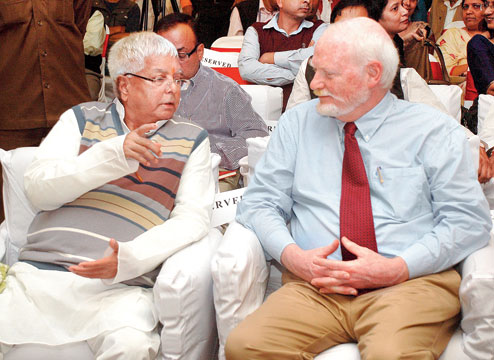
Professor emeritus James Manor from the Institute of Commonwealth Studies, University of London, minced no words while delivering the lecture, "India's states: The struggle to govern", here on Monday as a precursor to Asian Development Research Institute (ADRI) silver jubilee celebrations due in 2016-17.
"The centralising prime ministers in the form of the Gandhis weakened so many institutions that Parliament, the courts, Election Commission and the federal system all were rebuilt and re-powered between 1989 and 2014 by the successive governments at the Centre, in a period during which no single party had a majority in the Lok Sabha," James said.
He pointed out that there were just one or two instances of abuse of power by prime ministers during this 25-year period, which was much less than that by British prime ministers led by Margret Thatcher.
Ironically, as absence of majority to any single party in the Lok Sabha caused a major distribution and decentralisation of power away from once dominant Prime Minister and Prime Minister's Office (PMO), chief ministers in various states used both legitimate and illegal ways to centralise powers in their hands. "Many chief ministers like MG Ramachandran (Tamil Nadu), Ramakrishna Hegde and BS Yeddyurappa (both Karnataka), Chandra Babu Naidu and YS Rajasekhara Reddy (both Andhra Pradesh), Bhairon Singh Shekhawat (Rajasthan), Digvijay Singh (Madhya Pradesh), Jyoti Basu (Bengal) and Lalu Prasad (Bihar) innovated a lot in this regard," James added.
The professor emeritus regaled the audience about how in an Assembly election in Karnataka, BJP leader Yeddyurappa paid huge amount of money to key Congress leaders in 20 districts to cripple the Opposition and win the polls.
"The BJP chief minister in Rajasthan, Bhairon Singh Shekhawat, was more skilful. He would seek a list of 10 desired things from Congress MLAs and tell them that four of them would be given soon but the rest would depend on how they behave in the Assembly. He was quite successful and had a very peaceful tenure," James added.
The British professor pointed out that a surge in state and central revenues initiated a phenomenon in which "centralising chief ministers" used the funds to launch new programmes for development, populist measures, and patronage within the party to usher orderly conduct among workers. These helped in sustaining their rule and getting re-elected. All others, even the party MLAs, are neglected and the centralising chief ministers work through bureaucracy.
However, the British professor, who has spent several decades in India, said he firmly believes that India is a strong, vibrant democracy and has a federal system in which state governments have done much more for development than anywhere else in the world.
ADRI member-secretary Shaibal Gupta delivered the welcome speech.