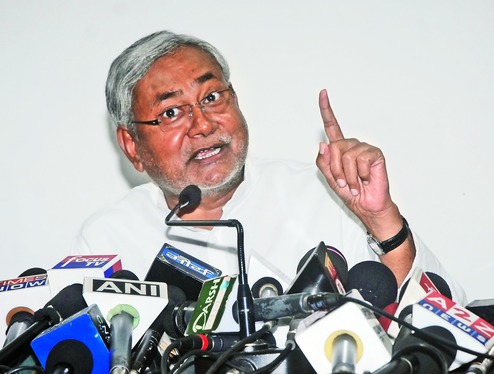

Patna: Chief minister Nitish Kumar on Saturday taunted RJD chief Lalu Prasad for allowing his sons to abuse his political rivals.
In his continuing online war against Lalu, the chief minister tweeted: " Bal bachho aur parijan se gaali dilwana, samajik sadbhawabna aur sanjhi virasat ka utkrusht udaharan (Getting children and his own men to hurl abuses is the best example of harmony and joint heritage)". It was an apparent dig at Tejashwi, Tej Pratap and RJD MLAs who had hurled abuses like chor (thief), ghatelbaj (scamster) and aatankvaadi (terrorist) at him and other political rivals.
The RJD hit back instantly. RJD MLA Shakti Singh Yadav declared that using " sevaks (spokespersons)" to hurl indecent words was in the JDU's culture. He was referring to a press note by JDU spokesperson Sanjay Singh where he said that while Lalu had eaten fodder, his son (Tejashwi Yadav) had eaten soil, referring to the soil scam in which soil from the construction site of a mall owned by Lalu and his family was allegedly sold to the Sanjay Gandhi Biological Park.
The language of Bihar politicians has nose-dived ever since the Grand Alliance broke in July. RJD and JDU politicians have hurled words like paltu Ram and gasita Ram at each other. It has got only worse in recent days, with Rabri Devi using words for Nitish and Sushil Kumar Modi that cannot be reproduced in print.
Lalu himself has been dubbing Nitish a fox while JDU spokespersons have described Lalu as a hissing snake. They are not stopping there. Lalu's elder son Tej Pratap had publicly threatened to beat up deputy chief minister Sushil Kumar Modi at his home. He later made national headlines when he threatened to skin the Prime Minister alive. "It was an embarrassment and it only helped the central government become more hostile to Lalu and his family members," said an RJD leader.
In the 1970s, politicians were guarded in their criticism of rivals, choosing words like "misguided", "not honest", or "not development-oriented''.
"After Bofors, politicians began naming politicians when calling them corrupt," said a senior Congress leader who did not want to be quoted. "But today we see not just abuse, but also public threats."