 |
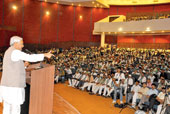
| Chief minister Nitish Kumar addresses a meeting of the state JD(U) EBC cell at International Hall in Rajgir on Sunday. Telegraph picture |
Patna, April 21: Away from the glare of the BJP, chief minister Nitish Kumar has silently started working with his core support base at the grassroots realising that his speech at the JD(U) national executive meeting worked like a “guided missile” to rip apart the NDA.
After his ripping attack on Gujarat chief minister Narendra Modi — the BJP’s probable prime ministerial nominee — on April 21 in New Delhi, Nitish has preferred to stay silent. He is spending most of his time with the people belonging to the weaker sections in the hinterlands, far removed from the political cacophony here.
A day after returning here from New Delhi, Nitish went on a three-day sojourn to the West Champaran’s Valmiki Tiger Reserve, nearly 200km from here. He reviewed the schemes for the Tharu tribes and other weaker sections and returned to the city last night only to leave today for Rajgir — the picturesque venue of great historical and mythological importance — in his home district of Nalanda, nearly 100km from here.
Sources said the chief minister would spend most of his time holding meetings with the extremely backward castes (EBCs), Mahadalit and minority cells of his party. While he began his two-day interaction with the JD(U)’s EBC cell members today, he would do the same with the Mahadalit cell on April 23 and 24 at Rajgir.
“The chief minister has called us for a two-day interaction and training session at Rajgir on April 28 and 29,” the JD(U)’s minority cell chief and the party MLA, Dawood Ali, told The Telegraph.
JD(U) MLA Ali said: “He (Nitish) will impart us lessons on how the government has worked for the betterment of the minorities and other weaker sections, suggesting us to spread the work among the people at the grassroots.”
The sources said Nitish would stay in Rajgir for most of the next 10 days. “He will come to Patna only to attend some unavoidable official functions for some time during these 10 days,” a source said.
After his Rajgir sojourn, he would proceed on his Seva Yatra in Chhapra and Gopalganj — the bastions of his archrival Lalu Prasad.
Nitish has cancelled his weekly janata durbar tomorrow. The fourth Monday of April, as usual, was earmarked for the meeting of the NDA workers and office-bearers with the chief minister. “The cancellation of the scheduled Monday durbar is a reflection of Nitish trying to avoid the BJP leaders after saying an ‘emphatic no’ to Modi’s candidature as the prime ministerial candidate,” said a senior BJP leader.
A product of the socialist politics, Nitish is said to be consciously accompanying some upper caste faces — water resource minister Vijay Kumar Choudhary, a Bhumihar, and Sanjay Jha, a Maithil Brahmin, to discreetly drive home the message of maintaining the caste balance at his ventures.
The way he has been acting after firing the salvo at his Gujarat counterpart has sharp resemblance to the way he behaved while leaving the Janata Dal led by his once “redoubtable” friend Lalu in 1994-95. Observers of Bihar politics vividly recalled how Nitish consciously worked to avoid Lalu for almost a year in the run-up to leaving the Janata Dal and forming his Samata Party.
Once he had decided that he would leave the company of Lalu, with whom he had been operating since the 1974 JP Movement, Nitish never looked back. He avoided attending even the private social functions where Lalu was expected. Despite Lalu making repeated efforts to win back his “estranged friend”, Nitish went on to form the Samata Party, the earlier incarnation of the JD(U), and contest the 1995 Assembly elections in alliance with the CPI-ML(Liberation).
He suffered a huge reversal at the hustings with his fledgling party winning only seven of the 324 seats in the united Bihar. But instead of going back to the Lalu’s camp, he took a sharp right turn, striking an alliance with the BJP. The Samata Party-BJP alliance worked with the Nitish’s party winning six seats against the BJP’s 12 in the 1996 Lok Sabha elections.
The JD(U)-BJP alliance went from strength to strength in the successive elections, eventually bringing the Nitish-led NDA to power in Bihar in 2005. Seventeen years down the line, the formidable alliance is on the edge with Nitish locking horns with the BJP on Modi.