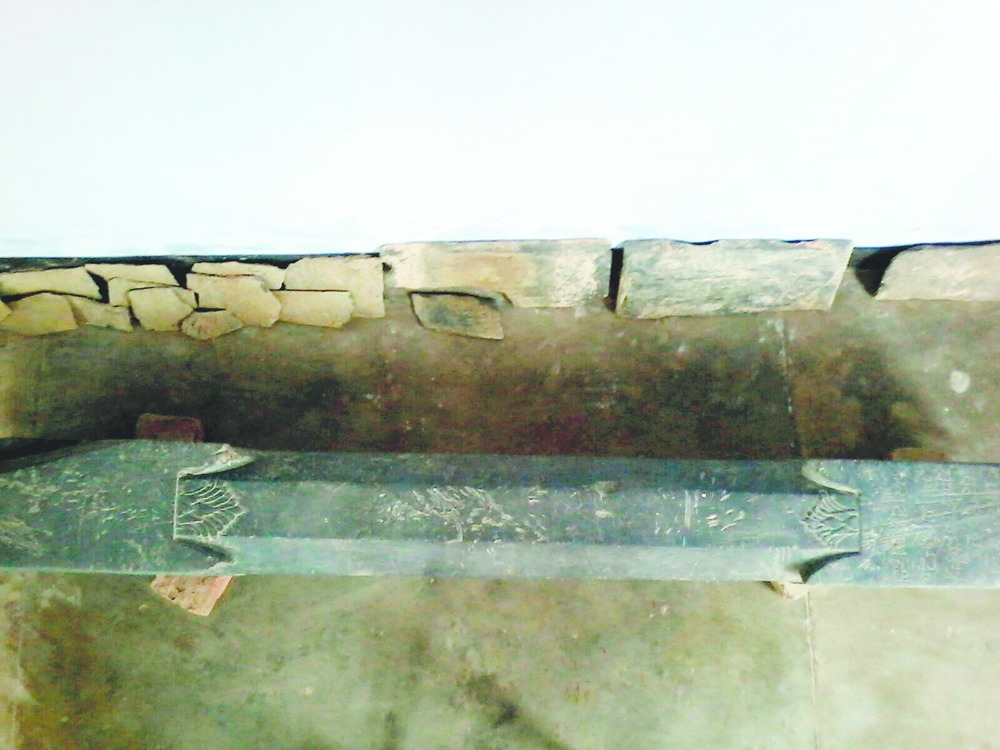

Darbhanga, Dec. 12: A black granite pillar with inscriptions, discovered on the Raj campus last week, is all set to add a new dimension to the study of political and economic history of Mithila.
To unravel the valuable clue the pillar may offer about the life and times in this region, a request to form a high-powered team of historians of repute was sent to the vice-chancellor of Mithila University on Friday.
Madan Mohan Mishra, the head of the department of ancient Indian history, archaeology and culture department, has sent the request. It was on his instance that the pillar was dug out by the students of this department on December 2 and was kept in Moti Mahal, where the department is situated. In fact, a portion of the pillar became visible while a hand pump was being sunk in front of Moti Mahal. A few stone plates were also found.
According to Mishra, the pillar is 6ftx7.5inches and carries a floral design apart the word Sankeshwar inscribed on it. "It is significant that only a few pillars have been found in Mithila so far. But this one is special because of the inscription and the floral design resembling a panel. It is premature to say whether the pillar was brought here from somewhere else or not. We are trying our best to know how old the pillar is. Carbon dating can tell us about the time, the pillar might have been chiselled. For this, Archaeological Survey of India has been approached," he said.
Sankeshwar's identity is yet to be corroborated by other sources. Earlier, on Thursday, Bhavnath Jha (from Patna), Shashinath Jha of Sanskrit University and Bhimnath Jha tried to decipher the inscription. They did not converge to the version that Sankeshwar might have a king. They opined that he might have been an ambitious fief or powerful official of Karnat dynasty.
Bhimnath Jha said: "The language of the inscription was Sanskrit but was written in Tirhuta (Mithilaksar) script in the Vikram Samvat year 1398 (or 1341 AD)."
According to the historians here, Karnat dyanasty rule ended in 1323 AD and the Oinwar dynasty took over in 1356 AD. The interregnum is described by some historians as the "third period of anarchy" in the history of Mithila.