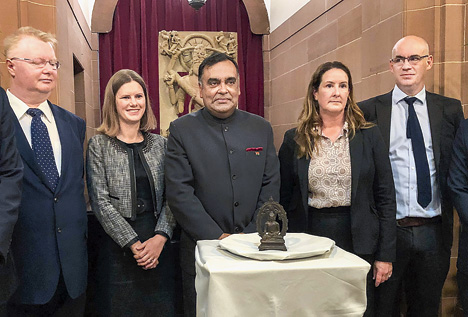


Patna: Close on the heels of Britain's Scotland Yard recovering one of 16 bronze statues of Lord Buddha stolen from the Nalanda Museum in the sixties, the Archaeological Survey of India (ASI) headquarters has received information that another from the same lot could have found its way to the Metropolitan Museum of Art in New York.
ASI authorities are moving to verify the Buddha statue with the "Met Museum" (as the Metropolitan Museum is popularly called) and will press for its return to India if it is authenticated by experts as one of the stolen bronzes from Nalanda. The Met Museum has over 20 lakh objects with it.
"One of the bronze statues of Buddha stolen from our Nalanda Museum is suspected to be kept at the Metropolitan Museum of Art in New York. We have received information regarding it from our sources. We are sending details to the Indian consulate in the US to verify it. If confirmed, we will request the Met Museum authorities to return it to our country," ASI director (antiquity) D.N. Dimri, based in New Delhi, told The Telegraph.
When contacted about the possibility of the bronze figurine being with it, Met Museum's senior press officer (marketing and external relations) Naomi Takafuchi said: "On background, we were unable to find a work that approximates the description provided. The Met posts cataloguing information, including ownership history, for its collection online at metmuseum.org."
Naomi also suggested consulting the museum's website. "If you see an object that you think matches your description, send us the accession number for the work," she said.
The Met Museum catalogue of displayed objects has 77 bronze figurines and artefacts from India, of which 13 are from Bihar. Four of them are figurines of the Buddha - three from the Pala period and one from the Gupta period.
Asked which figurine could be the one suspected to have been stolen from Nalanda, ASI's Dimri, who leads a team engaged in recovering such Indian artefacts from all over the world, said he would send the desired information to the consulate in New York for further action.
Dimri also pointed out that it was not necessary that a museum puts its entire collection on display or on its website.
"Besides, displays and websites of museums keep changing. Moreover, most of the museums remove objects from display and websites if they are controversial," Dimri added.
On September 4, two antique statues stolen from India and displayed at two American museums were handed over by Manhattan district attorney Cyrus Vance Jr to India's consul general at New York, Sandeep Chakravorty.
Both artefacts were forfeited once the owners were presented with evidence that they were previously stolen from India. One of the statues that was handed over in New York is a 12th century granite sculpture of the Chola empire of south India, depicting Lord Shiva and displayed at Birmingham Museum in Alabama. The other idol is also of the same period showing Bodhisattva of Wisdom - Manjushri - stolen from a temple in Bodh Gaya in the 1980s and displayed at Ackland Art Museum of the University of North Carolina.
The process for the return of the statue recovered in London and now in the possession of the Indian high commission there is being initiated by the ASI.
"It has already been proved that the bronze statue recovered by Scotland Yard is one of those stolen from the Nalanda Museum. We have intimated the Indian high commission officials to bring it back so that it could be returned to the place from where it was stolen, i.e. Nalanda Museum," Dimri said.
ASI Patna circle superintending archaeologist H.A. Naik said he learnt about the recovery of the Nalanda bronze from newspaper reports and was yet to receive any information from official channels about its return.
"As per the rules, the stolen artefacts upon recovery are automatically returned to the place from where they were taken away," Naik added.
The Nalanda Museum lost 16 bronze statues of the Buddha in two thefts. The first happened in 1961 in which thieves took away 14 statues, while the next occurred in 1962 in which two more were stolen.
"These 16 bronze statues were discovered by the ASI in Nalanda. They are from the Pala period and correspond to the 10th to 12th century AD. They are considered priceless as they depict the Buddha in various poses. The one that was recovered in London has a height of six-and-a-half inches as per our records and shows the Buddha in 'Bhumi Sparsh Mudra' (earth touching pose)," Nalanda Museum curator and assistant superintending archaeologist Shanker Sharma said.
The Nalanda Museum, established in 1917, is the second oldest onsite museum of the ASI in the country after the one at Sarnath in Uttar Pradesh, which was set up in 1910. It has over 13,000 antiquities of which 350 are on display.