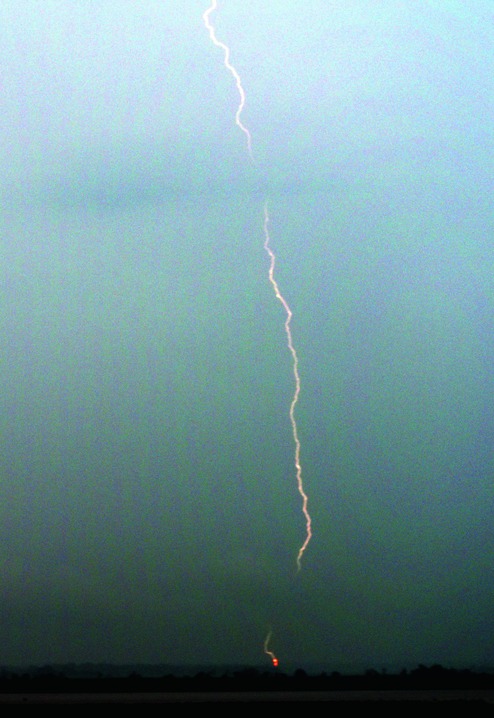

Patna, July 15: "Jolted" out of slumber after lightning killed 156 people this year, including 31 last week, the state government plans to install an Early Warning System to predict thunderbolts a good half-an-hour before they hit the earth's surface.
The sharp rise in deaths due to lightning was first noticed in 2016, when the number of fatalities climbed to 106. Experts in the field of disaster management assert that the way the number is increasing, Bihar could surpass all other states in this regard.
Vyasji, vice-chairman, Bihar State Disaster Management Authority (BSDMA), told The Telegraph: "Currently, Bihar is at fifth or sixth position if we consider loss of lives due to lightning. Kerala, Andhra Pradesh, Odisha, Maharashtra and Karnataka also report a large number of such incidents. But the way figures have shot up here in the past two years, it could easily climb to the top in the country over the next two years."
Vyasji added that the "reasons behind such an unusual rise in lightning fatalities are not exactly known". However, it has led the state government to mull the steps that could be taken to check the frequency of such incidents.
Currently, there are two options with regard to thunderbolts before the state government - Total Lightning Network provided by US-based Earth Networks, while the other system has been developed by the Indian Institute of Tropical Meteorology (IITM), a central government institution based in Pune.
Earth Networks claims to have over 1,200 sensors in more than 40 countries to provide the most extensive and advanced lightning network across the globe with ability to monitor in-cloud lightning to enable forecasters to generate faster, localised storm and lightning alerts and also warn of other forms of severe weather such as heavy rain and high winds.
Andhra Pradesh has become a customer of Earth Networks' data earlier this year, and is using it with the help of its state disaster response agencies operating in the field to alert people about imminent lightning strikes up to around 30 minutes beforehand. However, the alerts could also be delivered to people via a mobile app.
Bihar disaster management department principal secretary Pratyaya Amrit said: "Lightning strike is a big challenge. We are going to have an Early Warning System for lightning in the state and implement it in the current (monsoon) season. One such system is operational in Andhra Pradesh and we are sending a team to study it. But we have to do it quickly so that the warning system is provided to our state too."
Pratyaya added: "Earth Networks could provide warning about lightning strike around 30 minutes beforehand with precise location. It could be used to alert people via mobile apps about imminent danger and save lives. The app will also provide information on rain and farmers could use it for agricultural activities."
Meanwhile, IITM has also developed its own sensor-based Early Warning System for lightning, which is being implemented on a pilot basis in some areas of Maharashtra. It has also offered its technology to Bihar and sent a proposal to the central government for this. It is expected to get a nod for it by October.
A source in the disaster management department said previously private Indian weather forecasting company Skymet Weather Services had also approached the state government with a proposal to establish weather sensors across Bihar to predict lightning. "The price of each sensor was Rs 50 lakh and a large number of sensors were needed to cover entire Bihar. The cost of the entire facility would have been very high so the Skymet proposal was dropped," the source told The Telegraph.
Workshop
The disaster management department will organise a two-day workshop, "State Platform for Disaster Risk Reduction", on July 21 and 22. The workshop will discuss aspects related to disaster management and risk reduction in the light of the Sendai Framework. Several experts and officials from agencies related to disaster management from different parts of the world will take part. Officials from 27 state government departments that coordinate with the disaster management department have also been invited.