 |
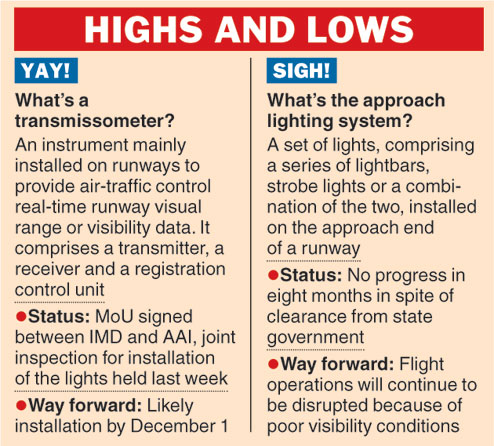
First, the good news. A transmissometer on the runway of Jayaprakash Narayan International Airport would ensure smooth flight operations even in rainy or foggy conditions. The India Meteorological Department is likely to install the gadget by December 1.
Now, the bad one. The Airports Authority of India (AAI) has failed to install the approach lighting system (ALS) to bring the mandatory visibility down to 800m. ALS was supposed to be installed on Peer Ali Path (popular as airport road) and inside Patna zoo. Had the lighting system been in place, the mandatory visibility condition for flight operations would have gone down from 1,200m to 800m. With winter a couple of months away, its absence isn’t the best news for fliers.
The work for installing the transmissometer is, however, on (see chart).
“The AAI has issued a no-objection certificate for installing the transmissometer, following a joint inspection. The equipment has been bought by the headquarters and is likely to be installed by December 1,” said Ashish Sen, director, India Meteorological Department, Patna.
According to a memorandum of understanding between AAI and IMD, transmissometers are proposed to be installed at 27 airports this fiscal. Each set costs around Rs 1 crore.
The Patna airport is among the nine where it is being installed in the first phase. Visibility has always been a prime concern at Patna airport because of the short runway. It does not even have digital machinery to measure visibility. According to guidelines of the International Civil Aviation Organisation, state-of-the-art equipment such as transmissometer and instrument landing system should be used to calibrate the available visibility. Though Patna airport has a category-I ILS, it lacked a transmissometer.
Aviation experts hailed the decision to bring the transmissometer to Patna.
“The system of assessing visibility at the airport through the naked eye is quite challenging for the pilots and the operating crew, as it requires manual calibration with air-traffic control. The transmissometer would give automated and accurate information on visibility conditions, ensuring smooth air operation,” said Atul Singh, the executive director of Centre for Aviation, Policy, Safety and Research in Delhi.
On the installation of ALS beyond the airport’s northern boundary wall, officials at Patna airport were mum despite the project getting approval earlier this year.
Sono Marandi, the director in charge of the airport, was unavailable for comment but sources said bidding to procure the device was under way.
Atul said: “If the airports authority succeeds in installing the ALS before winter, it would be a big help to ensure smooth flight operations from the city. At present, ALS is installed on a stretch of 210m prior to the runway. Ideally, the minimum length is 420m — it allows flights to land with visibility at 800m or less.”