|
| Chief minister Nitish Kumar at the site of the bridge on the Gandak, on Wednesday. Picture by Deepak Kumar |
Gopalganj, May 2: This is one bridge even arch-rival Lalu Prasad should thank chief minister Nitish Kumar for.
If the Kosi Mahasetu turned around the lives of people in northeastern Bihar, the upcoming 17-km-long (including approach roads) Gopalganj-Bettiah bridge on the Gandak promises to do a lot more for the region Lalu comes from.
Unlike the Mahasetu, a National Highways Authority of India (NHAI) project, the bridge on the Gandak is being built by a relatively lesser-known body, the Bihar Bridge Construction Corporation.
The Mahasetu linked Darbhanga and Supaul districts and shortened distances by miles for settlers on the diara bed of the Kosi. The Rs 317-crore Gopalganj-Bettiah bridge would do a lot more. It would link north Bihar’s two major districts, Gopalganj and West Champaran, and shorten the distance from Gopalganj to West Champaran’s headquarters town of Bettiah by almost 60km.
It will also shorten the distance between the Asokan pillar at Lauria-Nandangarh in West Champaran and Kusinagar, the place of Gautam Buddha’s Mahaparinirvana in Uttar Pradesh by almost 70km. Besides, it will become another easy route between India and Nepal, shortening the distance from Gopalganj to Raxaul on the Nepal border by 60km.
The utility of the bridge can be gauged from the fact that it will reach out to the inaccessible diara villages — Rampur-Tengrahi, Bisunpura, Mehadia, Nimudia, Sihorwan — on the eastern end of the river in Gopalganj and link them to Mangalpur, Bariapur, Rajwahi, Gumania and Niranjana on the western end in West Champaran.
The villages in the sprawling Gandak diara are like another “Chambal” with criminal gangs and Maoists having a free run, with no police to reach them. Cut off from the mainstream, the settlers have a world of their own where gun culture and muscle power rule the roost.
“In fact, the settlers live an extremely tough life as their settlements remain submerged for almost half the year when the Gandak is in spate. The people keep shifting with their cattle from one embankment to another. The bridge will enable the government machinery to access and rescue them,” said Pratyaya Amrit, principal secretary, road construction department and managing director of the bridge construction corporation. Pratyaya was accompanying chief minister Nitish Kumar who inspected the site during his Seva Yatra on Wednesday.
Pratyaya also cited how some unruly people enjoying this “splendid isolation” resisted the construction of the bridge, as, they feared, it would make them accessible to the law-and-order machinery. “A criminal gang shot dead two supervisors that Vasishtha, an Andhra Pradesh-based construction company, had assigned to build the bridge on June 12, 2012. Work was hampered for months.” But the administration worked hard to restore confidence among the engineers and workers. Work resumed in January and was going on a war footing when the chief minister inspected it. “We target to complete it by June 2014,” Pratyaya told The Telegraph. Nitish, who inspected it under a blazing sun, with the temperature touching 43°C, too, was satisfied with the progress.
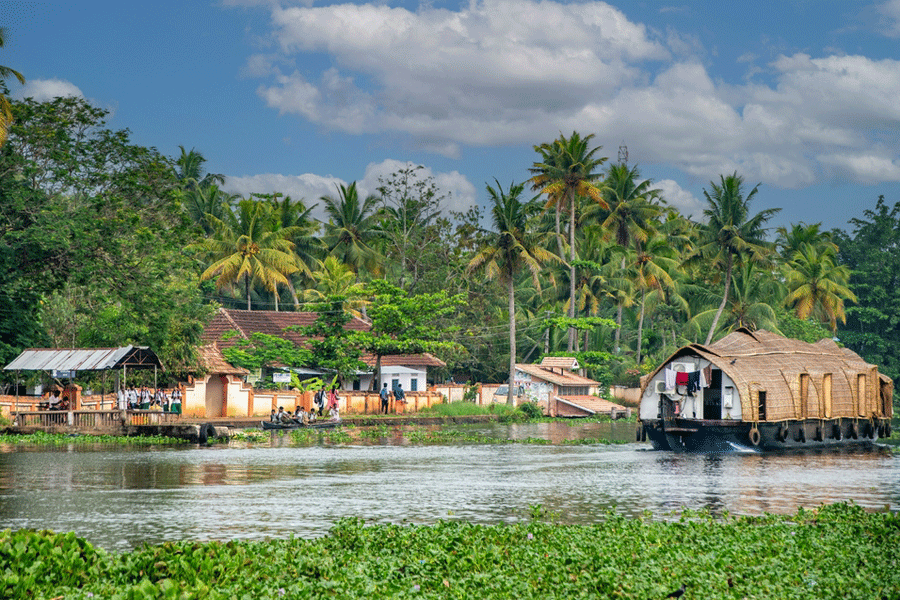
Once completed, the bridge will make locals look beyond the boat. “Boats are the only means for us to go to Mangalpur (West Champaran) from Rampur-Tengrahi and vice versa. Last season, 18 villagers died when a boat capsized,” said Parasuram Sah, a Bisunpura villager. Sah lost his family members in the mishap but received no relief or compensation. He hopes once the bridge is ready, death rates will come down and officials can reach them with relief after a tragedy.
Aditya Shankar Shahi, mukhiya (village head) of Bisunpura panchayat said: “Such mishaps claim almost 40 to 50 lives every monsoon. But the people have no option. We are sure that the bridge will change our lives for the better”.
Raju Thakur of the same village said: “We don’t get BPL cards because there are no approach roads. This bridge could change all that.”
The length of the bridge on the riverbed is 1,920m (about 2km). It will have a 3km-long (and 80ft-wide) approach road on the Gopalganj side and a 12-km long one on the West Champaran side. One had to travel 104km from Gopalganj via Khajura on National Highway 28 to reach Bettiah. Once the bridge is completed, a traveller will cross it and reach Bettiah and vice versa by travelling just 45km. For national and international tourists interested in Buddhist sites of Kusinagar and Lauria-Nandangarh, this bridge will prove to be a boon by shortening distances, economising the journey and making it more comfortable.
The bridge will add another feather to the cap of the Bridge Construction Corporation, almost sinking with debt before Nitish took over as the chief minister. “In six years, the corporation has built as many as 1,123 bridges across the state, a phenomenal record,” said Pratyaya, the IAS officer who played a key role in the corporation’s revival. “Nitishji, who replaced the 15-year-old Lalu-Rabri regime, is about to give the most precious gift to Lalu Prasad — Gopalganj’s most famous native — by way of this bridge. Laluji should at least thank his estranged friend (Nitish) once,” said a public works department engineer on condition of anonymity.