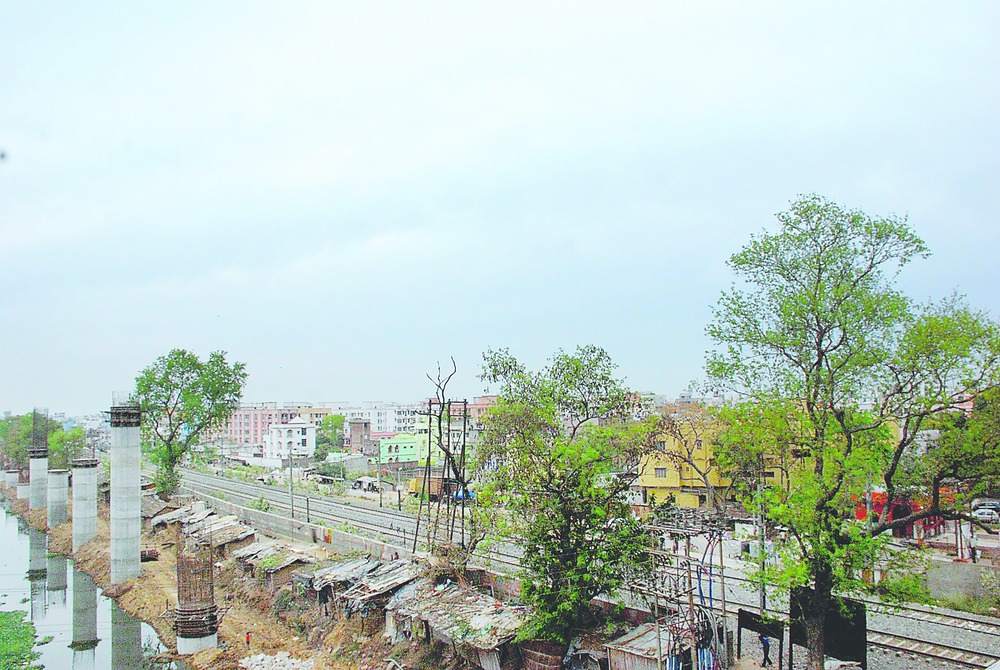

Residents woke up to a cloudy Sunday, much to their delight.
It was also breezy under the influence of a Nor'wester as predicted earlier this week by weathermen.
While Gaya received showers in the morning, Patna had to comfort itself only with cloud cover and a plunge in the mercury column.
The city is however expected to remain dry as the system is expected to move towards Bengal after 24 hours. The local Met observatory has given a forecast for thundershowers in Patna on Monday.
Private weather agency Skymet too stated on Sunday that thundershowers and thunderstorm activity is expected over many parts of east India, including Odisha, Jharkhand and Bihar, over the next 24 hours.
According to Skymet, an induced cyclonic circulation is positioned over northeast Rajasthan and west Uttar Pradesh. A trough is extending from this system up to Jharkhand. Besides, an anti-cyclone over northern Bay of Bengal is feeding moisture over Jharkhand, north Odisha, and adjoining Bihar.
"The system is however expected to clear from Bihar after 24 hours," said a meteorologist at the Patna Meteorological Centre.
Residents, however, didn't mind the cloudy weather. "It was getting hotter with every passing day. It is so erratic that there was hardly any spring season this time and we moved into summer from winter directly. The cloud cover today (Sunday) brought much relief and we enjoyed it by going on a long drive with friends," said Sandeep Kumar, an employee of a private bank in Patna.
Such sudden overcast and thunderstorm in summer season are termed as Nor'wester. This is owing to continuous blow of westerly winds amidst high temperature conditions. The Nor'westers hitting Bihar originate from the Chhotanagpur plateau region, when air over the plateau heats up and gains altitude with moisture support from an anti-cyclonic circulation or similar weather system in the Bay of Bengal.
Weathermen claimed that the state is expected to receive frequent Nor'westers this summer season. "The temperature is being recorded a few notches higher than the normal this year. This is being attributed to the El Niño weather phenomenon, which is higher sea surface temperature in the Pacific Ocean.
Excessive heating of land area is also creating confluence zones attracting moisture and leading to sudden thundershowers," said a senior meteorologist in Patna.