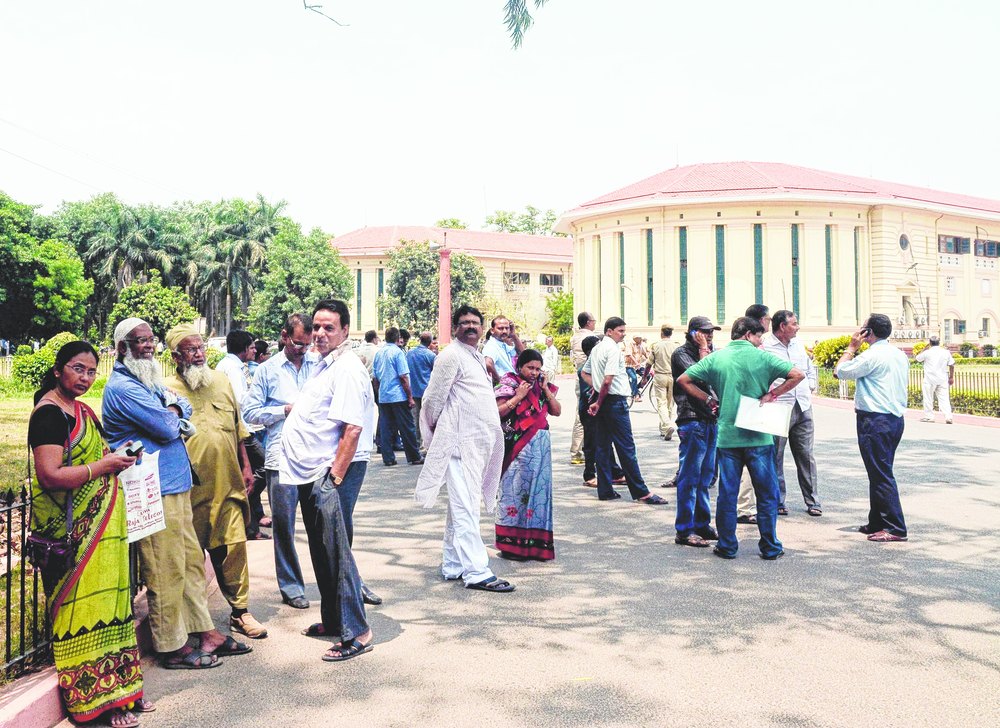

Residents fear for their buildings following a series of quakes and aftershocks in the past 17 days.
After the tremors of April 25, chief minister Nitish Kumar had hinted at colossal loss of lives were a Kathmandu-like quake to hit Patna. Expectedly, Patna residents are on the edge after Tuesday's fresh temblor.
"Earlier, there would be a mild quake every three or four years and we would feel relieved that our houses and lives were spared. However, there have been four major tremors and countless aftershocks since April 25 and I am genuinely concerned about the safety of my building," said Anil Kumar, a resident of Patliputra Colony - an upscale locality where most houses have been constructed in the 1960s.
Tuesday's earthquake, measuring 7.3 on the Richter with its epicentre in Nepal, left many houses in Patna with cracks.
Krishna Kumar Singh's three-storied building in Lodipur area developed cracks. So also, Shiv Paswan's single-storied house in Jakkanpur area of the city.
According to Ajay Kumar Sinha director-cum-nodal officer, Earthquake Safety Clinic, which runs from the National Institute of Technology (NIT) in Patna: "Earthquakes don't kill, buildings do. Most casualties take place because old structures collapse during quakes. The vulnerability of city buildings is worrisome, as no assessment of seismic vulnerability of city buildings has been carried out in recent years."
Shaligram Prasad, under secretary-cum-estate officer at the building construction department, said: "The department has not carried out assessment of city buildings on its own, but after last month's quake, based on feedback from individuals, around 262 buildings were categorised under criteria G1 to G5 vis-à-vis vulnerability." G1 signifies buildings that have developed fewer cracks, while G5 includes buildings that have structural cracks.
Ajay Kumar, who is also the head of civil engineering department at NIT Patna, also said: "In case of frequent tremors, buildings that have developed cracks are dangerous to live in and require immediate retro-fitting. But, if there are no cracks, such buildings are not that dangerous."
"If old structures have developed structural cracks, retro-fitting should be done immediately and if the cracks exceed 10-15mm in size, such buildings should be pulled down," Ajay Kumar said.
But if the cracks are non-structural, such buildings are not dangerous. Non-structural cracks are those where the wall doesn't bear the load of the building.
Sources said vulnerability of buildings in the city raises alarm bells, as many small and medium developers are cutting costs and not investing enough to make their buildings quake-proof even though it is legally binding on them.
To generate more income, some people have set up telecom towers on their buildings, making the structures vulnerable. The Lodipur building, which has developed cracks, houses a telecom company tower on its third floor.
After Tuesday's quake, many residents there staged a protest, demanding that the police and district administration remove the telecom tower from the building. House owner Krishna Kumar Singh said: "On the basis of directions from police officials, I have decided to remove the tower from my building."
According to Ajay Kumar, damage to structure can be minimised if quake-resistant buildings are built and there is retrofitting of old structures. There are various ways to retrofit old structures. Jacketing a column in a soft-storey building helps.
An old structure can be given more strength by bracing of structure. Constructing walls in open space on at least three sides can strengthen a building.
Masonry buildings can be given strength by erecting seismic band from all sides. And under-construction buildings can be given strength by increasing pillar depth. In four-storied buildings, pillar depth should ideally not be less than 6-7m.