
Patna, March 26: In an era when big corporate houses, retail chains and market forces tend to dictate agriculture economy and livelihood of farmers, top economists are now suggesting that cooperatives could be the way out to counter them and usher in better conditions in the farm sector.
"Cooperative of farmers could be the only way to counter retail chains and corporate houses, which deal only with big farmers. This does not mean cooperative farming, but cooperatives to buy agriculture inputs and sell produce. This will give farmers the much needed bargaining power against suppliers, traders and corporate retail chains," said Pranab Bardhan, professor emeritus of economics at University of California, Berkeley.
Bardhan added that such cooperatives were a new trend for India but were finding success in Madhya Pradesh and Tamil Nadu, where farmers have formed companies to come together. They cultivate individually but buy farm inputs and sell their produce together. They are different from the agriculture cooperative societies that mainly indulge in extending credit instead of buying and selling.
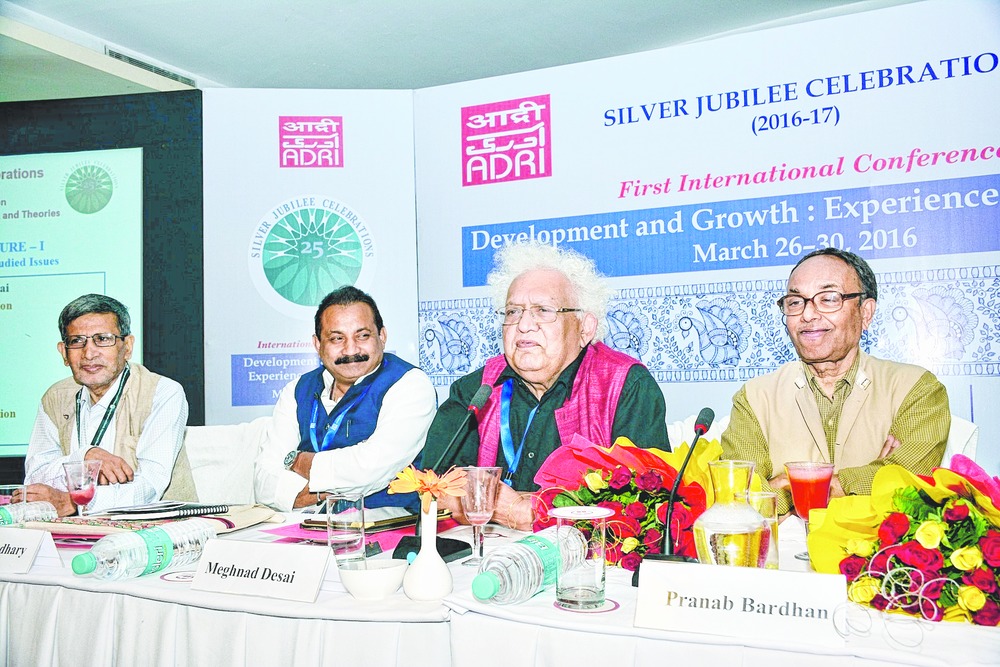
Bardhan's lecture, "Land and equity - some understudied issues", was part of five-day "International Conference on Development and Growth: Experience and Theories" organised by Asian Development Research Institute (Adri), which began here today as part of its silver jubilee celebrations 2016-17.
The lecture was chaired by British parliamentarian and London School of Economics professor emeritus Lord Meghnad Desai. Bihar education minister Ashok Choudhary was the chief guest. International Growth Centre country director Anjan Mukherji, Adri member-secretary Saibal Gupta and director Prabhat P. Ghosh were also present.
Bardhan has suggestions for farmers, especially those in Bihar, to shift from conventional crops to fruits, vegetables, lifestyle products for better remuneration. He cited litchi as an example. "The main problem in this is the lack of cold storage in the state. The government here could collaborate with the private sector to start cold storage chains," he added.
Bardhan has suggestions for farmers, especially those in Bihar, to shift from conventional crops to fruits, vegetables, lifestyle products for better remuneration. He cited litchi as an example. "The main problem in this is the lack of cold storage in the state. The government here could collaborate with the private sector to start cold storage chains," he added.
Pointing out the issue of land acquisition, which has courted several political controversies, including the flawed land acquisition acts brought by UPA-II and later NDA- II governments at the Centre, Bardhan said neither the state nor the market should be allowed to acquire land for reasons of fairness, transparency, welfare of farmers.
On the sidelines of the conference, Desai said land acquisition in England or European countries is completed by market forces, which somehow fail to work in India.
Desai said industrialisation was important for development and job creation, which would lead to reduction of population pressure on land. He also laid emphasis on attracting investment from outside for industrial development.
Ashok said there was very little land to redistribute now in comparison to 1960s and the question now is how to utilise the land best. The correlation between productivity and farm size should be looked into.