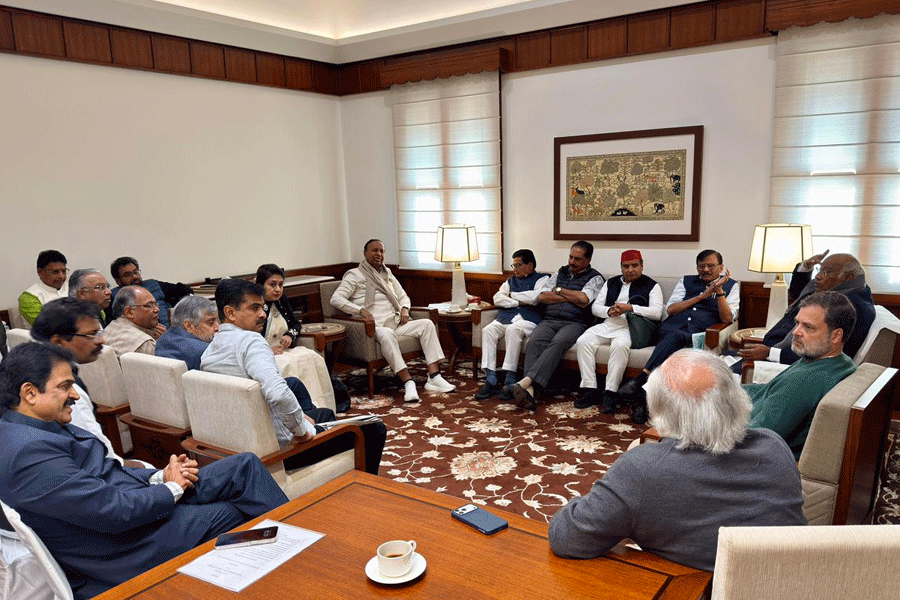
A senior BJP source said the party's decision to associate itself with Bihar chief minister Jitan Ram Manjhi was "influenced" by the state troika of Sushil Modi, Nand Kishore Yadav and Mangal Pandey.
However, the decision - that culminated in a comeback of sorts of Nitish Kumar - was projected as a "fait accompli".
"Had we adopted a hands-off policy, we would be seen to tangentially back Nitish Kumar, by default, one can say. If that happened, it would be disastrous for the BJP. The bottom-line was to take on Nitish and confront him, " said the source.
An informal discussion among the BJP's senior leaders that took place immediately after Manjhi announced his resignation concluded that the BJP might play the "Mahadalit" card full throttle.
"Dalits constitute 18 per cent of the state's population. Of course, you have to deduct the five per cent Paswans from this. Every Dalit is feeling humiliated with Manjhi's ouster. In fact, Nitish and Lalu Prasad together have humiliated the Dalits. One can't change the fact that Manjhi is a Mahadalit and not a Brahmin. Unko bithaya (as the chief minister) Nitish ne, unko uthaya Nitish ne. Par Manjhiji ka chhodne ka faisala unka hi tha (Nitish installed Manjhi as the CM, he tried to unseat him too). But the move to resign was Manjhi's. The BJP never ever thought of forming a coalition government with Manjhi had he passed the trial of strength. Yes, we were clear we would support him if he went in for one. If there is a perception that we instigated his revolt against Nitish, that is false," a leader maintained.
He stressed that there was no feeler from Manjhi to either join or team up with the BJP before the Assembly elections. "The media is claiming that the BJP has suffered losses through the Manjhi episode. What losses? It is Nitish's Janata Dal (United) that has split, his votebank has been disturbed. That's good for us," said a top source.
The BJP didn't appear particularly fazed by the prospect of fighting a bi-polar battle in Bihar against the Nitish-Lalu-Congress combine. A leader explained why.
"A bi-polar fight doesn't mean that every Yadav will vote for Nitish and every Kurmi-Koeri will vote for Lalu because the antagonisms run very deep. Bihar is endowed with an old votebank of those loyal to Dr Rajendra Prasad and, therefore, anti-Nehru, anti-Indira Gandhi. Such voters went with Lalu or Nitish. This vote will come to the BJP. There's also a big progressive vote that looks forward to sectoral reforms. The presence of Lalu with Nitish will deflect such votes towards us," the leader said.
The example of an election held in a western state was cited to buttress the point that in politics, arithmetic didn't necessarily translate into a bonanza of votes.
In 1995, a powerful regional chieftain of this state merged his party with the Congress months before the polls. Combined, their votes added up to 62 per cent. The BJP - that had positioned itself as a serious contender for power in that state for the first time - had only 28 per cent votes.
The verdict overturned the logic of mathematics because the BJP romped home with a two-thirds majority.
The leader extrapolated the BJP's experience of this state for Bihar.
"Go deep into the ground and one can seek the reasons for this sort of thing. There are two sarpanchs (local heads) in a village in Bihar. One won on Nitish's symbol and the other lost on Lalu's symbol. It is inconceivable that both these sarpanchs, who have their own interests at heart before anything else, will vote for the Nitish-Lalu combine. One of them will move to the BJP. Assume it's the loser but even the loser will have 30 to 35 per cent votes. And Bihar has nearly 80,000 villages, so the sarpanchs will be a crucial link in the chain to a victory," the leader said.